
A Mendip village of grey limestone cottages with clay tile roofs

Roofers in Coleford

Coleford is 13.2 road miles south of Bath, down in the Mendip Hills where the Mells River runs through a parish that once had working collieries. A Methodist chapel from 1865, a church from 1831, older terraces and a factory on an old pit site share the parish, and a chapel roof, a terrace and a factory shed each call for different materials and access.

Local roofs

A river parish with a coalfield behind it

Coleford stands on the Mells River in the Mendip Hills, and the parish takes in the hamlets of Lipyeate and Newbury as well. The shape of the place comes from two things: the water and the coal. Mackintosh Colliery opened in 1867 and shut in 1919 after flooding, and Newbury Colliery closed in 1927. A factory now stands on the Newbury site, built by Natural Stone Products. Walk the village and you find the traces of a working past alongside the usual houses and gardens.

Two buildings carry 19th century dates most clearly. The Anglican parish church of the Holy Trinity was built in 1831 by J. Sperring, and the Methodist chapel followed in 1865. Church and chapel roofs of that period usually cover a large open space, and that kind of roof ages differently from a house roof: longer slopes, fewer interruptions, and a lot of weight resting on a few long timbers.

There is one more landmark with a roof story, though not a roof. The aqueduct of the Dorset and Somerset Canal, called the Huckyduck locally, was abandoned unfinished in 1803, and visible remains survive. It is a useful reminder that water has long shaped this place. Our work in the village is the same job at a smaller scale: getting rain off a building quickly and away from its walls.

Planning, listed building matters and building control here are handled by Somerset Council. We describe the work, go up, take our own pictures of the roof, and put the price on paper before anything starts.

Council
Somerset Council
From central Bath
13.2 road miles, south
Mackintosh Colliery
Opened 1867, closed 1919 after flooding
Holy Trinity Church
Built 1831; Methodist chapel built 1865
Hamlets in the parish
Lipyeate and Newbury

What we find

Long chapel slopes and damp from two directions

Long slopes over open hallsA chapel or church hall roof spans a wide room, so movement shows as a dip along a slope or a ridge that no longer runs straight. We sight along the courses from the ground, then check the trusses and purlins from inside before suggesting what to relay.
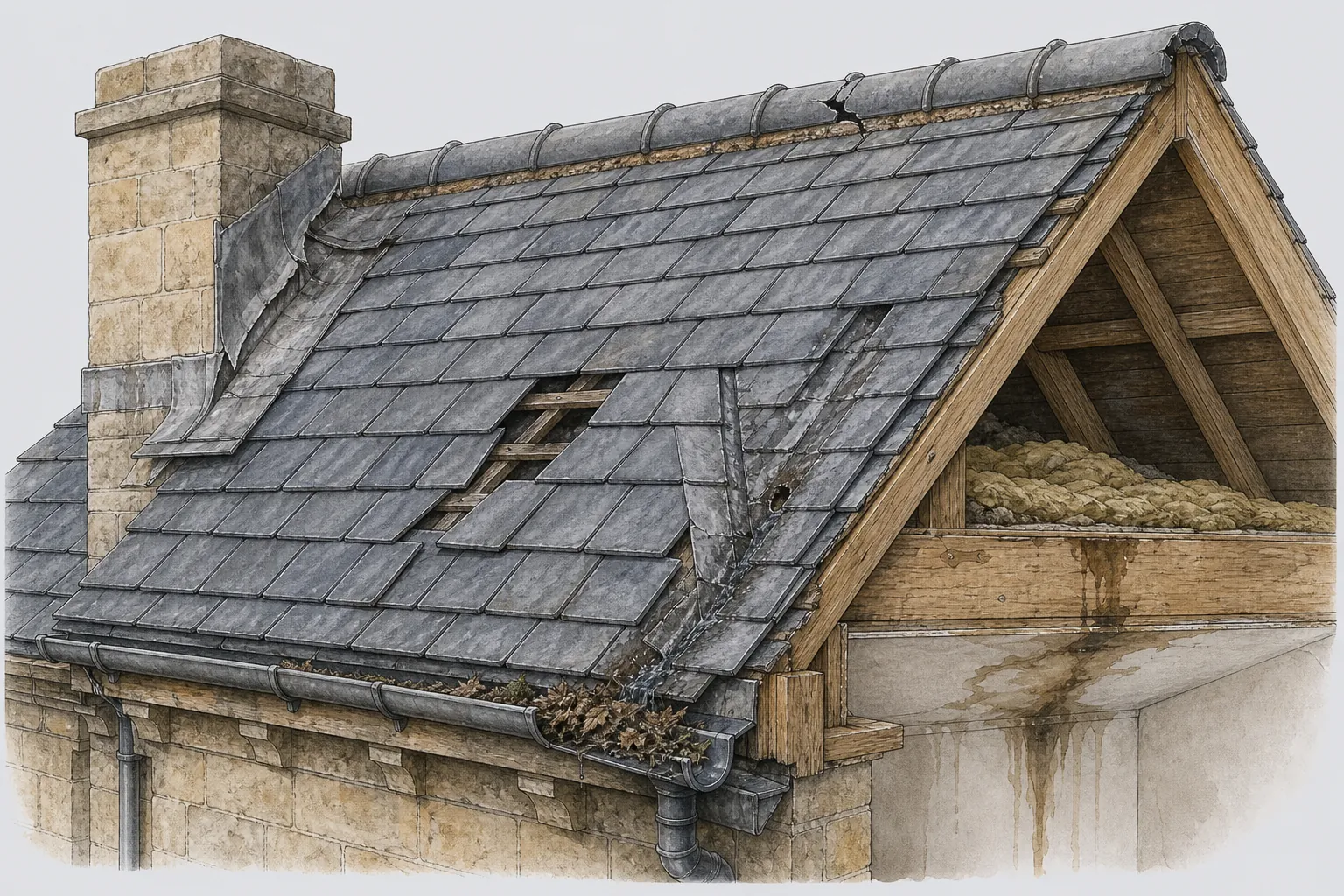
Damp that arrives from below and aboveIn a valley with a river and shaded gardens, roofs stay wet for longer. Green growth, saturated gutters and rotting fascia ends are common signs. We clear and check before deciding whether the covering itself has failed.
Wear on older terracesA terraced row shares chimney stacks and party walls, and every shared stack is a place where one owner's repair affects the next. We look at the stack, the flashings either side and the verge pointing along the gable.

Chapel and church roofs from 1831 and 1865

A single-span roof over a congregation is a different problem from a house roof, and it needs a different survey.

Holy Trinity, built in 1831, and the Methodist chapel, built in 1865, are the two buildings in Coleford that most people picture when they think of the village's age. Buildings of their kind are usually one large room under one large roof, and that is the point from which any repair begins. A house roof is broken up by internal walls that stiffen it. A chapel roof has no such help: the trusses carry everything across the full width, and any weakness in a joint or a bearing shows as movement along the whole slope.

We go inside first. The questions are practical. Are there stains on the underside of the boarding? Is daylight visible between slates? Have any of the trusses dropped at their feet, where they bear on the walls? Does the plaster ceiling, if there is one, show cracks that line up with a rafter? Those answers tell us whether the job is a patch to a valley, a re-slate of the worst slope, or something that needs a structural opinion before a single slate comes off.

Outside, the details that fail are the same ones that fail anywhere, only larger. A long gable verge (the tiled strip that overhangs the end wall) catches every gust, and a loose tile there can fall on people below. A ridge that runs the whole length of a hall has many joints. A valley between nave and porch collects water from two roofs and any moss that falls into it.

Reaching these roofs safely matters as much as repairing them. Nobody should work from a ladder against a tall hall wall, so scaffold or a platform is priced in from the beginning. Our commercial roofing page covers the larger buildings we survey, and a church hall or chapel that is in community use is treated the same way: surveyed, photographed and priced in writing.

Should the building be listed, consent has to be agreed ahead of any work. Ask Somerset Council who deals with your building, and bring our written description with you.

1831

Year the parish church of Holy Trinity was built

1865

Year the Methodist chapel was built

1803

Year the Dorset and Somerset Canal aqueduct was abandoned unfinished

Figures: Coleford, Somerset entry, Wikipedia, checked October 2026

Older terraces and cottages

A village that once had working pits has older terraces whose roofs share more than a party wall.

Mackintosh Colliery ran from 1867 to 1919, and Newbury Colliery closed in 1927. For most of that time the village had working pits, and a plain terraced or semi-detached house of the late 19th or early 20th century has a recognisable set of weak points. We do not guess a build date before we see the house; we simply check those points in order.

The chimney comes first. On a terrace the stacks often straddle the party wall, which means two households depend on one structure. Water that gets in at a cracked cap or a worn flashing can run down the breast into either house. Before a stack is rebuilt or even repointed, the neighbour should know, and the work is easier when both sides are repaired together. Our chimney repairs page explains the stages, from raking out loose joints to taking the stack down and rebuilding it.

The verge comes second. Where a terrace ends, the gable edge is held by mortar that has often outlived its usefulness. Current standards no longer trust mortar by itself on the ridge, hip and verge, so any we re-set also get mechanical fixings. Dry-fix, where clips and caps do the holding with no mortar bed beneath, suits many roofs of that age and is simpler to inspect later.

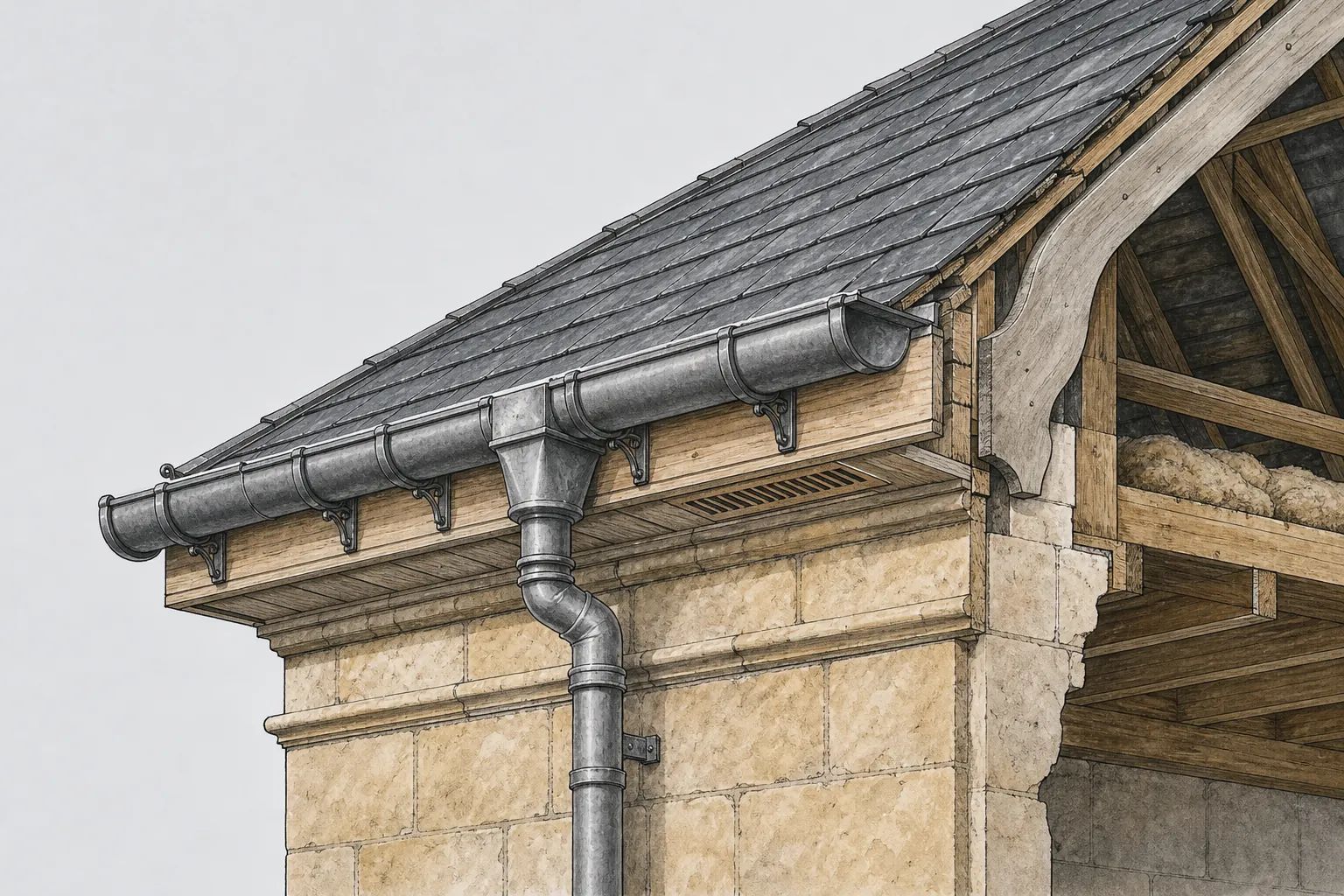
The third weak point is the eaves. A small house with a low roof sits close to its gutter, and a blocked or sagging gutter wets the fascia, the rafter ends and the wall below. Replacing a short run of gutter before the timber behind it rots is among the cheapest fixes in roofing, and among the most often put off. Material and fall are discussed on our guttering and fascia service page.

Where we find a covering near the end of its life, the options are repair, partial relaying or full re-covering, and each comes with its cost drivers explained, so the decision is yours.

Roofs beside the Mells River

Near a river, shaded slopes can stay wet long after rain, and the roofs show it.

Coleford stands on a river in the Mendip Hills, and you can feel it in the way a roof behaves. A slope that faces away from the sun, under trees or beside a bank, may take far longer to dry after rain than the same slope in an open field. The result is the same list of symptoms that every damp roof has: moss in the courses, algae on the surface, gutters carrying leaf litter and a sodden fascia.

Moss is not automatically a threat. A thin film on a sound tile does little. The trouble starts when growth packs into the lap between slates or tiles, holds water against the surface and lifts the edge of the unit above it. In a frost, trapped water expands, and a tile that is only a little tired starts to flake. We judge which kind of moss we are looking at before recommending anything.

Cleaning has its place, though it is not a cure for a failed roof. Pressure washing can damage delicate coverings, so we prefer gentler methods on older tiles and slate and we check each slope first. MyBuilder's 2026 cost guide puts roof cleaning at about £300 and upward, with a pitched roof typically £450 to £850; those are national ranges, and the figure we give you comes after we have surveyed.

Guttering matters more here than on a dry hillside. Houses near the river often have mature trees nearby, so leaf and seed drop is a constant feeding of the gutter line. We check that outlets are clear, that falls run to the downpipe, and that joints are sealed. If a downpipe discharges against a wall instead of into a drain, the damp you notice in the bottom metre of that wall may not be a roof fault at all.

Bats and nesting birds occasionally use roof spaces and eaves, and both are protected. If we find signs while surveying, we pause and take advice before touching anything, which is worth raising with us early if you know a colony visits.

Typical UK roof cleaning ranges by roof type

Roof typeTypical UK range
Flat£300 to £600
Pitched£450 to £850
Slate£500 to £1,000
Tile£400 to £750

Source: MyBuilder roof cleaning cost guide, 2026. Quotes from us follow a survey.

The factory site and other working roofs

Where a colliery stood, a stone products factory now operates, and its roof has different demands from a house.

The Natural Stone Products factory stands on the site of Newbury Colliery, which closed in 1927. Buildings of that kind, whatever their age, are not covered by the rules of thumb we use for homes. A workshop, store or industrial unit usually has a wide, shallow roof of metal sheeting, built-up felt or a single-ply membrane. There are fewer routes for water to take, so each fixing, lap and rooflight is a possible entry point.

We start any commercial survey with the drainage: where the water leaves, and what it does if the outlet clogs. Box gutters, which are rectangular channels sunk between slopes or beside a parapet, are a common fault line. Once the outlet fails, the gutter fills, the water rises over the lining and finds the first hole. We look at falls, outlet condition, the state of the joints and whether the lining has been patched repeatedly.

Single-ply systems such as EPDM, a synthetic rubber sheet, are common on larger flat areas, and we check seams and upstands carefully. What a commercial roof costs turns on its build-up, its insulation, how we reach it and how the edges are finished, which is why we price from a survey and not from a rate card. If a building is occupied and working, we also plan around the people and plant beneath the roof.

It helps to know what you want from the work. Some owners need a patch to get through a season. Others want a replacement that will carry on for many years. Both are legitimate, and neither should be dressed up as the other. We say directly which one a given roof supports.

For small traders, farm units and storage buildings, much the same method applies at a smaller scale. A single-storey unit with a leaking skylight, a cracked sheet or a failed flashing at the wall is still a roof that needs surveying properly. The steps are laid out on our commercial roofing hub, and a survey costs nothing anywhere within 30 road miles of Bath.

Patch or replace

Choose a patch when the membrane is sound and one detail has failed, and replace when leaks keep returning in different places.

Map showing the location of Coleford.

Nearby

Roofers near Coleford

Roofing services in Coleford

Local questions

Questions from the Mells River parish

Why does a roof near the river in Coleford stay green when others nearby stay clean?

Shade and moisture. Where trees, banks or a neighbouring building keep a slope out of the sun, water lingers in the laps and moss follows. We check whether the growth is surface only or packed into the joints. If it is surface only, a gentle clean and better gutter clearance may be enough. If the growth has lifted tiles, repair comes before cleaning.

Who looks after the roof on a Coleford chapel or church hall run by a community group?

The trustees or committee, and they usually need the facts in writing before they can decide. We survey, photograph the roof, explain what is urgent and leave them a fixed written price to table at a meeting. If the building is listed, consent is part of the plan, and Somerset Council is the body to ask.

My terrace in Coleford shares a chimney stack with next door. Can you repair my side only?

Sometimes, but it is rarely the best result. The stack is one structure, so water that gets in on one side can emerge on the other. We explain the options and put the neighbour's side in the description so both owners know what is proposed. If the neighbour declines, we repair what is ours and tell you what that leaves exposed.

Can you work on a flat or sheeted roof at a unit on the old Newbury Colliery site?

Yes. A roof like that is priced after a survey, as its system, insulation and access change the answer. We look at falls, outlets, laps and rooflights, say whether a patch will last, and give a written price either way. Commercial work is covered by the same 10-year workmanship guarantee.

Get your free survey

Get your free roof survey

Tell us what's happening and we'll call you back to arrange a visit. Prefer to talk? Call 01225 285181.

  • Photos of your own roof
  • A fixed price in writing
  • 10-year workmanship guarantee
Call Free survey