
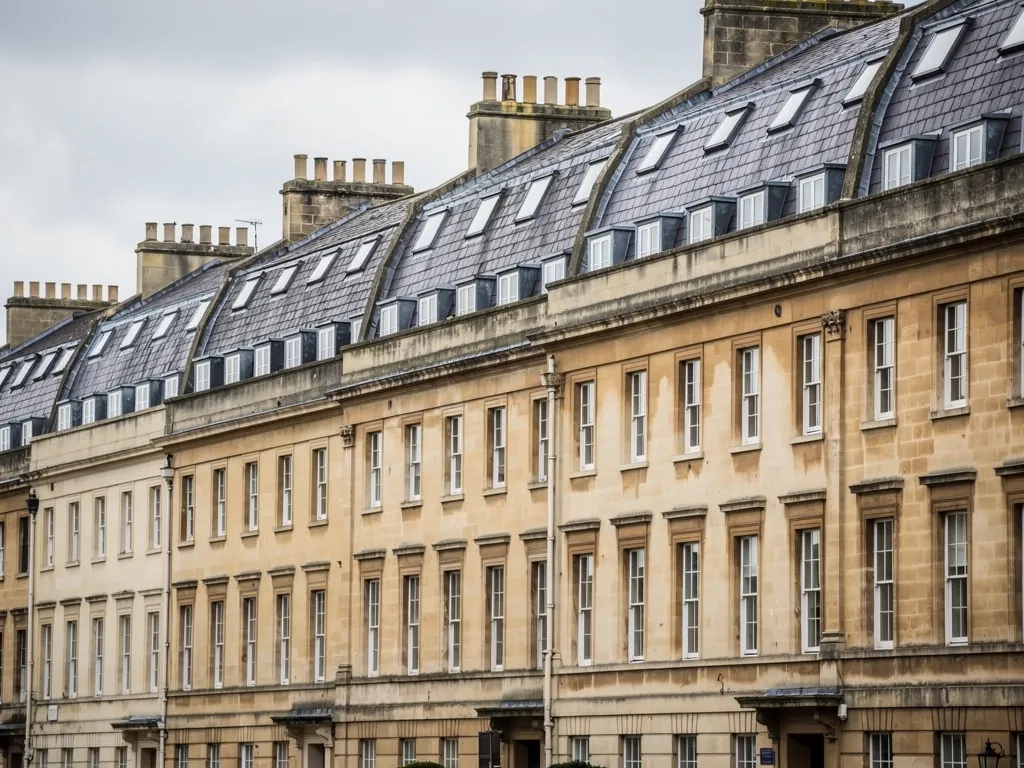
A Mendip village of grey limestone cottages with clay tile roofs

Roofers in Chilcompton

Chilcompton sits in the Mendip Hills south-west of Bath, 12.6 road miles from the centre, a village built on farming and mining. A 15th-century church tower, farm sheds and a church converted to a house all stand in the village, and a survey of each comes first, so the repair fits the building and its use.

Local roofs

A Mendip village of farmers and miners, and a church that spans four centuries

Chilcompton lies in the Mendip Hills on the B3139 between Radstock and Wells, and the River Somer rises in small streams around the village. Its history is mainly one of farming and mining. A coal waste mound still stands at the north-east end, and Chilcompton's railway station, which served the Somerset and Dorset Joint Railway, closed in 1966.

Farm outbuildings, from stores and workshops to sheds with sheet roofs, are the roofs people tend to forget until water comes through. Two church buildings stand out. St John the Baptist's church, listed Grade II*, has an embattled tower of around 1460, and the former Christ Church on Stockhill Road, Downside, built in 1838, is now a private residence.

To anyone who has to climb them, that spread of dates is the real picture. A tower that is more than five centuries old, a Victorian church, working farm sheds and later houses share a parish and a weather system, but they share almost nothing else. Their coverings differ, their fixings differ and so do the rules about what you may do to them. Reading the building before you propose anything is most of the work.

We start every job by looking at the roof you have, photograph what we find, and then write down the repair and a fixed price. Where the roof is old, the replacement is chosen to match it.

Council
Somerset Council
From central Bath
12.6 road miles, south-west
Grade II* church
St John the Baptist, tower of around 1460
Former Commissioners' church
Christ Church, 1838, now a private residence
Coal waste mound
At the north-east end of the village

What we find

Farm sheets, parapet lead and wind on open ground

Sheet roofs on farm and garden buildingsCorrugated sheets that have been up a long time crack at the fixings, lift at the laps and may contain asbestos. The material is identified first and nothing is disturbed until it is; then we check the purlins (the horizontal timbers the sheets sit on) for rot, and then decide between repair and replacement.
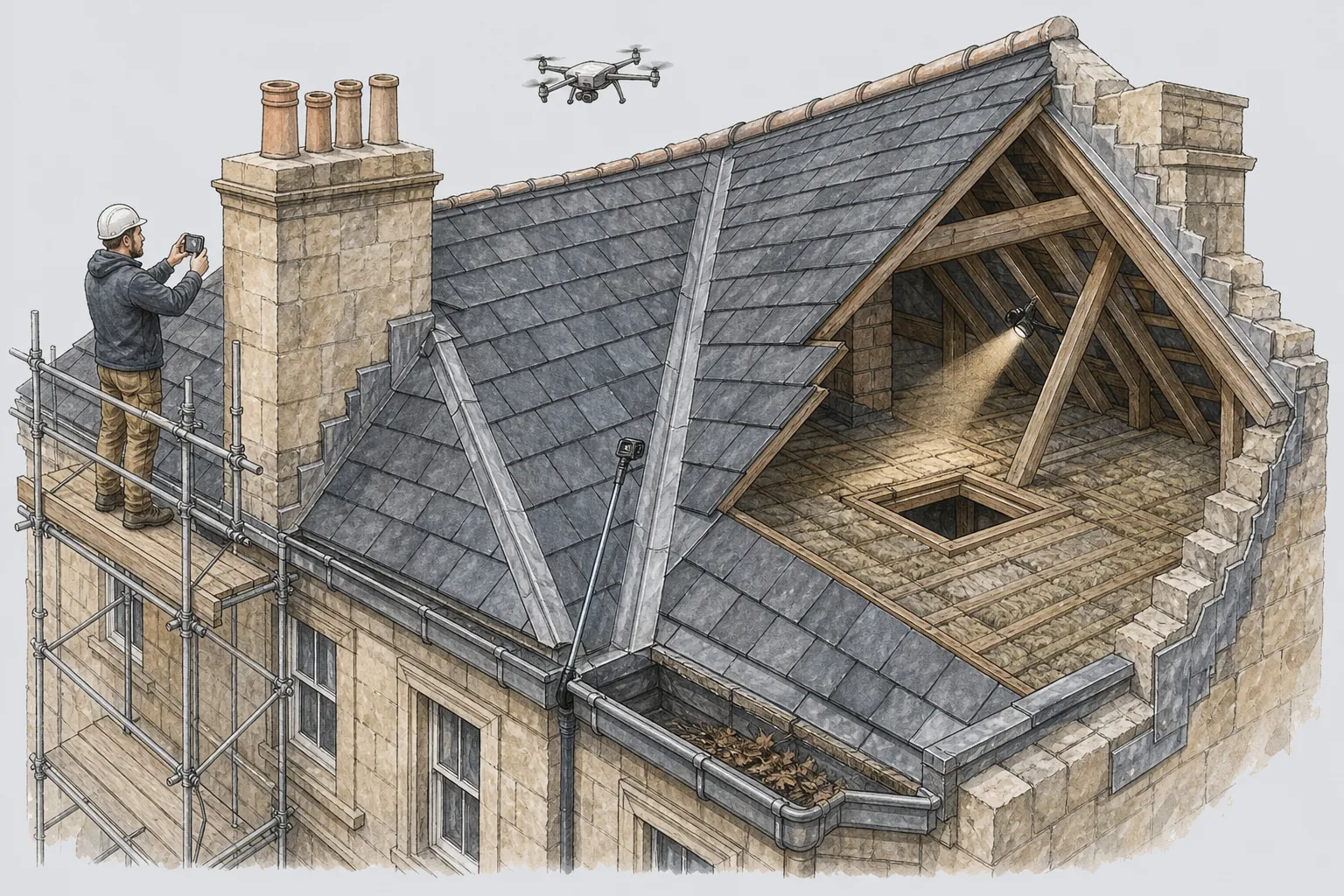
Lead channels behind parapetsA parapet hides a lead-lined gutter. We look for splits at the joints and drips, and for slates or tiles that have crept down over the lead and now hold water against it.
Wind damage on open groundHill villages take the weather side-on. We check ridge lines, verges and the first few courses at the eaves for lifted or missing pieces, because wind goes looking for exactly those places.

Farm sheds, garages and the asbestos question

Outbuilding roofs are easy to ignore, and the oldest sheet coverings need a careful method before they are touched.

A farming and mining village collects outbuildings, and few of them get a second thought. Garages, workshops, lean-to stores and sheds carry sheet coverings that have often outlived the people who put them up. They get little attention, and when they let go the contents get wet before the house does.

Old corrugated cement sheet may contain asbestos. Whether a particular sheet does is a matter for identification, not guesswork, so until a roof has been identified it is treated as if it might. Under HSE guidance, taking asbestos cement sheeting off with care is non-licensed work as long as the sheets are lifted intact. Heavy breakage, which means a lot of dust and debris, moves the job into notifiable non-licensed work. That is why the method matters more than the speed: how the sheets are fixed, what state they are in and where they will be stacked all shape the plan. The rules are laid out in the HSE guidance for anyone who wants to read them.

With the covering identified, the choice is between mending, covering over and stripping. A sound sheet roof with a few failed fixings can often be mended and left in place. A roof that is cracked across many sheets, or that has rotted purlins underneath, is better stripped and re-laid, because a new covering over rotten timber is a short-term answer. On a garage the new roof may be flat or pitched, and the material depends on the span, the falls and the budget. A flat garage roof needs a fall towards the gutter so water does not pond, and that fall is set out before any membrane goes down.

The detail on materials, fall and costs sits on our garage roof replacement page. The table below shows national ranges only, taken from a MyBuilder guide of 2026; your own fixed quote is written after the survey.

National ranges for garage roofs and asbestos removal (MyBuilder, 2026)

JobTypical range
One-car garage with a flat roof£700 to £1,000
Two-car garage with a flat roof£900 to £1,400
Garage with a pitched roof£2,500 to £4,500
Asbestos removal, averaged across jobsAbout £2,000

A church tower, a Commissioners' church and the parapet

The tower of St John's and the converted Christ Church show how a wall that rises above the roof changes the way water leaves it.

St John's, the village church, is listed Grade II* and carries more than four centuries of work in one outline. Its Perpendicular embattled tower dates from around 1460. The nave and aisles were completed in 1839 by Jesse Gane, and the chancel followed in 1897 by Frederick Bligh Bond. Battlements are a form of parapet, the wall that rises above the edge of a roof, and parapets are where roofing gets difficult.

Behind a parapet rain cannot simply fall off the edge, so it collects in a parapet gutter, a trough of lead laid along the foot of the wall. The lead has to be dressed up the face of the wall, laid with steps to keep water moving and joined with welts or rolls that allow for the metal's movement in heat and cold. When it fails at a joint or drip, the water does not appear on the outside. It runs into the wall and the roof timbers, and the first sign is usually damp inside.

Christ Church on Stockhill Road, built in 1838 by John Pinch the Younger as a Commissioners' church, is now a private residence. Whether any given conversion is listed is something to check with Somerset Council before work, and the answer decides whether consent is needed. A former church keeps its tall, steep roof and often its parapets, and the rainwater route from the ridge to the ground is long. Every junction on that route needs to be sound.

Lead is specified by code, a number that sets how thick the sheet is, and the code that suits a flashing is not always the one that suits a gutter. We pick it for the detail, not for the quote. Our page on lead roofing explains the work, from a small flashing to a full gutter, and what separates a lasting repair from a patch.

Words you will hear

Parapet
A wall that carries on upwards past the edge of a roof or tower.
Parapet gutter
A lead trough set behind a parapet to gather the roof's rain.
Lead code
The grade number of rolled lead, which settles the sheet's thickness.
Purlin
The horizontal timber across a roof that supports sheets or rafters.

Weather on the hill and what an insurer will ask

Wind finds the weak spots on an upland roof, and a claim is easier when the evidence has been gathered properly.

Chilcompton lies in the Mendip Hills, and a roof on open ground there can take the wind with little shelter. Wind does not damage a healthy roof evenly, and a roof that has stood through many winters can still lose a tile in the one gale that finds its weak line. It finds the places where something is already loose: a slipped slate, a lifted ridge tile, a verge whose pointing has gone, or the first courses along the eaves where uplift is strongest. We check those lines first on a roof like this, because a small gap there lets in air and rain that a closed roof would shed.

When a storm does damage a roof, two practical questions follow. The first is making it safe. Water coming in gets stopped first, with a temporary cover where needed, and the lasting repair is planned once things are dry. Leaks and storm damage take priority in our diary, though we do not promise a timetable.

The second is the insurance position, which is between you and your insurer. Many insurers use a definition of storm that includes gusts of at least 55mph, and ordinary policies tend to carve out wear and tear, such as rain getting in because a roof was left unmaintained. In one Financial Ombudsman case, the ombudsman relied on local weather reports and found that wind was the main cause of the tiles coming off. A claim never has a guaranteed outcome, but dated photographs and a written account from a roofer give an insurer something concrete to assess.

MyBuilder's 2026 repair guide gives storm-damage fixes a typical band of £500 to £1,500; a few slipped tiles sit between £100 and £300, and a major repair starts at £2,500. These are national figures. The detail of how we approach urgent work is on our roof repairs page, and the fixed quote follows the survey.

Myth

If wind takes tiles off, the insurer has to pay for the repair.

Fact

Policies commonly exclude wear and tear, and insurers often look for a storm-strength gust, so what caused the damage and how well the roof was kept both come into it.

Roofs of many ages and one sensible check

A village with a 15th-century tower and a modern garage on one road needs checking by condition, not by date.

Chilcompton's buildings span more than five hundred years, and the roofs on them were renewed at different dates, with different materials and different care. Age alone tells you little. A well-laid roof can be sound at 100 years, and a badly laid one can fail in 15, so the useful measure is how the fixings, timbers and junctions are holding up, not the date on the deeds.

The way to find out is a proper inspection. From the ground, a good deal can be seen: gaps in the courses, a dipped ridge, stains at the eaves, vegetation in the gutters. Up close there is more. We look at nail fixings, the state of battens and the condition of lead at every abutment. Where a roof is hard to reach, a drone can survey it, and where heat loss or hidden damp is the worry a thermal survey can show it. MyBuilder's 2026 guide puts a standard inspection at £150 to £250, a drone survey at £200 to £400 and a thermal survey at £300 to £500, as typical national ranges.

Timing matters. A look in early autumn, before the leaves fall and before the first gales, lets small faults be cleared on a dry day. A look after a storm confirms whether anything has moved. Neither has to lead to work, and a report that says the roof needs nothing is as useful as one that lists faults. Often the finding is that the roof has years left and needs a gutter cleared and a ridge tile refixed.

When a fault is found, the written report says what it is, where it is and what the repair involves, with photographs. Our roof inspections page explains what a survey covers and how the findings are presented.

Map showing the location of Chilcompton.

Nearby

Roofers near Chilcompton

Roofing services in Chilcompton

Local questions

Chilcompton farmers, miners' families and owners ask

Can the roof of a former church like Christ Church on Stockhill Road be repaired like an ordinary house roof?

The materials may be familiar, but the structure is not. A church roof is tall and steep, with long rainwater routes and often parapets, so the junctions need more attention than on a house. First check whether the building is listed, because that decides whether consent is needed. We then survey it, photograph each fault and write down a fixed price for the repair.

Do I have to replace the asbestos cement sheets on my farm shed in Chilcompton?

Not necessarily. Sheets that are sound and undisturbed can often stay, and the first step is to have the material identified. HSE guidance places careful removal in the non-licensed category and heavy breakage in the notifiable one. Which route fits your roof is explained before any price is agreed, and a failed roof is lifted sheet by sheet instead of being smashed up.

How strong does the wind have to be before an insurer calls it a storm?

Many insurers use a definition that includes gusts of at least 55mph, though policies differ, so read yours. Wear and tear is commonly excluded, which is why a roof's condition before the storm matters. Dated photographs, plus a roofer's written findings, give your insurer something to assess. We cannot promise an outcome, because the decision is the insurer's.

The gutter behind the parapet wall on my house keeps leaking. Is that a Chilcompton thing or a lead thing?

It is a lead thing, and it happens wherever a gutter sits behind a wall. Splits at a joint or drip let water run into the wall, and slates that have crept down can hold it against the lead. We lift the edges, check each lap and welt, and tell you whether a repair works or whether the run needs relaying in a lead grade chosen for the detail.

Get your free survey

Get your free roof survey

Tell us what's happening and we'll call you back to arrange a visit. Prefer to talk? Call 01225 285181.

  • Photos of your own roof
  • A fixed price in writing
  • 10-year workmanship guarantee
Call Free survey