
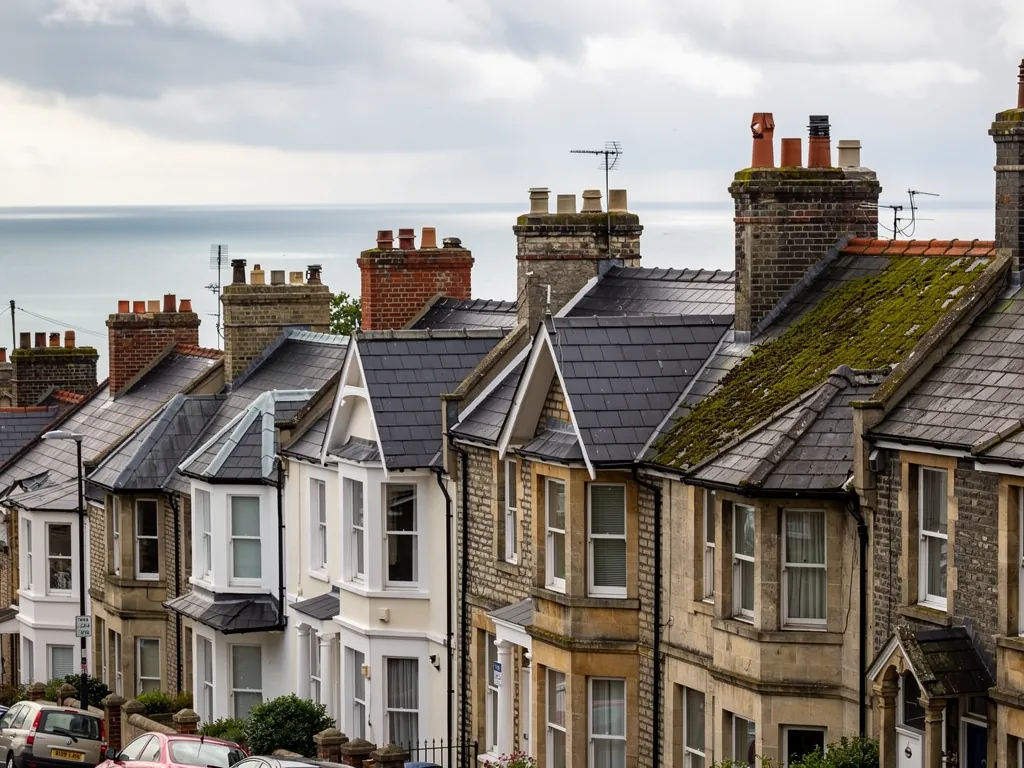
Victorian villas with slate roofs in a North Somerset town near the coast

Roofers in Portishead

Portishead is a seaside town where early Victorian streets meet the redeveloped marina at Port Marine, 21.8 road miles from central Bath. What we do here runs from chimney stacks on older terraces to the details of a listed Tudor Gothic inn.

Local roofs

Early Victorian streets and a new waterfront

Portishead has a split personality, and both halves are visible on its roofs. The dominant architecture of the town is early Victorian, with some buildings keeping their original features. Around the marina, the former dock and power station sites have been redeveloped as Port Marine, which includes an area built in the style of a fishing village and modelled on Polperro.

Alongside them stand the town’s landmark buildings, some older and some newer. The Royal Hotel, built in a Tudor Gothic style in 1830 by the Corporation of Bristol, survives as The Royal Inn and carries a Grade II listing. The red brick National Nautical School, built by Edward Gabriel in 1905, is now part of a gated community known as Fedden Village. Court House Farmhouse dates from the medieval period, was remodelled in the 17th and 19th centuries, and carries a Grade II* listing. The Church of St Peter was rebuilt in the 14th and 15th centuries in the Perpendicular Gothic style and was made a Grade I listed building in 1952.

A roofer treats those periods differently. An early Victorian roof asks about chimneys, valleys and abutments built by hand and now worn. A Port Marine roof asks about junctions and details that are young but not immune to faults. A listed roof asks about consent first. The planning authority is North Somerset Council, and we hand you a written scope and photographs to take to it.

Council
North Somerset Council
From central Bath
21.8 road miles, north-west
Royal Inn
Tudor Gothic of 1830, listed Grade II
St Peter's Church
Grade I, listed 1952
Court House Farmhouse
Medieval, Grade II*

What we find

Victorian stacks, waterfront junctions and coastal edges

Chimney stacks and their jointsOn early Victorian houses the stack is often the oldest, most exposed part of the roof. We look at the pointing, the pots and the lead collar at the foot of the stack, and hunt for hairline cracks that let water in.
Junctions on newer waterfront roofsWhere a dormer, balcony or bay meets the main roof there is a joint of lead, sealant or membrane. We inspect each for splits and gaps, because faults at junctions are common on young roofs.
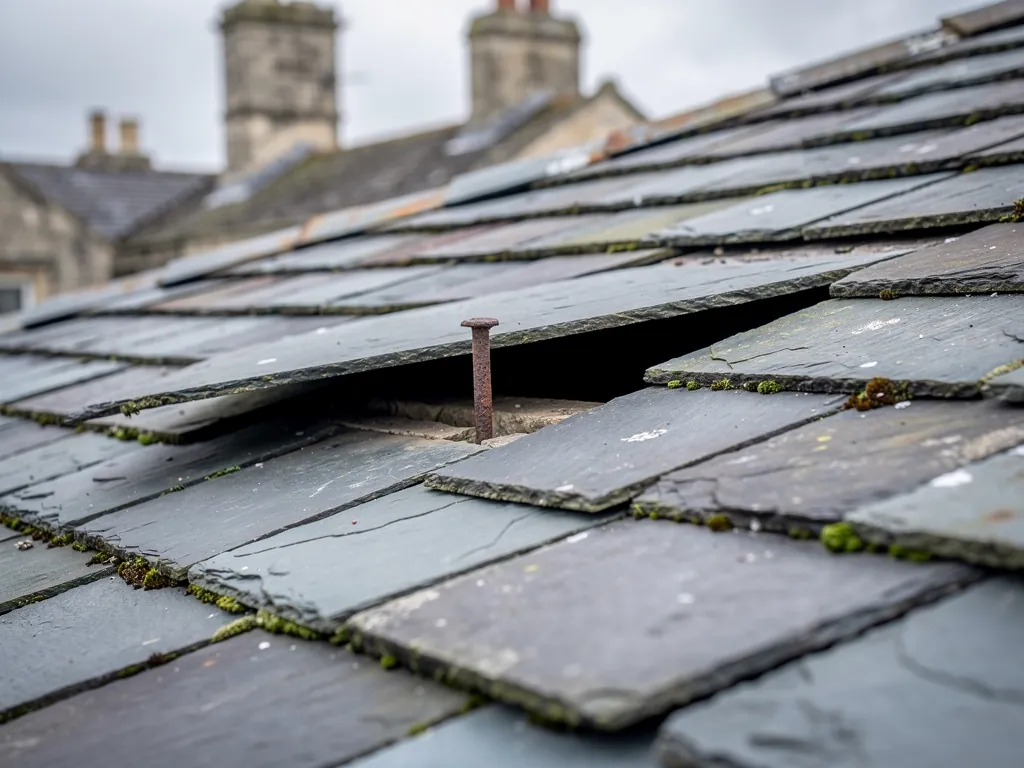
Fixings on exposed coastal edgesRoofs near open water take the wind on their edges. We examine ridge, hip and verge pieces for movement and look for fixings that have corroded or loosened.

Early Victorian terraces and their stacks

The town's dominant style was built to a pattern, and so are its faults.

When a town is dominated by one period of building, the houses share their weak points. In Portishead that period is the early Victorian one, and the weak points are the ones a roofer expects to find on a house of that age: chimney stacks, the joints around them, the valleys between roofs and the gutters at the eaves. Some buildings have kept their original features, and where they have, the roof deserves repair in the original manner.

The chimney is the usual starting point. A stack stands above the roof line, takes the weather on every face and is held together by mortar that has had a long time to weather. Flaunching is the mortar slope round the base of the pots, and its job is to throw rain clear. Once it cracks, the stack takes in water. Pointing recedes and the joints open. Lead flashing at the foot of the stack lifts or splits. Each fault is a separate repair, and a survey will show which of them are needed. Typical UK prices reported by MyBuilder (2026) give repointing an average near £750 and flashing repair a band of £250 to £1,200. Only a survey lets us put a fixed figure on your stack.

Where a stack has leaned, cracked through or lost its top courses, a partial rebuild may be the safer course. Before that, we check the cause: a stack that has moved can mean movement in the wall beneath it, not only weather.

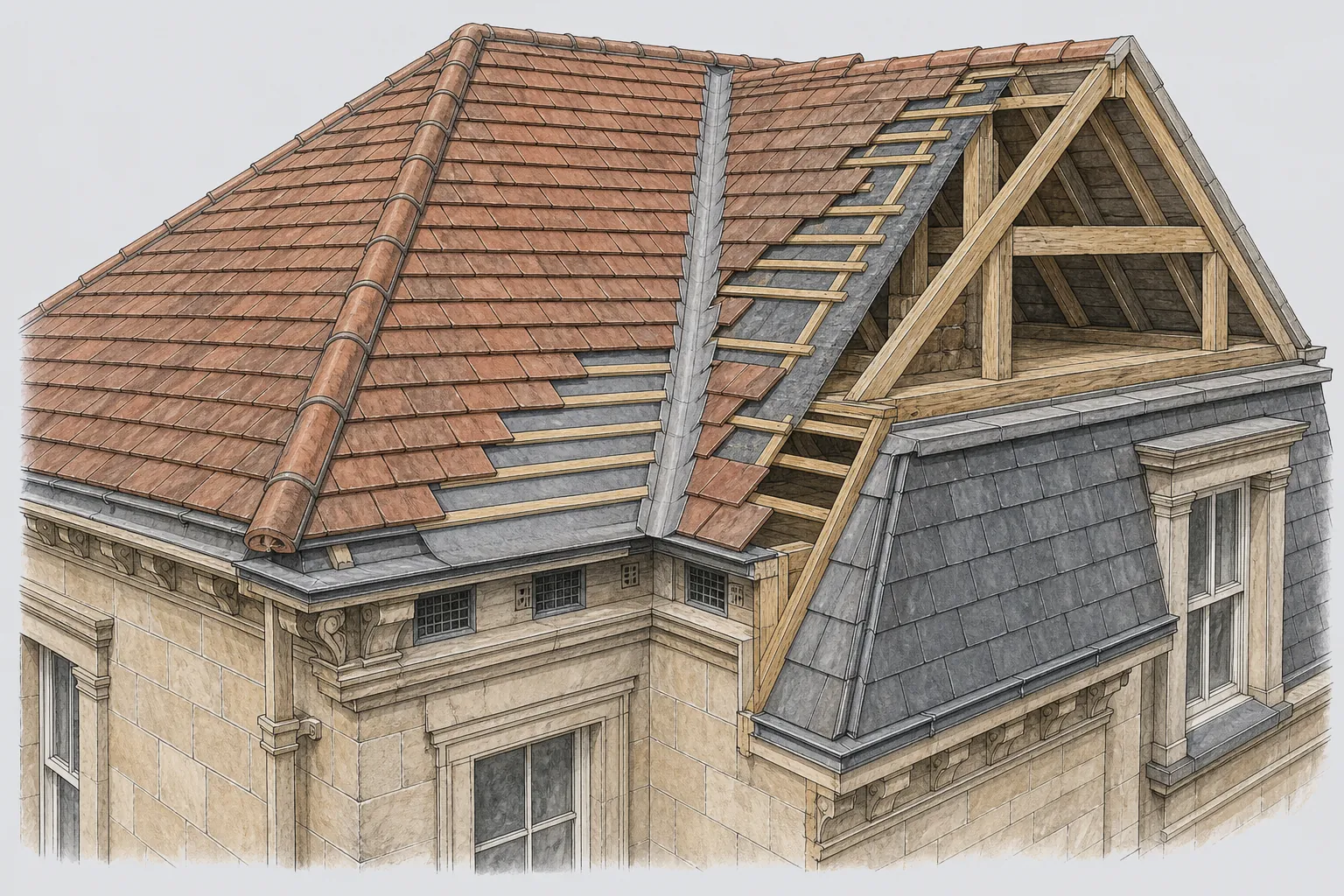
Roofs of this age may also have valleys and, behind a parapet, a gutter hidden from the street. A leak starts in such places when nobody has looked for years. The stack itself is covered on the chimney repairs page, and the roof around it under pitched roofing.

Port Marine and the waterfront roofs

The marina development gave Portishead new streets, new details and new places where water can get in.

The former dock and power station sites around the marina are now Port Marine. One part is built in the style of a fishing village, modelled on Polperro, which suggests close-set roofs and varied levels. The more junctions a roof has, the more places there are for one to fail.

The age of these roofs is their main feature. They are young enough that old-age problems are not the issue; the risks are faults of workmanship and details. An open ridge, a verge that has begun to lift, a lead flashing that was dressed too tight. A dormer cheek where the lead has pulled away. A roof window whose flashing kit has shifted. These are the things we check first, with the first visit often a straightforward inspection to see whether anything has changed since the roof was finished.

The location adds one more consideration. A site beside open water is open to wind, and the mix of wind and rain tests every edge. We cannot quote a local figure, so we do not guess at one. We simply treat every edge as if it will be tested and prefer mechanical fixing to mortar alone, as the 2014 slating and tiling standard, BS 5534, expects.

Roof windows and rooflights are common in houses of this type, and they are worth checking each year: seals, flashings and the condition of the surrounding lead. If you are thinking of adding or replacing one, our skylights and roof windows page covers the consent and permitted development position, so it is not repeated here. Many of these houses will also be under a builder's warranty; check its terms before anyone alters the roof.

Words you will hear

Dormer cheek
The little side wall on each flank of a dormer.
Flaunching
Mortar shaped round chimney pots to shed rain.
Valley
The internal angle where two slopes join and share a channel.
Flashing
A strip of metal, usually lead, sealing a roof joint.

The Royal Inn, Court House Farmhouse and St Peter's

Three listed buildings, three periods, and one rule: ask before you alter.

Portishead's listed buildings span six centuries. St Peter's was rebuilt in the 14th and 15th centuries in the Perpendicular Gothic style and was made Grade I listed in 1952. Court House Farmhouse is medieval, was remodelled in the 17th and 19th centuries and is Grade II* listed. The Royal Hotel, now The Royal Inn, was built in 1830 in a Tudor Gothic style by the Corporation of Bristol and is Grade II listed.

The roofs of buildings like these are part of their listing. That has practical effects. Putting back what was there differs in kind from changing a material, and the second needs listed building consent from North Somerset Council before work begins. The council's own pages at n-somerset.gov.uk are the place to ask. Consent is a distinct permission from planning, and altering a listed building without it can be an offence.

Each building has its own character on the roof. A Tudor Gothic building such as The Royal Inn may carry decorative details that are hard to reach and easy to damage. A medieval farmhouse remodelled in two later centuries will have joins between its phases, each with its own timber and its own history. A Perpendicular Gothic church will have a large roof with lead gutters and flashings. In every case, we record what is there before touching it.

We cannot make a legal ruling on your building. Instead we set the work out exactly: the covering, the method, the lead and the lime mortar, so the conservation officer has a definite proposal in front of them. For lead work in particular, see our lead roofing page.

Listed roof rule

On a listed building, agree the scope with the council first and then repair like for like.

Fedden Village and the red brick buildings of 1905

A school converted to a gated community brings brickwork, chimneys and shared responsibility.

The red brick National Nautical School was built by Edward Gabriel in 1905 and is now part of a gated community known as Fedden Village. A building put up as a school in 1905 and converted into homes brings a familiar problem: a roof that was designed for one institution and is now relied on by many households.

On such buildings we look at the whole roof as a system. The brick chimneys, with their pointing and flaunching. The abutments where one section of roof meets another. The valleys. The gutters at the eaves, which on a large building carry a great deal of water to few downpipes. Rainwater goods need clear runs and secure fixings, and when a long gutter sags, the overflow runs down the brick and stains it.

Access is part of the job too. A gated site means arrangements for entry, scaffold locations and deliveries, and a managing agent usually coordinates them. We write the survey to suit: pictures, a simple roof plan split into zones, a priority list and a single price for the lot. The agent can then share it with owners and the owners can see for themselves what is proposed.

For brick stacks, repointing in a matching mortar is usually the first step, and a lime-based mix suits older brickwork. How we judge coverings, battens and underlay as one system is explained under pitched roofing. Where the roof is shared, we ask the managing agent about any guarantees already in place before we plan repairs.

Myth

Brickwork on a chimney never needs maintenance because brick is hard.

Fact

The brick is hard but the mortar joints are not, and once they recede water gets into the stack and frost opens them further.

Map showing the location of Portishead.

Nearby

Roofers near Portishead

Roofing services in Portishead

Local questions

Questions from the old streets and Port Marine

Why do chimney stacks on early Victorian Portishead houses need attention more often than the roof?

A stack stands clear of the roof line, so every face takes the weather. The mortar and flaunching age faster than the covering, and the lead flashing at its base moves with the building. A survey checks all three, and sometimes the cause turns out to be movement in the wall beneath. Fixing the joints is usually a smaller job than a rebuild.

My Port Marine roof has a dormer and a roof window. Where do leaks usually start?

At the junctions. The dormer cheek, the flashing round the window and the valley between the dormer and main roof are the usual suspects. We inspect each for lifted lead, gaps and failed sealant. Catching a fault there early is a small repair, and leaving it can soak the timber behind.

Can I repair the roof of a Grade II listed house in Portishead without consent?

Only if the repair puts back what was there and North Somerset Council agrees it does not alter the building's character. Anything else needs listed building consent first. Ask the council before work starts, and we can describe the work in writing so you have a clear scope to put forward.

I live in Fedden Village. Who arranges roof work on the old school building?

The answer depends on how the building is managed, so begin with the managing agent or freeholder. We can survey the roof and write it up with pictures and one fixed price for the agent to pass round, which makes it simpler to agree the scope and the order of work.

Get your free survey

Get your free roof survey

Tell us what's happening and we'll call you back to arrange a visit. Prefer to talk? Call 01225 285181.

  • Photos of your own roof
  • A fixed price in writing
  • 10-year workmanship guarantee
Call Free survey