
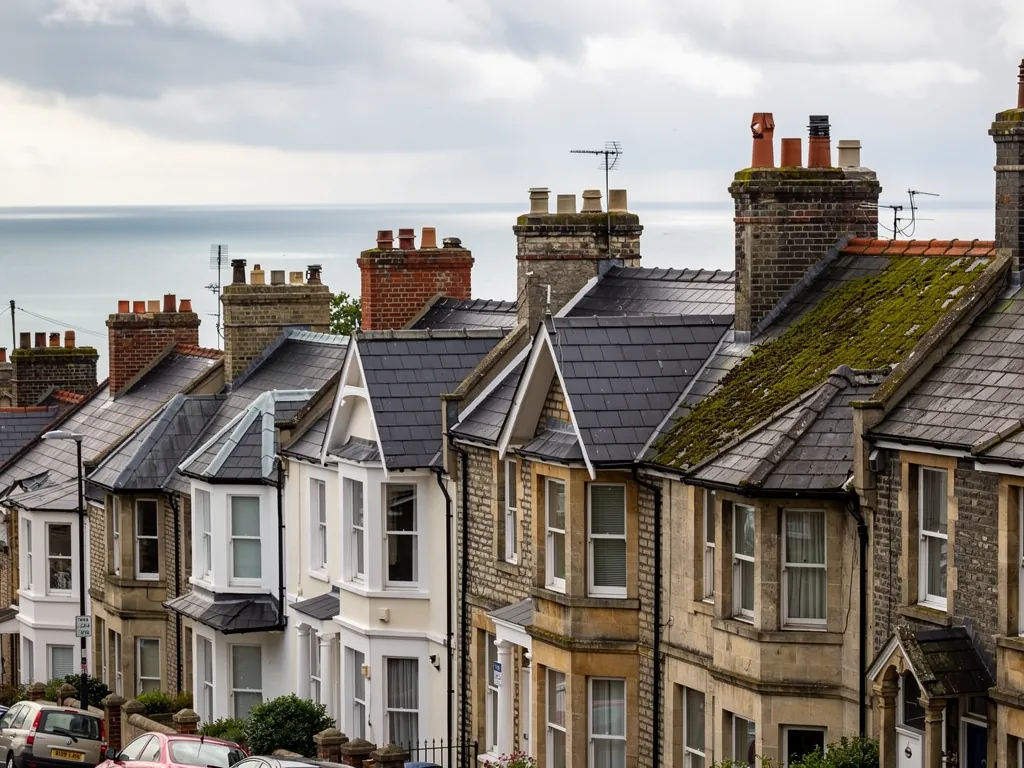

Victorian villas with slate roofs in a North Somerset town near the coast

Roofers in Pill

Pill, with Lodway and Ham Green folded into it, stands on the southern bank of the Avon. By road it is 18.3 miles from central Bath, in the north-west. A river village with a railway history and a former hospital site makes for roofs of very different ages and very different problems.

Local roofs

A river village that a railway cut through

Pill lies on the southern bank of the Avon, and the former hamlets of Lodway and Ham Green are now joined to the village. It is a place shaped by water and by transport. The Portishead Railway line, which opened in 1867, passed right through Pill, and a large number of buildings had to be demolished to make way for it. The village sits on the A369 between Bristol and Portishead, close to the M5.

Its history goes back much further than the railway. The Ham Green Pottery kiln, excavated in 1959 in the fields above Chapel Pill, made pottery between 1100 AD and 1250 AD, and the pots were exported from Pill by boat. Much more recently, Ham Green House opened as an isolation hospital in 1899. After the hospital largely closed in the 1990s, much of the site was redeveloped for housing and the Eden Office Park.

For roofs, that gives us four kinds of work in and around the village. There are the older houses of the village core, where a row that was cut short can leave a roof with an awkward end. There are the houses of Lodway and Ham Green. There are the homes on the old hospital grounds. And there is the commercial roof on a modern office park. Each fails differently, and the questions you ask of a river-bank roof are not the same as those you ask of a business unit.

North Somerset Council is the planning and building control authority. Each roof is surveyed and photographed, the price is fixed in writing, and any Building Regulations point is raised at the outset.

Council
North Somerset Council
From central Bath
18.3 road miles, north-west
Railway
Portishead Railway, opened 1867
Medieval pottery
Ham Green Pottery, 1100 AD to 1250 AD
Hospital site
Ham Green House, 1899; now housing and Eden Office Park

What we find

River-funnelled wind and terrace end abutments

Wind funnelled along the riverA roof on a river bank has open ground in front of it. We check for loose and chipped tiles on the weather side, lifted ridge pieces and flashing that has been pulled away from the wall.
Abutments where terraces endWhere a row of houses stops short, the end roof meets a wall, a gable or a neighbouring slope. The junction relies on lead, mortar or both, and it is the first place a long-standing leak tends to start.
Flat roofs on offices and extensionsMembranes on flat roofs fail at the seams and around outlets. We check for ponding, blistering and splits, and test the deck beneath before deciding between repair and renewal.

Weather off the Avon

A roof beside a river meets the wind with little to break it.

A house on the southern bank of the Avon looks across open land at the water. That openness is pleasant, and it is also the reason a roof here is tested harder than one in the middle of a town. We do not have a figure for local rainfall or wind, and we will not invent one, but the principle holds anywhere with a clear approach: air arriving at speed gets under loose edges and lifts them.

The first signs are small. A tile edge chipped at the corner. A strip of ridge mortar that has cracked. A flashing, the lead or metal strip sealing the join between roof and wall, curling away at its top edge. None of these is a leak in itself, but each is the starting point for one, because water follows the line of a gap.

When a call comes in about a leak, we begin by working out where the water is entering, which is often not where it appears inside. Water can travel a surprising way along a batten or a rafter before it drips. We check the likely entry points in order: ridge, valleys, flashings, then the field of the roof.

If the roof is leaking now, we make it safe first, and storm damage and leaks take priority in our diary. That may mean a temporary cover or a patch. Then comes the lasting repair, aimed at the cause. Our roof repairs service describes how a typical repair is diagnosed and carried out, and what we do when it turns out that a larger job is needed.

Where the railway cut through

A line that took out a large number of buildings changed the shape of the village, and the end of a row needs its own checks.

The Portishead Railway passed right through Pill, and a large number of buildings were demolished to make way for it. Which streets were affected is not something we can map for you, and no particular house is being singled out. What can be said is a general point about roofs that were once part of a longer row.

A terrace roof is built to be continuous. The party wall between two houses carries the roof timbers and often rises above the slope as a low wall. If the terrace is shortened, the last house in the row gets a new gable or a patched end. The junction where its roof meets that wall relies on flashing, and flashing ages. The lead cracks with movement. The mortar holding it in a groove washes out. The result is a leak that appears at the same corner of the same room, season after season.

Another form of the same problem is the verge, the exposed edge of the roof where it passes the gable. A mortar verge ages, and wind will find any gap under the end tiles. Under BS 5534:2014, mortar cannot be relied on alone to hold tiles at the verge, so a repair includes mechanical fixings. A dry-fix verge, which is clipped on and tested to BS 8612:2018, is a tidy alternative.

If you own an end-of-terrace or a house with an unusual gable, a survey from the roof and from the loft will show the state of the flashing, the party wall head and the timbers. The pitched roof is the subject of our pitched roofing page.

Words you will hear

Party wall
The wall shared between two adjoining houses.
Verge
The roof edge that runs along a gable.
Abutment
The line where a slope finishes against a higher wall.
Dry-fix
Clip-on ridge and verge parts, fitted without a mortar bed.

The Ham Green hospital site and the office park

A former isolation hospital is now homes and offices, with roofs to match.

Ham Green House opened as an isolation hospital in 1899. After the hospital largely closed in the 1990s, much of the site was redeveloped for housing and for the Eden Office Park. That gives Pill two quite different groups of roofs from the same piece of land: the houses and the commercial units.

The newer houses are relatively young, so what we usually see are early faults rather than age. A ridge that was bedded without fixings, a verge that has opened, an underlay torn at the eaves. We recommend checking any builder's or developer's warranty first and letting it run for the faults it covers. For anything outside it, a survey tells you what needs doing.

Commercial roofs are another matter. An office park will usually have flat or low-pitched roofs, with membranes, upstands, rooflights and drainage outlets. The typical failure points are the seams, the details round penetrations and the outlets where leaves and debris collect. A flat roof that ponds water will age much faster than one that drains. For typical UK prices, MyBuilder (2026) gives flat roof replacement at £2,800 to £7,500, and per square metre EPDM at £90 to £130 and GRP at £95 to £150. For commercial work our fixed quote follows the survey.

A business that cannot stop trading has a particular need: work that fits around the building's use. We agree access, noise and working hours with whoever manages the unit and plan the work in phases where we can. The flat roofing service explains EPDM, GRP, felt and lead and how each is chosen, and what a warm-deck upgrade means for a roof's insulation.

Where flat roofs usually fail

PartWhat goes wrong
SeamsJoins open as the membrane moves with temperature.
OutletsLeaves and grit block them and the roof ponds.
UpstandsThe edge against a wall cracks or pulls away.
DeckBoards beneath soften once water has reached them.

Lodway, Ham Green and matching what is there

A parish that exported pots by boat in the 12th century knows something about clay, and about leaving well alone.

The Ham Green Pottery made ware between 1100 AD and 1250 AD, and it left Pill by boat. It is a fair reminder that this stretch of river has long been a place where things were made, loaded and shipped, and the village has the layered housing to show for it.

The older houses of Lodway and Ham Green, and of Pill itself, will have been repaired many times over. An old roof is a record of its repairs, and a good repair reads as part of the same record. Our approach is to identify what the roof is made of before doing anything else. If it is clay, we match clay in colour, profile and size. If it is natural slate, it goes back as natural slate. We do not substitute a different material to save time, because the difference shows from the street and often changes the load the roof timbers carry.

That load is worth a note. Re-covering in something 15% heavier or more brings in Building Regulations and a check on the timbers. Smaller jobs differ: approval is not normally required where a job covers less than a quarter of the envelope and less than 50 per cent of the roof. The council for Pill is North Somerset Council, and its building control information is at n-somerset.gov.uk. If notification is needed, we handle that paperwork alongside you.

If your roof is old and has been patched several times, the useful question is whether the patches have a common cause. A survey can answer it. The pitched roofing page explains how we assess coverings, battens and underlay together before recommending repair or re-covering.

Material match

Replace clay with clay and slate with slate, because a different material changes both the look and the weight.

Map showing the location of Pill.

Nearby

Roofers near Pill

Roofing services in Pill

Local questions

Pill, Lodway and Ham Green questions

Does a house at the end of a Pill terrace have a higher risk of leaks at the side wall?

It has a junction that others in the row do not: where the end roof meets its gable or party wall. If that junction relies on old lead or mortar, it can leak at the same corner year after year. A survey from the loft and the roof will show whether the flashing and wall head need renewing. It is a local repair, not a whole new roof.

My flat roof is on a unit at Eden Office Park. Can it be repaired without closing the business?

Often it can. We plan the work in sections, agree access and noise limits with the building manager and work around opening hours where we can. First we survey the membrane, seams, outlets and deck to see whether a repair will hold or whether renewal is the better value, then confirm the price in writing.

Does the river make roofs in Pill wear out faster?

We have no measured figures to quote. What an open site does is expose edges: ridges, verges and flashings take the wind first. Keeping those edges well fixed, and the gutters clear, is the best protection. Regular checks catch the small faults before water gets in.

Who deals with a loose tile on a house built on the old Ham Green hospital land?

Check the warranty first. If a developer or builder's guarantee is still running, using it keeps your cover intact. If it has ended, or the fault falls outside it, we can survey the roof and repair or refix the tile, with a price in writing.

Get your free survey

Get your free roof survey

Tell us what's happening and we'll call you back to arrange a visit. Prefer to talk? Call 01225 285181.

  • Photos of your own roof
  • A fixed price in writing
  • 10-year workmanship guarantee
Call Free survey