

Bristol Victorian terraced houses with slate roofs and bay windows on a hill

Roofers in Filton

Filton sits north-west of Bath, 19.2 road miles away, a Bristol suburb that filled in between the wars and is now growing again on the old airfield. Large pre-war houses, rows of 1930s semis and brand-new streets on the airfield site sit side by side, and a hipped 1930s roof needs different work to a new estate's trussed one.

Local roofs

A suburb laid down in two waves

Filton expanded fast between the wars. Semi-detached houses spread first on the western side of the A38 and, in the 1930s, on the eastern side as well, turning a village into a suburb of Bristol. Filton Park shows the result clearly: the housing there is privately owned, semi-detached and built in the 1930s, while the pre-First World War properties in the same district tend to be quite large, set in generous gardens.

Those two house types ask different things of a roofer. A big pre-war house has a complicated roof, with several slopes, bays, chimneys and the junctions between them. A 1930s semi is simpler in plan, but there are a great many of them, and the same details recur from one pair to the next. When one roof in a row has a fault at the party wall or the bay, its neighbours often have the same fault waiting.

Filton Church was begun in around 1340 and has been much altered since. It is a reminder that the suburb sits on an older settlement.

The newest chapter is the former Filton Airport site, now being redeveloped as the Brabazon neighbourhood, which has planning permission for 6,500 homes. Filton Abbey Wood station serves the south of the town, with Bristol Parkway and Patchway stations serving the north and east. We work across the town, and every visit ends with a written price you can compare at your own pace.

Council
South Gloucestershire Council
From central Bath
19.2 road miles, north-west
Filton Park
Semi-detached housing from the 1930s
Church
Begun around 1340, much altered
Brabazon
6,500 homes with planning permission on the old airfield

What we find

Interwar hips, bay roofs and many junctions

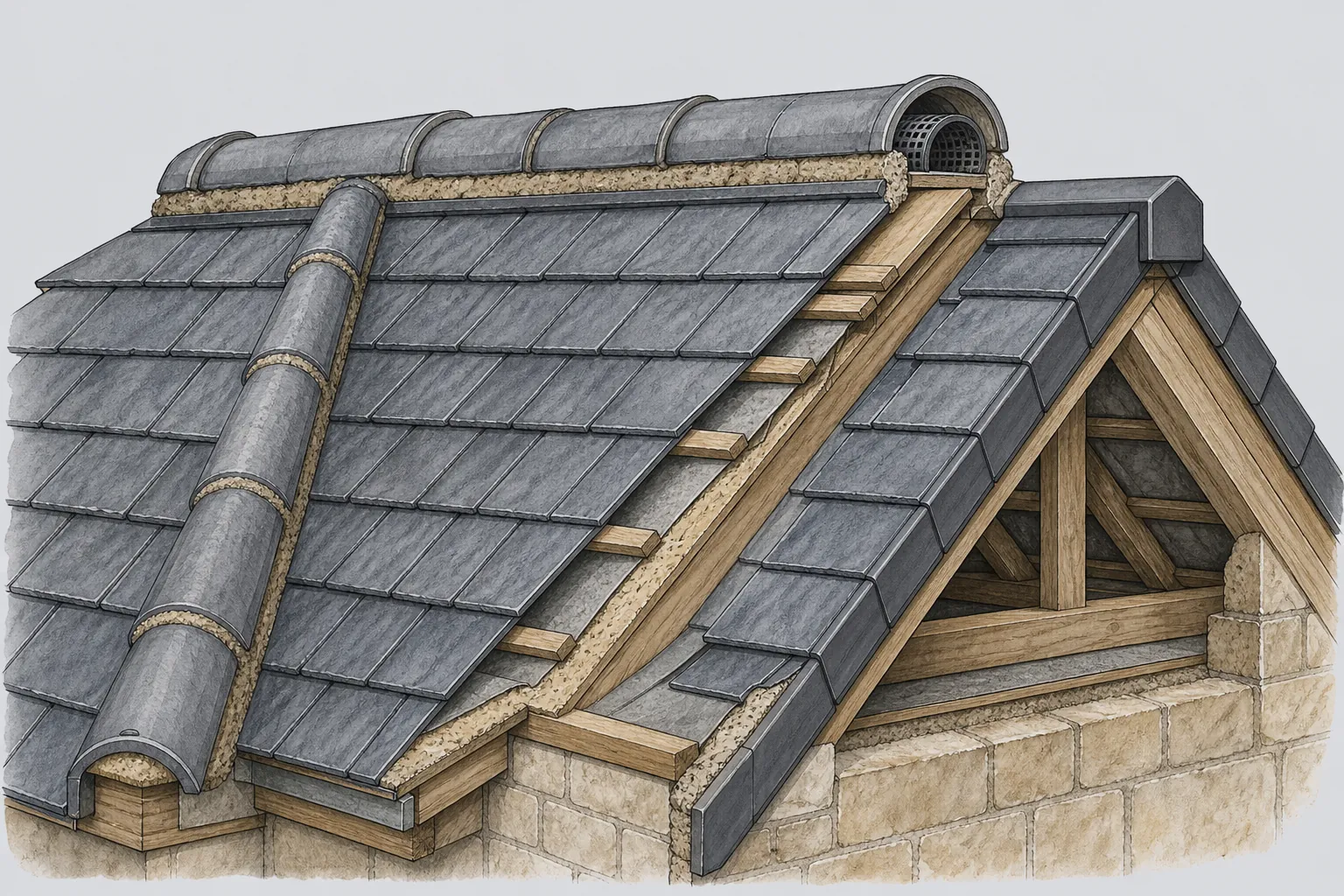
Hips and party walls on the interwar semisA semi has a shared wall running up through the loft and out through the roof. We check the flashing where it crosses the slope, and the hips (the sloping ridges at the corners of a hipped roof) for loose bedding and slipped tiles.
Bays and porches with their own small roofsThe lean-to above a bay window or front door is easy to forget from the street. We look at the flat or low-pitched covering, the lead at the wall and the gutter beneath, as leaks there show up as stains in the front room.
Big old roofs with many junctionsOn the larger pre-war houses, every chimney, dormer and valley is a possible entry for water. We work along the roof junction by junction, rather than inspecting only the plain slopes.

Interwar semis and their repeated faults

Pairs of houses that were built to a pattern tend to wear out in a pattern too.

A street of 1930s semis is a gift to the person doing a survey, because once you have seen the first roof, you know where to look on the rest. The builders of the time worked quickly, to a fixed plan, and many of the houses have a hipped roof, where the ridge stops short and sloping hips run down to the corners. A hip has more joints than a plain gable, and every joint is a place for water or wind to get in.

The first suspect is the bedding. Hip and ridge tiles of that age were set in a bed of mortar, and the mortar has by now had many winters to crack. Where it has shrunk away from the tiles, you can often see daylight along the hip from inside the loft. Repointing helps for a short while, but fixing the tiles mechanically is the lasting repair, and it is what current standards expect.

The second suspect is the party wall. The brickwork between two semis rises through the roof, and the junction is sealed with a flashing or a mortar fillet. A mortar fillet cracks as the two houses move at slightly different rates, so a neighbour's heavy rain can end up in your loft even though your own covering is fine. We replace failed fillets with a proper lead or similar flashing where the structure allows it.

The third is the loft itself. A house of this period may have a bare timber roof with no lining at all, or a thin felt that has dried and torn. Without an underlay the only barrier to wind-driven rain is the tile overlap, and that overlap was never meant to do the job alone.

Our pitched roofing work covers each of these, whether the answer is a repair on one side or a full strip and re-cover. The survey tells you which, and it comes with a fixed price in writing.

Typical faults on a 1930s semi roof

PartWhat goes wrongUsual remedy
HipsBedding cracks and tiles loosenRe-lay with mechanical fixings
Party wallMortar fillet splits at the slopeReplace with flashing
UnderlayMissing, torn or brittleRenew when re-covering
EavesFelt perished at the gutter lineEaves repair or full strip

Large houses in Filton Park

Roofs with generous proportions come with generous numbers of details.

The pre-First World War houses in Filton Park are larger than their later neighbours and stand in bigger gardens. A larger house nearly always means a larger and more complicated roof: more slopes, more chimneys, a dormer or two, and several valleys where the planes meet. The covering may be natural slate, plain clay tile or something that replaced them, and the only way to know is to climb up and look.

Valleys deserve particular attention. A valley is the gutter-like fold between two slopes that face each other, and it carries the water from both. In many older houses the valley is lined with lead, laid under the slates or tiles on both sides. Lead is a hard-wearing metal, but it splits where it has been dressed over a sharp edge, and from the ground you cannot see the damage. A soaker, one of the little lead sheets tucked between courses at a wall or stack junction, can rot at its edge, and the result is a slow leak that wets a ceiling long before it drips.

The chimneys are the other main task. A tall brick stack in an exposed garden takes the weather on every side. We check the flaunching (the sloped mortar cap that seats the pots and sheds water), the brick joints and the flashing where the stack meets the slope. A stack that leans, or has bricks that flake, needs more than pointing, and our chimney repairs page explains when a partial rebuild is better than patching.

These are the roofs where a mismatch shows most. A bay with the original clay tile next to a patch of grey concrete tile is noticeable from the road. We match like for like where we can, and where the original is no longer made we look for reclaimed or close equivalents and show you samples before ordering.

None of this requires the house to be listed or in a conservation area, but if it is, South Gloucestershire Council should be asked first. We can describe the work in the detail the council needs.

Words you will hear

Hipped roof
A roof with slopes on all sides, so no gable at the ends.
Soaker
A folded lead piece worked in between courses at an abutment.
Flaunching
The mortar cap on a stack that seats the pots.
Valley
The internal channel where two slopes join.

Bays, porches and flat patches

The small roofs attached to a house are often the ones that leak first.

Walk along any Filton street of semis and you see them: the flat or shallow-pitched roofs over bay windows, front doors and side extensions. They are small and low, but they have a hard job. A short roof next to a tall wall collects water running off the main slope and has little fall to shed it.

Most of them are covered in felt, in a layered bitumen system or in a single membrane for instance EPDM, which is a rubber membrane, or GRP, a resin and glass-fibre coat that cures rigid. Each has its own failure modes. Felt cracks and blisters. EPDM is tough, but the edges and corners are where it lets go. GRP is smooth and watertight until the substrate moves, at which point it splits along the joints in the boards. A leak that appears in the front room after a heavy shower is often traced to one of these.

The other weak point is where the small roof meets the wall. A strip of lead, called a flashing, is tucked into the brickwork and dressed down over the covering. If the mortar joint it sits in has eroded, or the lead has lifted, water runs behind. Raking out the joint and refitting the flashing costs far less than a ruined ceiling.

We look at the whole stack: the covering, the boards, the insulation if any, the lead, the gutter and the downpipe. Where the deck has stayed wet for long enough to rot, we tell you, because there is no point laying a new membrane over soft timber. Our flat roofing page sets out the materials and what each suits.

Small roofs seldom need big jobs, and we price them honestly as small jobs, with the repair and the replacement options set out so you can choose.

Repair or renew

Repair a flat bay roof when the deck is dry and sound, and renew it when the boards have gone soft.

Brabazon and the newest roofs in town

A new neighbourhood on the old airfield brings roofs that need little, but not nothing.

The Brabazon neighbourhood is rising on the former Filton Airport site, with 6,500 homes consented. Roofs there are new, built to current standards and, in most cases, fitted with modern underlays and mechanically fixed ridges. A new roof rarely needs rescuing, but it can need small attention, and the early years are the time to find a fault while it is still a minor one.

Typical early jobs are modest. A tile cracked by a trade working on the roof afterwards. A ridge end cap that was never fully secured. A gutter joint that leaks on one side. A solar panel or aerial that someone mounted and sealed badly. None of these is a reason to worry, and all of them are easier and cheaper to fix before they have let water into a new plaster ceiling.

Many people in new housing do not know what lies under their tiles, and that is a fair position. A short inspection will tell you. We check the covering, the ridge and verge fixings, the lead at the abutments, the gutters, and the eaves detail. We take pictures of the roof and put the findings on paper, which is useful if you need to raise something with a builder or a warranty provider.

Any work that changes the structure of a newer house, such as a new roof window, may need Building Regulations approval and has to meet current thermal limits. For roof windows the rules are set out on the roof windows service page, and we leave the detail there.

On the older streets, a small re-roof is not normally notifiable, while a larger re-cover is, and a covering that is a good deal heavier can bring a structural check. The Planning Portal sets the thresholds. We explain where the line falls on your house and arrange the paperwork through your building control body.

Map showing the location of Filton.

Nearby

Roofers near Filton

Roofing services in Filton

Local questions

Filton Park, 1930s semi and Brabazon queries

Why does water get in at the party wall of my 1930s Filton semi?

The usual cause is the junction where the wall passes through the roof. Many were sealed with a mortar fillet, which cracks as the two houses move, rather than a lead flashing. Water then runs down beside the wall into the loft. We renew the junction with proper flashing where we can, and check your neighbour's side from the loft so the repair holds.

Can you match the tiles on a large pre-war house in Filton Park?

Often, yes. We identify the covering first, then match its size, colour and profile with new or reclaimed material, and show you samples. Where a house has a bay or porch in different tile from the main roof, we match each to its own part. The goal is a repair that nobody looking from the street will notice.

Do the new Brabazon roofs need any maintenance in their first years?

Light attention is sensible. A roof inspection after a year or two can catch a cracked tile, an unsecured ridge end or a loose gutter joint while the fix is small. Our notes come with photographs, which is handy if you want to take a defect back to the builder.

Is a flat roof over my Filton bay window worth repairing or replacing?

That depends on the boards beneath it. If the deck is dry and firm, a repair to the covering and lead often does the job. If the timber has absorbed water and gone soft, the whole small roof needs renewing. During the survey we open up one corner to see which applies, and set out both options with a fixed price.

Get your free survey

Get your free roof survey

Tell us what's happening and we'll call you back to arrange a visit. Prefer to talk? Call 01225 285181.

  • Photos of your own roof
  • A fixed price in writing
  • 10-year workmanship guarantee
Call Free survey