
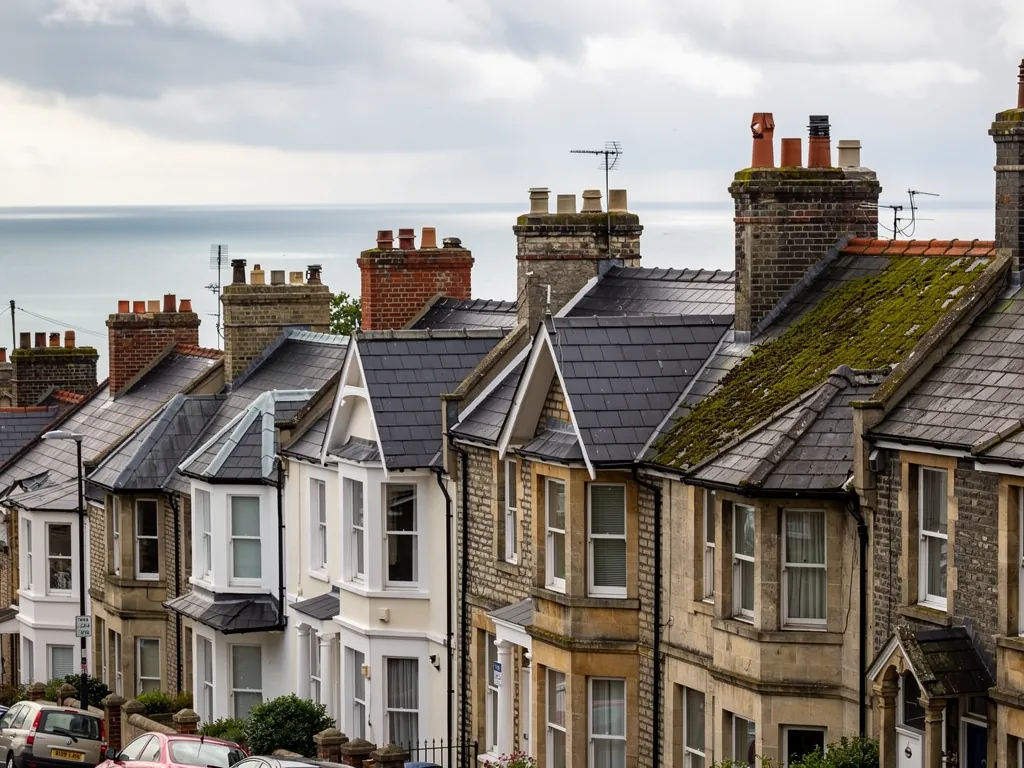
Victorian villas with slate roofs in a North Somerset town near the coast

Roofers in Clevedon

Clevedon is a seaside town built over seven hills, 26.4 road miles west of central Bath. The town grew as a Victorian resort, many of its houses stand on steep plots with sea-facing slopes, and we repair their roofs to match: the covering that was laid, the lead that keeps it dry and the gutters that carry the water away.

Local roofs

A farming village that became a Victorian resort

Clevedon changed from a farming village into a popular seaside town in the Victorian period, and the roofs of the town still tell that story. It is situated on and around seven hills: Church Hill, Wain's Hill, Dial Hill, Strawberry Hill, Castle Hill, Hangstone Hill and Court Hill. Houses climb those slopes in terraces and detached villas, and many look out towards the Bristol Channel.

The older fabric is notable. Clevedon Court on Court Hill is one of the few remaining 14th-century manorial halls in England, built by Sir John de Clevedon in about 1320. Walton Castle on Castle Hill is a 17th-century fort built between 1615 and 1620 as a hunting lodge for Lord Poulett. Clevedon Pier opened on Easter Monday 1869, was dismantled in 1985 and rebuilt in 1986, and was upgraded to Grade I listed status in 2001. Next to it, the Royal Pier Hotel of 1823, Grade II listed, fell into disrepair after closing in 2001 and has since been converted into apartments.

For a roofer, a resort town is a place of steep sites, shared buildings and the sort of weather that finds every weak joint. It also has a lot of Victorian houses that have been altered, extended and re-roofed across the years, which makes the first job on any of them working out what is really up there.

The survey carries no charge. Pictures of your own roof go into a report, and the written price that follows stays fixed.

Council
North Somerset Council
From central Bath
26.4 road miles, west
Setting
Seven hills, from Church Hill to Court Hill
Pier
Opened 1869, rebuilt 1986, upgraded to Grade I in 2001
Clevedon Court
14th-century manorial hall, built about 1320

What we find

Sea-facing slopes and villa lead in Clevedon

Sea-facing slopes with tired fixingsSlopes that look over the Channel take salt in the air and the full force of a westerly. We check slate and tile fixings for corrosion, and run a hand along the courses for any covering that has started to creep.
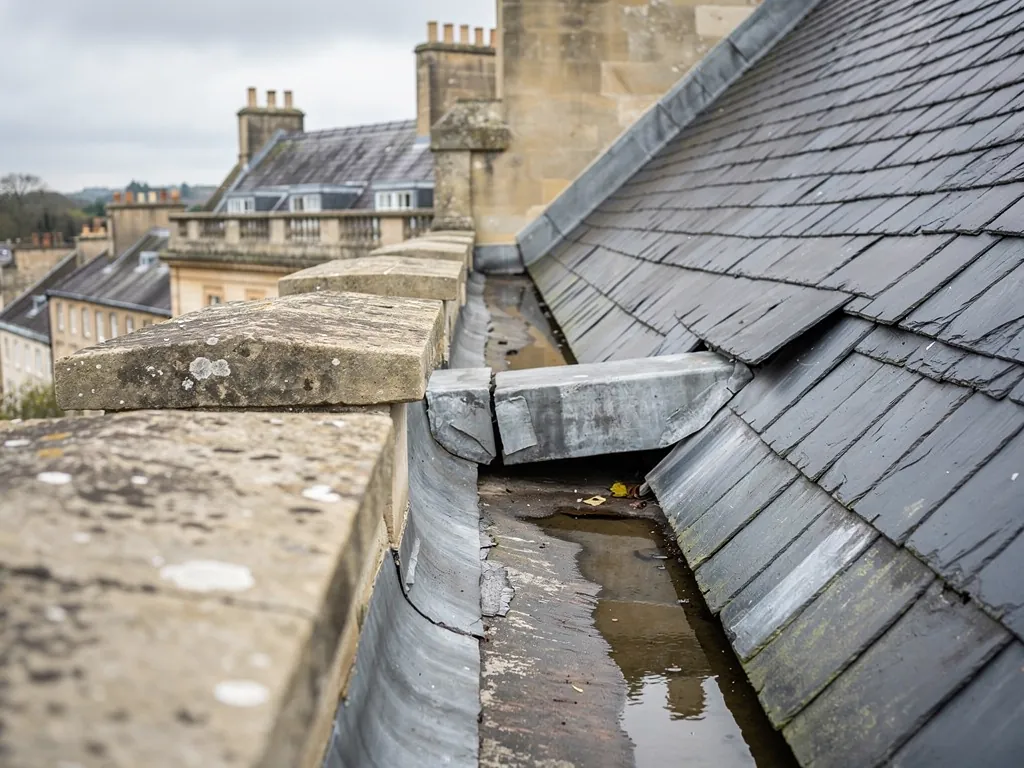
Lead and gutters on the Victorian villasBay windows, dormers and the valleys between gables all rely on lead. We look for cracks at the folds, lifted edges and gutters that run behind the parapet where a leak is invisible from the street.
Shared and converted roofsWhere a former hotel or large house has been divided, one roof serves several owners. We survey the whole thing, so the report fits a managing agent, or leaseholders acting together.

Seven hills, steep plots and difficult access

In Clevedon a roof is often reached by a steep path, not a flat drive, and that shapes both method and cost.

Build a town over seven hills and you get terraces that step up the slope, gardens at several levels and plots that are hard to get materials to. A roofing job on Dial Hill or Strawberry Hill is not the same as a job on level ground. Lorries cannot always reach the door. Scaffold needs to be tied into walls that may be on different levels at front and back. Slates and tiles have to be carried, not dropped by a lorry-mounted loader.

We plan for that at survey. Besides what the roof needs, we ask how a crew will reach it safely: whether a full scaffold is needed, where a chute can be placed so waste can come down, how much can be stored on site, and where neighbours' access has to be kept clear. Those answers feed the fixed written quote, and access sits on a separate line, so you can see exactly what it adds.

The slope also affects the roof itself. On a hillside house, one side of the building can be near ground level while the other is two or three storeys up. A roof that appears plain from the road can have a long, steep rear pitch with a valley running down to a gutter that can only be reached by tower. A leak on that side can run unseen for a long time.

Wind plays a part too. A house on an exposed shoulder of hill takes gusts from several directions. The ridge, hip and verge tiles are held on mechanical fixings under current standards, and where an older roof still has mortar-only bedding, we replace it with a fixing that does not rely on mortar. Natural slate on exposed pitches is dealt with on our slate roofing page.

Plan access first

On a steep Clevedon plot, the scaffold and the route for materials decide the programme before the roof does.

Victorian villas, bay windows and the lead that holds them together

Resort architecture was ornamental, and every ornament added a joint that must be kept watertight.

Victorian seaside building loved a feature. Bay windows, gables with decorative barge boards, dormers, turrets, porches with their own little roofs: all of these put more edges, valleys and junctions onto a single house. Each junction needs flashing, and most of the flashings are lead.

Lead lasts a long time when it is well detailed and badly when it is not. A bay window roof is usually a small lead-covered slope, and its common failure is a crack at the joint where the lead was folded. A dormer has cheeks (the side walls) and a back gutter, and any of those can leak. A valley between two gables is a gutter in its own right. We lift the covering back at each of these points, look at the lead underneath and tell you if it needs a patch, a new section or a rebuild.

Behind the parapet, the story is hidden. A parapet gutter runs in lead along the foot of a low wall across the front of a terrace. Passers-by never see it, it collects leaves and the dirt from the slates above, and when it splits at a joint, water finds its way through the masonry. The first sign inside is a stain on a front bedroom ceiling. Clearing the gutter is the first step. Checking the lead for splits at the laps and drips is the second.

On a villa that has been altered, we also look at what earlier repairs used. Sealant over a split lead, a bitumen patch over a slipped slate, a cement fillet at a flashing: these hide the original fault and often make it worse. Our lead roofing page describes the right way to do each junction.

Words you will hear

Parapet gutter
A lead-lined drain running along the foot of a front wall that rises above the slates.
Valley
The sunken line where two roof slopes meet and drain together.
Cheek
One of the two small side panels of a dormer, each needing its own flashing.
Barge board
A board fixed along a gable edge, covering the ends of the roof timbers.

The Royal Pier Hotel and roofs with many owners

When a grand building is divided into flats, the roof becomes a shared responsibility.

The Royal Pier Hotel, a Grade II listed building next to the pier, was built in 1823. It closed in 2001, fell into disrepair, and has since been converted into apartments. It is a good example of what happens to Clevedon's larger buildings: they stop being a single property and become several, and the roof becomes a shared asset.

A shared roof has its own difficulties. Every leaseholder is affected by a leak, and not every leaseholder is the one living below it. Whoever manages the building has to agree a scope that every owner can accept, a price that can be put to a vote and a report that shows why the work is needed. We write our survey for that audience: a simple description of the defects, photographs of each, a clear order of priority and a fixed price. Where the building is listed, we state what the council will need to see.

Flats also bring flat roofs. Many large Victorian buildings have been given flat sections over time, over stair towers, rear extensions and bin stores, and they are often the first part to fail. Our commercial roofing work covers larger and multi-occupancy buildings, with a survey that records access, drainage and every junction.

The same applies to hotels, guest houses and shops along the front. Commercial buildings have to keep trading while the roof is worked on, so the programme matters. We plan the order of work, the scaffold and the hours so the building can carry on, and a roof that is actively letting water in gets made safe before anything else. Planning for a seaside commercial property also means thinking about gutters and outlets that cope with heavy rain, since a blocked outlet on a flat section can cause damage quickly.

Clevedon Court, Walton Castle and the listed edge

A town with a 14th-century hall and a Grade I pier has a lot of buildings that need consent.

Clevedon has more heritage than a typical seaside town. Clevedon Court, built about 1320, is one of the few surviving 14th-century manorial halls in England. Walton Castle was built between 1615 and 1620 as a hunting lodge. The pier, rebuilt in 1986 after being dismantled, is Grade I listed. Most homes in the town are not on that scale, but plenty of them are listed or stand in conservation areas, and the roofs on them are part of the protection.

Listed building consent comes from North Somerset Council. It is a different application from planning permission, and carrying out work without it can be an offence, so it should be settled before work starts. Typically the council will want to know the covering, the method and the fixings. For repairs, we aim to retain sound material, swap failed pieces for matching ones and note each step as we go. If a house is in a conservation area but not listed, the rules differ, and the council's planning team can tell you what applies to your street.

Roof windows are a frequent question on Victorian villas, where a loft room would take advantage of the views. The rules on consent and on the windows themselves are covered in our roof windows page, and the answer for a listed or protected house will often be different from the answer for an ordinary one.

When a repair is small, a tile or a patch of lead, the work is simple. When it is large, the sequence is survey, consent, price and programme. We help with each step, give you the facts in plain language and avoid guessing at what the council will say. If it is a Building Regulations matter, such as a re-roof that crosses the thresholds, we explain it and deal with the paperwork via North Somerset building control or a registered building control approver.

1320

Approximate year Clevedon Court was built, one of few 14th-century manorial halls left in England

1869

Year Clevedon Pier opened on Easter Monday

1823

Year the Royal Pier Hotel was built

Figures: Clevedon entry, Wikipedia, checked October 2026

Map showing the location of Clevedon.

Nearby

Roofers near Clevedon

Roofing services in Clevedon

Local questions

Asked across the seven hills of Clevedon

My Clevedon house is on one of the hills and the scaffold looks awkward. How does that affect the job?

The effect is on planning and cost. It rarely decides whether the work can be done. At survey we check how materials get to the roof, where a scaffold can stand on sloping ground, and where waste can come down. Those answers decide whether a standard scaffold, a tower or a platform is the right choice. Access is shown on its own line in the written quote, so you can see what it adds.

Our Victorian bay window roof keeps leaking around the lead. Can it be fixed without redoing the whole bay?

Often, yes. Bay roofs fail at one or two joints, and a cracked fold or a lifted edge can be cut out and renewed without disturbing the rest. We lift the covering back, look at the boarding underneath and tell you whether the lead needs a patch, a new section or a rebuild. If the boarding has rotted, that is part of the repair, and we show you what we find.

I own a flat in a converted hotel building. Who decides about the roof?

Your lease and the building's management set-up decide that, and we cannot see either. Usually the freeholder or a residents' company arranges roof work for the whole building and the cost is shared. We can survey the roof and hand the managing agent an illustrated report and a fixed quote to circulate. If the building is listed, we flag the consent that will be needed.

Is there a way to check if my Clevedon street lies in a conservation area?

Ask North Somerset Council, which holds that information, and check the Historic England list if you think your house may be listed. Our survey records what is on your roof and what it needs, and we describe it in everyday words for the council. A like-for-like repair there is usually easier to agree than a change of material, and we will tell you which kind of job yours looks like.

Get your free survey

Get your free roof survey

Tell us what's happening and we'll call you back to arrange a visit. Prefer to talk? Call 01225 285181.

  • Photos of your own roof
  • A fixed price in writing
  • 10-year workmanship guarantee
Call Free survey