
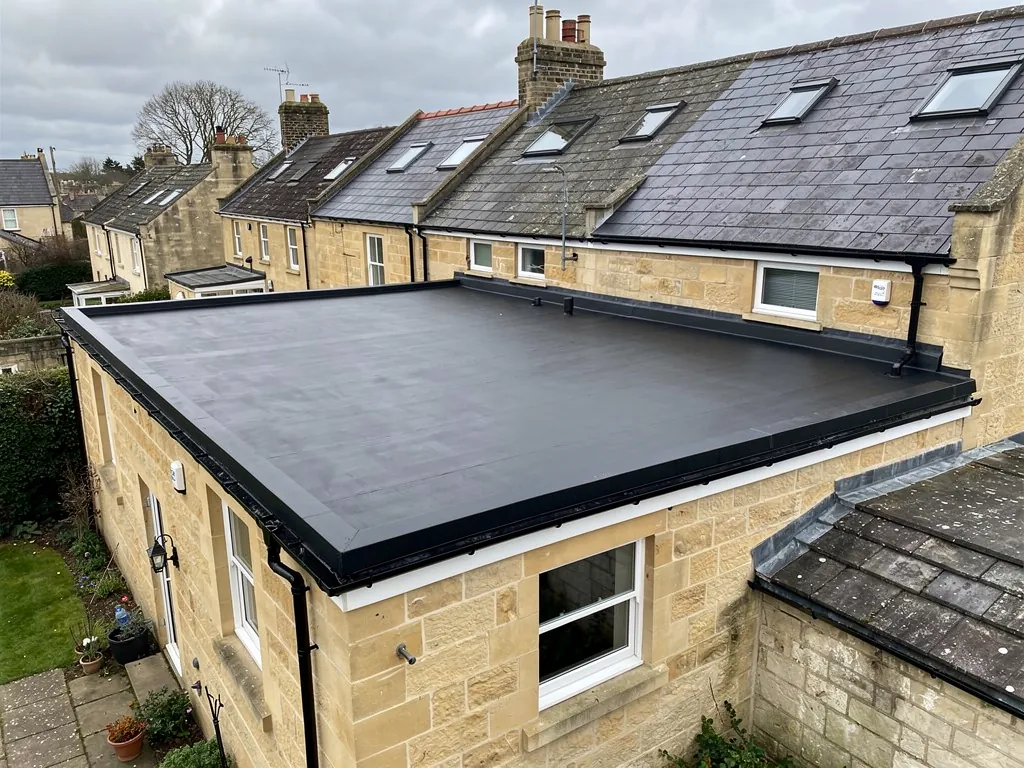
A green roof is a flat or gently sloping roof covered with living plants. On a house the usual form is a thin layer of substrate planted with sedum, a family of low, drought-tolerant succulents that tolerate a shallow soil and a hard life. It suits a rear extension, a garden room, a bin store or a bike shelter, where the roof is seen from upstairs windows more than from the street. The appeal is obvious: it softens a flat roof, holds back some of the rain and gives insects somewhere to live. The risks are less obvious. A green roof is heavier than a bare membrane, it hides the waterproofing from view and it needs looking after. Three questions decide whether one is a good idea on your building: can the structure carry it, is the waterproofing right for roots and wet conditions, and who will maintain it? This guide covers each in turn. The coverings underneath are described across our flat roofing pages.
The build-up, layer by layer
A green roof is a stack of layers, and each exists for a reason. From the structure upward the usual order is as follows.
- Deck and falls. A timber or concrete deck, laid to a fall so water is led to the outlet. Green roofs hold water, so a fall is still needed. See our flat roof fall guide.
- Insulation and vapour control. A warm roof build-up, with insulation above the deck, is the usual arrangement beneath a planted surface.
- Waterproofing membrane. The layer that keeps the building dry. On a green roof it must be rated to resist roots.
- Protection layer. A fleece or mat over the membrane that guards it from stones and from the weight above.
- Drainage layer. A moulded sheet or lightweight aggregate that carries surplus water to the outlet and stores a little for the plants.
- Filter layer. A thin fabric that stops fine particles from the substrate washing into the drainage layer and blocking it.
- Substrate. A lightweight growing medium, mineral rather than garden soil, shaped to drain freely.
- Vegetation. Sedum plugs, cuttings or a pre-grown blanket, and sometimes herbs and wildflowers in a deeper mix.
Systems for houses are normally the extensive kind, with a shallow substrate and low plants. An intensive roof has deep soil and supports lawns, shrubs or small trees, which is a roof garden and a far heavier undertaking. People asking for a green roof usually have the extensive type in mind, and that is the one this guide describes.
A proprietary system is usually supplied as a set: membrane, drainage, substrate and plants from one maker. Mixing parts from different sources makes it hard to know who is responsible when something fails.
Weight, structure and the Building Regulations
A green roof is not a light covering. The substrate and the plants are heavy when dry and heavier when soaked, and it is the saturated weight that the structure has to carry, along with wind and any snow. A roof designed only for a thin membrane and an occasional person on a ladder may have been sized with no allowance for this at all.
What the check involves
Before a green roof is specified, someone qualified checks the joists, their spans and their bearings, the beams that carry them and the walls below. The check uses the saturated weight of the proposed system, which the manufacturer publishes, not the dry figure. On an older Bath house the extension may have been built to a light specification, so the survey looks at the timbers and what they sit on, not just the roof surface. A structural engineer's calculation is the sound way to settle the question where there is any doubt. We do not guess a load on site.
Why it matters in law
Under the Planning Portal guidance for re-roofing, swapping to a substantially heavier covering, with the line drawn at a 15 per cent rise in weight, means a Building Regulations application and an assessment of the supporting structure. A green roof will normally exceed that by a wide margin when it replaces a bare membrane. A new extension has its own Building Regulations application, and the roof is part of it. Where the roof is a replacement covering on an existing flat roof, you should expect building control to be involved. The Planning Portal re-roofing page sets out the rules.
Insulation still counts
The soil layer is not insulation. Thermal performance has to come from the insulation in the build-up. Approved Document L expects a new roof element on an existing dwelling to reach a U-value of 0.15, which is why a planted roof still carries its insulation board.
Waterproofing: why the membrane matters most
The waterproofing is the one layer you cannot easily get at once the roof is planted. If it fails, the plants, substrate and drainage layers have to come off before it can be repaired. That makes the choice and the workmanship more important than on any bare roof.
Root resistance
Plant roots follow moisture, and they will probe a lap, a weld or a poorly made detail. A membrane under a green roof should be one certified by its maker as root-resistant for the system, or it should be protected with a separate root barrier. A standard felt or rubber sheet that is not rated for the purpose is a risk. The point is covered by the manufacturer of the system, and it should be in writing.
Common membrane types
Several coverings can sit beneath a green roof. Multi-layer bitumen felt with a root-resistant cap is widely used, and our torch-on felt roofs guide describes how that build-up is laid and why the fire precautions matter. Single-ply rubber and liquid-applied systems are also made in root-resistant forms. Each has strengths, and the right one turns on roof geometry and on the installer.
Upstands, edges and outlets
At every wall, edge and rooflight the membrane is turned up above the finished level of the planting, so that the substrate cannot spill over it and the plants cannot grow into the joint. Outlets sit within an inspection chamber with a border of gravel around them, so the drain stays visible and clear of soil and vegetation. A gravel strip at the edge also stops the plants spreading to the parapet or fascia.
Testing before cover-up
Because the membrane will be hidden, it makes sense to test it before the layers go on. Flood testing, where the roof is filled with water for a period and watched, is one approach. Electronic leak detection, which finds pinholes with a current across the surface, is another. Ask whether either is part of the plan. Finding a fault at this stage costs far less than finding it a year later under a mat of sedum.
Plants, drainage and what grows well
The plant choice is mostly a question of how much soil you give them. Shallow roofs suit sedums, which store water in their leaves and cope with dry spells. A deeper substrate opens the way to a mixed meadow of herbs and wildflowers, but only if the structure was designed for the extra depth.
Establishing the planting
Plants are supplied as plugs, as cuttings scattered over the substrate or as a rolled blanket that is pre-grown at a nursery. A blanket gives instant cover, and the others take a season or more to knit. Whichever form is used, the first season is the delicate one. Plants need regular watering until their roots reach the substrate, and the time of year when they are laid matters. Spring and early autumn are kinder than midsummer or midwinter.
Drainage and water storage
A green roof slows the run-off of rain, because some of it is held by the substrate and used by the plants. That is helpful, but it does not remove the need for drainage. Heavy rain still has to leave the roof, and the outlets must be sized for it. A roof that stays saturated will rot the sedums and put more load on the structure, so the drainage layer is not an optional extra.
Colour through the year
Sedum changes with the seasons. It flowers in summer in pinks and yellows, turns russet in autumn and can look dormant in a dry spell or a cold winter. Brown patches in August do not necessarily mean the plants have died, and a roofer or gardener can tell you which.
Wildlife
A planted roof attracts insects and sometimes ground-nesting birds. Nesting birds are protected, so cutting back or clearing should avoid the nesting season. The roof is not a place to find a bat roost, but if bats are known to use the building, speak to Natural England before work begins.
If you want a roof you can walk on and sit out on, a green surface is the wrong choice, and the walk-on flat roof guide explains the options for that instead.
Upkeep: what a living roof asks of its owner
A green roof is low-maintenance rather than no-maintenance. The job is less about the plants than about keeping the roof working as a roof.
- Inspect twice a year. Check the outlets, the gravel borders and the edges. Do it after leaf fall and again in late spring.
- Clear the drains. Leaves, seed heads and windblown soil collect around outlets. A blocked outlet leaves the roof waterlogged.
- Weed. Seeds of trees and grasses arrive on the wind. Pull them while they are small, because roots of woody plants can damage the membrane and the edge details.
- Feed lightly if needed. A slow-release feed in spring may help a thin planting, but a lean substrate is what keeps sedum compact, and heavy feeding encourages the wrong plants.
- Water in dry spells during establishment. After the first season, a healthy sedum roof copes with dry weather on its own in most conditions.
- Keep foot traffic to a minimum. A fragile surface should be walked on only for maintenance, and stepping stones or a path can protect it where access is routine.
Fire and vegetation
Dry vegetation burns. The usual precaution is a non-combustible margin, such as a gravel strip, at roof edges and around penetrations, and keeping the planting clear of vents and flues. Ask your roofer to explain how the roof is protected.
When something goes wrong
If a stain appears on a ceiling below, the membrane is the first suspect, and tracing the fault is harder under planting. That is why electronic leak detection and a clean record of how the roof was built are so useful. A repair means lifting the plants and layers in the area, patching the membrane, testing and replacing what was lifted. It is a small job if the fault is found early. Our guide to flat roof maintenance covers the routine checks that apply to every kind of flat roof.
Green roofs in Bath: consent, cost and when to say yes
A green roof has no sourced typical UK price in the cost guides we use, so we will not quote a rate. It is priced on survey, and the figure depends on the membrane, the drainage and substrate system, the size of the roof, any structural strengthening and the access for lifting heavy materials to roof level. Once we have surveyed, the fixed quote spells out each of those parts.
Planning and consent
A new extension needs the planning route that suits its size and position, and a green roof forms part of that design. Our flat roof planning guide describes what to check. Bath's World Heritage Site status covers the entire city, whereas its conservation area reaches roughly half, so the setting of an addition matters. Where the house is listed, the roof falls under consent rules, and B&NES Council is where to begin. A green roof is often seen as a gentle, reversible finish on a back addition, but whether it is accepted depends on the case, so ask first. Our guide to flat roofs on listed and conservation homes covers that process.
Who it suits
A green roof makes sense where the structure is new or has been checked, where the roof is seen from above and where someone will do the twice-yearly checks. It is a poor fit on an old, lightly built roof that nobody has assessed, on a roof with a lot of shade and falling leaves, or where the plan is to use the roof as a terrace. The survey tells us which side you are on, and our photographs show you the same, and where a plain membrane would serve you better we will say so. If you are leaning towards one, think about how someone will reach the roof safely for weeding and feeding, because a green roof nobody can get to soon fails.