

A Somerset village street of stone cottages with clay pantile roofs

Roofers in Camerton

Camerton is a coal village, 7.1 road miles from central Bath on the south-west side, with a medieval church at one end of its story and a country house at the other. Between those two sit the smaller houses of the mining years, and both they and the grander buildings are mended in the materials they were first built with, using the same covering each one already carries.

Local roofs

A parish church, a country house and a coal tip

Camerton has more layers than its size suggests. The parish Church of St Peter dates from the 15th century, with additions in 1638 and 1891, and it is Grade I listed. Camerton Court was built by the Jarrett family between 1838 and 1840 to a design by George Repton, and it replaced an earlier manor house. Those are the village's formal buildings. The rest of Camerton was shaped by coal.

The village grew with 19th-century mining, and Camerton New Pit closed in 1950. A coal branch line ran from Hallatrow to Camerton from 1882, and when it had closed, it was used as the setting for the film The Titfield Thunderbolt. What remains of the pit is a spoil tip called Camerton Batch, which stands in the centre of the village and became a Local Nature Reserve in 1997. The parish also takes in the hamlet of Tunley, where a hill fort is a Scheduled Ancient Monument.

For a roofer, that history is a map of building types. A medieval church roof is a matter for specialists and the diocese, but the buildings around it often share its stone and its lead. A house of the Court's period often has flat lead roofs, concealed gutters and tall chimneys. Cottages and terraces built in mining villages tend to be smaller, plainer and closer together, with shared walls, shared stacks and gutters that run along a row.

We treat each type as it deserves. We never assume a roof from its age or its street, and we give you a written scope with photographs of what we actually find on your own slopes.

Council
Bath and North East Somerset Council
From central Bath
7.1 road miles, south-west
Church
St Peter's, 15th century, Grade I listed
Country house
Camerton Court, built 1838 to 1840
Local Nature Reserve
Camerton Batch, designated 1997

What we find

Country house lead, pit cottage stacks and moss

Split lead on larger buildingsOn a larger house of the early Victorian period, hidden gutters and flat sections are often lined with lead. We look for splits at the folds, patches of sealant over old cracks and standing water, which tells us the fall has gone.
Shared stacks on the terracesA chimney stack that serves two houses is a joint responsibility. We check the pointing, the pots and the flashings on both sides, because water that enters on one side shows up as damp in the other house.
Moss, leaves and blocked outletsTrees and open ground around the Batch drop leaves and seed into gutters. Blocked outlets cause more leaks than broken ones, so we clear and test them before anything else.

Living near a Grade I church

Listing covers the building you can see and the roof you cannot, and the rules apply to neighbours' work only as far as their own listings reach.

St Peter's is Grade I listed, the highest grade, and that status belongs to the church itself. It does not extend automatically to every house nearby. What it does mean is that the setting of a listed building is something the planning authority considers, and that a roof visible from the churchyard may attract more attention than one tucked behind a barn. Whether your own house is listed is a separate question, and the answer is on the Historic England list, which you can search by address.

Should your own house carry a listing, the roof comes under it. The consent route runs through B&NES, and it is a different process from planning permission. The council's guidance tells owners to speak to its conservation team before beginning work, and describes unauthorised alterations as a criminal offence. For a roofer, the practical effect is that we describe the work to you before the price is fixed: what comes off, what goes back, what is new and why.

Like-for-like repair is the easiest category. Re-fixing a slipped stone slate, replacing a cracked ridge tile with a matching one, renewing a section of lead in the same pattern as before: these are generally the kind of thing a conservation officer expects to see. A new type of covering, a fresh roof window, a reshaped stack or a taller parapet is another matter, and we suggest you raise it with the council early.

We cannot give a legal ruling on any particular house. We can tell you how the roof is built, what is wrong with it, and what materials would keep it as it is. That gives you something concrete to take to the council, or to a conservation specialist if the building is a significant one. Our roof inspections page describes the survey that provides the evidence.

Myth

A Grade I church next door means my roof is listed too.

Fact

Listing applies to each building on its own entry; the church's grade does not pass to neighbouring houses, though a setting can still matter to the planning authority.

Lead roofs and hidden gutters on a country house

Houses of the Camerton Court period were built with flat lead and concealed channels that decide how well the whole roof keeps dry.

Camerton Court was designed in the late 1830s, and houses of that date and ambition often hide their drainage. The roof looks like a pitched slate or tile slope with a parapet or a deep eaves line, and behind that wall runs a lead-lined channel carrying the rain to a downpipe. That is a parapet gutter. Where two slopes meet at a low point, the channel between them is a box gutter or a valley, depending on how it is built. Flat roofs over a bay, a porch or a link between two wings are also lined with lead.

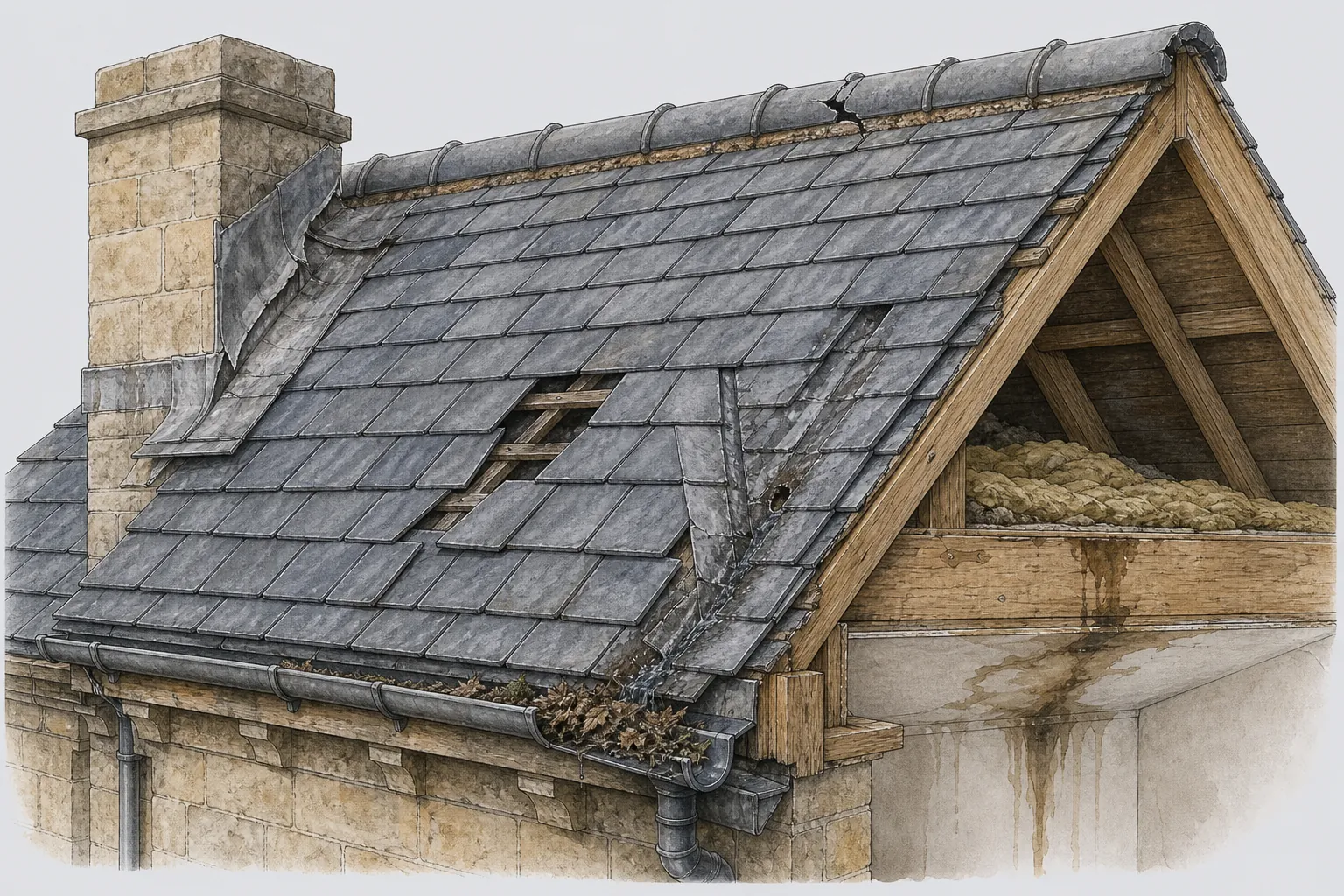
Lead is a long-lived material, but it is not indefinitely forgiving. Sheets expand in the sun and contract at night, so they are laid with rolls and drips (steps in the surface that let each sheet move independently). If the sheets are too large, or fixed too tightly, the metal creeps and splits, usually at a fold. Cracks develop slowly and are often hidden by moss or leaf litter. The signs inside the house are stains on a ceiling below a gutter line, or damp in the top of a wall.

Repairs fall into three groups. A split in a sound sheet can sometimes be mended with a lead patch, properly welted, not smeared with sealant. A run of tired lead needs relaying in new sheets. A gutter with a failed fall may need the timbers beneath it adjusted before new lead is laid. Sheet lead is graded by lead code, a number tied to thickness, and the grade suits the detail and the span, so we name it in the written scope.

All of this work is slow to do well and quick to do badly, which is why the detail on a large house deserves care. We describe the principles on our lead roofing page, and we show what we find on your own roof in photographs before we talk about price.

Words you will hear

Parapet gutter
A lead gutter hidden behind the wall at the edge of a roof.
Box gutter
A lead gutter sunk between two slopes or against a higher wall.
Lead code
A number that grades sheet lead by its thickness.
Drip
A step in a lead roof that lets water run off one sheet onto the next.

The miners' terraces and pit cottages

Terraced rows share walls, stacks and gutters, so repairs to them have to be planned along the row.

When mining took hold in Camerton, the village expanded to house the people who worked the pits. Camerton New Pit closed in 1950. Where cottages and terraces of the mining years survive, they tend to be small buildings, closely packed and often joined, and their roofs have been patched by successive owners.

The common problems are the shared elements. Where a stack straddles the party wall it serves two houses at once, and its pointing, pots and flashings concern both owners. A gutter running along the front or back of a terrace may belong to no single house. A roof slope can be repaired in sections by different people, so it ends up with several types of tile or slate. The simplest advice on a terrace is to talk to your neighbours early and look at the whole row.

On a survey we start at the stack and work outward. We check the flashings, the soakers along the gable, the ridge and the verge, then move to the eaves and the gutter. A soaker is a bent piece of lead, one under each course, that tucks beside a wall or stack and steers water back onto the slope. When a flashing is rebuilt, the soakers often need renewing as well, since their condition can only be seen when the course above is lifted.

Small roofs have an advantage, and it is worth using. Because the slopes are short, the whole row can often be surveyed from a single scaffold lift, which keeps the cost of access down. They are quick to scaffold and quick to re-cover, and a repair that suits one house can often be repeated across the row, saving time and keeping the roofline consistent. Where a house has lost its original covering, we propose a replacement that looks right beside its neighbours. Our chimney repairs page covers the stack work in detail.

Trees, moss and the ground around the Batch

Open ground and old woodland edges put debris on roofs and into gutters, and the work there is mostly about keeping water moving.

Camerton Batch is an old coal spoil tip, now a Local Nature Reserve, and it sits in the middle of the village. Around it and across the wider parish, including the hamlet of Tunley, there is open ground, hedgerow and tree cover. That is good for the village and a steady source of leaves, seeds and moss for roofs and gutters.

Moss itself does little harm on a sound roof, but it holds water against tiles and slates, and in a cold winter that water freezes and flakes the surface. Heavy growth along a gutter line blocks outlets. Tree roots do not reach roofs, but branches overhanging a slope rub the covering, drop leaves into valleys and trap damp. A valley choked with leaf mould can overflow behind the covering and rot the batten ends, which is a repair that costs far more than a seasonal clear.

Gutters are the first thing to check after autumn. We clear them by hand, flush the outlets and check each joint and bracket, because an overflow on a stone wall leaves a stain that can take a long time to dry. Where the fall has settled, we reset the run, because a gutter that holds a puddle will fill with silt and soon overflow again. It is a small job that protects the wall, the fascia and the rafter ends beneath, and it is far cheaper than repairing damp stone after a wet winter.

Wildlife is part of the picture. Bats and nesting birds are protected, so signs of either mean we stop and take advice before touching the area. Cleaning is another judgement call, since a pressure wash can damage delicate tiles. Our inspection service looks first and recommends the gentlest method that works. MyBuilder's 2026 guide puts typical UK inspection costs between £150 and £500, depending on the type of survey. Any repair that follows is priced separately, in writing.

Clean or leave

Clear gutters and valleys every year, but leave light moss on a sound roof unless it is holding water against the covering.

Map showing the location of Camerton.

Nearby

Roofers near Camerton

Roofing services in Camerton

Local questions

Camerton queries from the church to the Batch

Does the Grade I status of St Peter's affect roofing work on nearby houses in Camerton?

Only where your own house carries a listing or sits in a setting the council wants to protect. The church's grade belongs to the church. Check the Historic England list for your address, and if the house is listed, phone the conservation team at B&NES before ordering anything. We can supply a precise description of the work for that conversation.

Our house was built around the time of Camerton Court. Is the lead on the roof likely to be original?

It could be, but it may also have been renewed once or twice since. Lead that old tends to show thinning and splits at folds. We lift the covering at the edge, look at the underside and the fixings, and tell you in writing whether it can be patched or needs replacing, with photographs of what we found.

Can you work on one house in a miners' terrace without disturbing the neighbours?

Yes, with planning. Scaffold goes up on your house only, and we agree access, working hours and tidiness first. Where a stack or gutter is shared, we recommend a word with the neighbour before the work begins, because a fault on one side usually affects the other.

We live near the Batch and our gutters fill with leaves each autumn. What helps?

Regular clearing is the base, and we can fit guards where they suit the gutter. Check the valleys and the lowest courses too, since leaf mould collects there. If water has been overflowing, we look at the batten ends and the felt below the first course for damp, because that is where unseen damage starts.

Get your free survey

Get your free roof survey

Tell us what's happening and we'll call you back to arrange a visit. Prefer to talk? Call 01225 285181.

  • Photos of your own roof
  • A fixed price in writing
  • 10-year workmanship guarantee
Call Free survey