

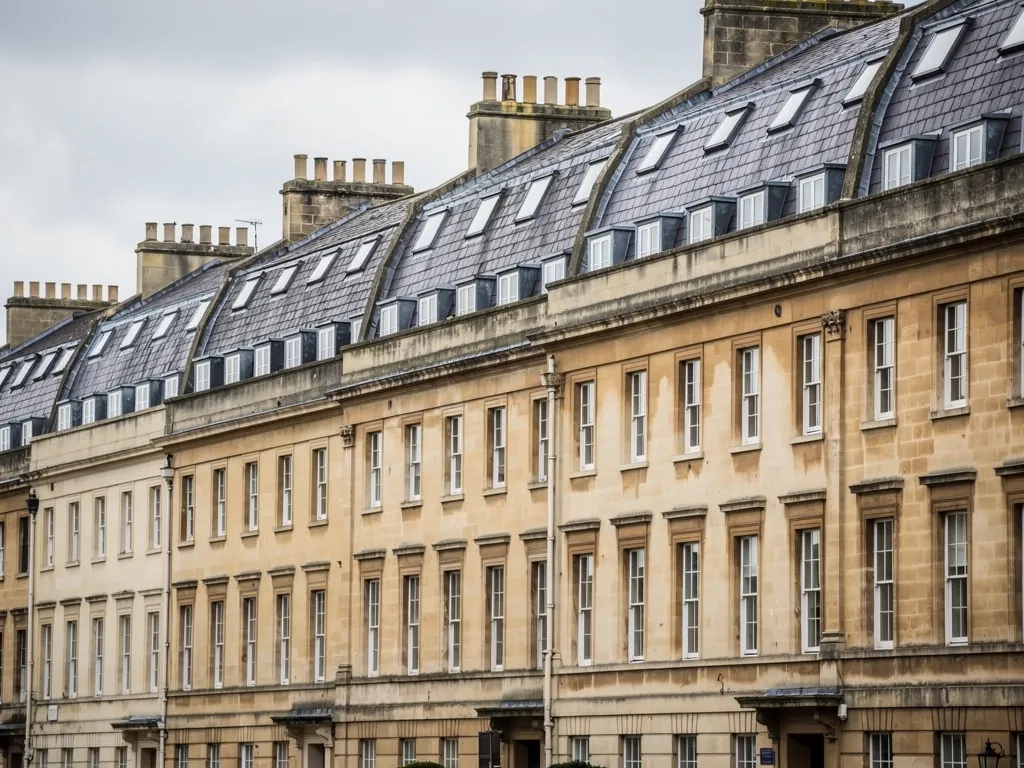
Bristol Victorian terraced houses with slate roofs and bay windows on a hill

Roofers in Chipping Sodbury

Chipping Sodbury is 15 road miles north of Bath, an old market town on the Cotswold edge where a medieval cross shaft stands in a centre that also holds a town hall remodelled in 1858. We work on the roofs behind the frontages, house and commercial alike, and we put a fixed price on paper once the survey is done.

Local roofs

A market town on the edge of the Cotswolds

Chipping Sodbury was founded in the 12th century by William le Gros, and the word Chipping in its name comes from Old English and means that a market was held there. The town has kept the character that implies: a working centre where buildings of different ages stand shoulder to shoulder. Its ward is called Chipping Sodbury and Cotswold Edge, and the Cotswolds rise to the east of the town.

Two landmarks mark its history. The Town Hall, now an events venue, was remodelled in 1858, and the Town Cross stands on top of the 1919 War Memorial with a medieval socket base and shaft. To the east, the Chipping Sodbury Tunnel was opened by the Great Western Railway in 1902 and runs under the Cotswolds. It is notorious for flooding in wet weather.

That last fact is a useful reminder for anyone with a roof in the town: water goes somewhere, and where it goes matters. In a place with a long-established centre, the question is often less about the covering than about how rain leaves the building, through valleys, gutters, hoppers and downpipes that may be shared with the neighbours.

We survey each roof before advising on it. The visit is free, it includes photographs of what we find, and the price we give you afterwards is fixed in writing.

Council
South Gloucestershire Council
From central Bath
15 road miles, north
Founded
12th century, by William le Gros
Town Hall
Remodelled in 1858, now an events venue
Town Cross
On the 1919 War Memorial, medieval socket base and shaft

What we find

Trapped water and low roofs behind the frontage

Roof water with nowhere to goBlocked outlets, undersized downpipes and gutters that fall the wrong way turn an ordinary shower into a leak. We trace the route water takes from slope to drain, and we test it by running a hose when we can.
Rear and low-slope roofs behind frontagesTown-centre buildings may have a rear extension or flat section that nobody sees from the pavement. We examine the covering, the perimeter and the line where it meets the main wall, since that is where such roofs begin to give.
Lead and slate of Victorian ageVictorian roofs rely on lead in valleys, flashings and gutters, and on slate fixed with iron nails. We look at lead for splits and fatigue, and at slates for the rust-stained nail holes that show a course is slipping.

Behind the frontage: town-centre roofs

A market town's roofs are shared with neighbours, hidden from the road and hard to reach, and that shapes how repairs are done.

In the centre of an old market town, buildings are close together and often serve more than one purpose. A property might have a shop or office at street level and a home above, or sit as part of a terrace whose roof runs over several owners. The roof you see from the pavement is the front slope. The rest may be a rear pitch, a flat extension and a run of gutters that nobody has looked at together.

Shared roofs need a clear scope. If a valley or a party-wall flashing leaks, the cause may belong to the neighbour's side, and a repair to one half will not cure it. We survey the whole line where we can reach it, report on which parts belong to your building, and explain where the work stops. That is useful to a managing agent, a landlord or a freeholder who needs a single document to circulate.

Access is the practical limit. A High Street building may have no rear lane, which means scaffold on the pavement, a licence from the highway authority and careful timing around deliveries and customers. We plan those details at the survey and tell you what permissions are needed, so there are no surprises on the first morning.

Commercial roofs are priced on survey. The covering, the access, the insulation, the edge details and the drainage all vary, and a quote from the road would be a guess. Our commercial roofing service sets out the systems we work with, and any low-slope section behind a frontage is dealt with under flat roofing.

If you manage a property with several tenants, ask for the report in a form you can pass on. A clear list of defects, in order of urgency, with photographs, makes decisions between owners much quicker.

The 1858 Town Hall and Victorian roofs

Victorian civic and commercial roofs depend on slate, lead and iron, and each of the three ages in its own way.

Chipping Sodbury Town Hall was remodelled in 1858 and is now an events venue. A building of that age and scale is a useful model for what a Victorian roof demands. Roofs like it typically combine valleys, parapets, a long run of slate and a good deal of lead, and where the building is in public use, any work has to fit around the people who use it.

Slate is durable but its fixings are not. Victorian slaters used iron nails, and iron rusts. A course of slates that was sound in 1900 may be held now by a few corroded stubs, and the first sign is a slate that slides a centimetre or two. Where that is happening across a slope, patching one slate at a time becomes expensive and ineffective, and the fairer option is a full re-slate: sound slates saved and relaid, new fixings, and fresh battens and underlay beneath.

Lead has its own pattern. It lines valleys and gutters and covers flashings, and its weakness is fatigue: after a century of expansion and contraction it can crack along folds and at laps. We look for splits, pinholes and patches of mastic that someone has used to hide them. Lead sheet comes in grades known as codes, with the heavier codes used where the exposure or the risk of damage is greater, and the right one depends on where it is laid. We do not guess at a code from the road.

Matching is the principle throughout. Slate stays slate, and replacement slates come in a matching size, colour and grade. Our slate roofing service describes how we do that, and the metalwork is covered under lead roofing.

Where a roof is part of a venue, we agree working hours and areas around the building's calendar, so repair does not stop the hall earning its keep.

Words you will hear

Lead code
The numbered grade of lead sheet, with heavier codes used on more exposed or harder-wearing work.
Soaker
Little lead tab interleaved with the slates along a wall or chimney side.
Tingle
A lead or copper strap that holds a slipped slate in place where a nail has failed.

Where the water goes

A tunnel under the Cotswolds that floods in wet weather is a reminder that drainage decides how a building copes with rain.

The Chipping Sodbury Tunnel, opened in 1902 and running under the Cotswolds, is notorious for flooding in wet weather. It has nothing to do with your roof, but it makes a useful point. Rain that falls on a hill has to go somewhere, and when the route is blocked or too small, it finds another. On a building, that other route is usually through the wall, the ceiling or the foundation.

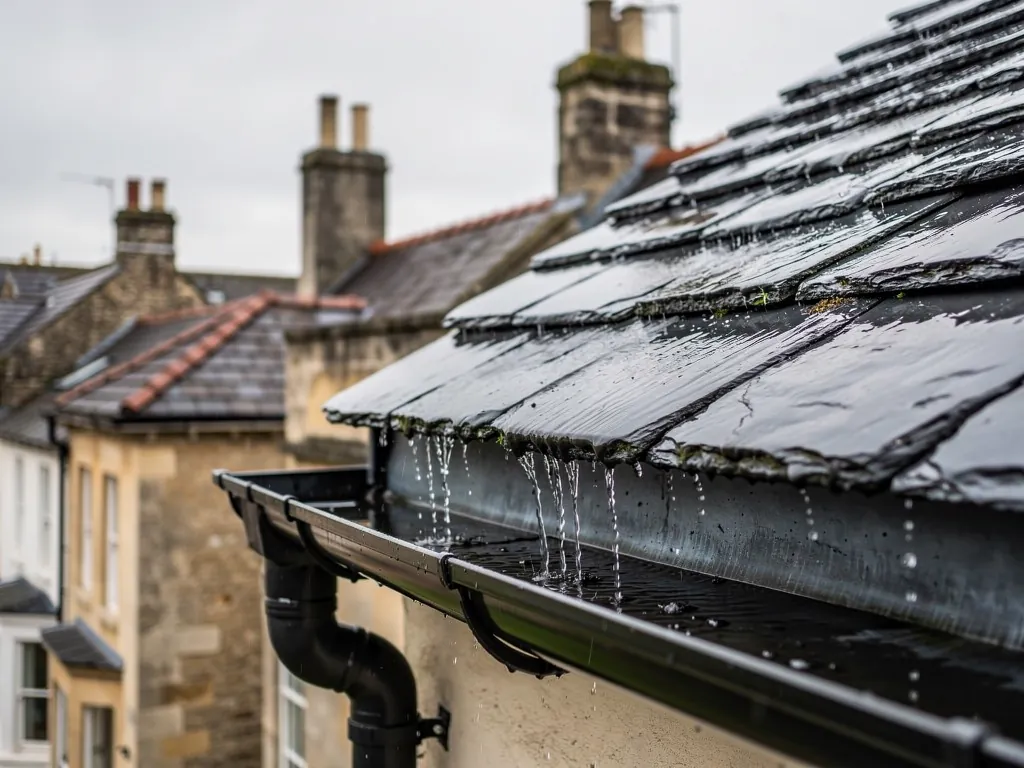
The roof's drainage has four parts. Gutters collect the water at the eaves. Outlets pass it into downpipes. Downpipes carry it to the ground. A drain or soakaway takes it away. If any one is wrong, the others fail with it. A gutter fitted without enough fall holds a pool and overflows at the back. A downpipe with a blocked bend backs up in a downpour. A box gutter between two roofs can overflow into the building if its outlet is smaller than the water it receives.

We check each part. We look for stained walls below the gutter line, for green growth in the joints, for brackets that have pulled away and for outlets choked with leaves. Where a section is damaged or the fall is wrong, we replace it. Where the whole run has aged, it is often cheaper to renew it than to keep mending joints. As a yardstick only, MyBuilder (2026) reports typical UK guttering costs of £30 to £70 a metre, scaffold extra on taller buildings. What you pay is fixed after we have surveyed.

Choice of material matters too: plastic, aluminium and cast iron each suit different buildings, and an old building often looks best with the material it started with. The choices are laid out under gutters, soffits and fascias.

Do not wait for a flood to test the system. After a long dry spell, one clear look at the outlets, and a bucket of water along the gutter, shows whether it is ready for autumn.

Myth

Gutters only matter if they are visibly leaking.

Fact

A gutter that overflows only in heavy rain can soak a wall for years before any stain shows indoors, so its outlets and falls are worth checking before the wet season.

The Cross, the centre and consent

In a town with medieval roots, find out the status of your building before you plan work on its roof.

The Town Cross, a medieval socket base and shaft set on the 1919 War Memorial, is a reminder that the centre of Chipping Sodbury has been in use for a very long time. Many of the buildings around it will be old, and some will carry legal protection. Finding out which comes first, because the answer decides who you speak to and what you can do.

You can check whether a building is listed on the national list held by Historic England. On conservation area status, and on any direction that limits what needs no permission, South Gloucestershire Council is the body to ask. The council is also the body that grants listed building consent, which is a different approval from planning permission and is needed before work that alters the character of a listed building.

In practice, a repair that uses matching materials and the same methods is the easiest to agree. Changing a covering, adding a rooflight or rebuilding a parapet needs more discussion. Roof windows have rules of their own, covered under roof windows and not repeated here.

Building Regulations are separate again. A small re-cover seldom needs approval, a bigger one does, and so does a move to a covering weighing 15% more than the old. When a job is notifiable, the council's building control service or a registered private approver handles it, and we prepare the paperwork.

Our workmanship comes with a ten-year written guarantee. Before any work starts you will have a scope, photographs and a fixed price, so that you and any freeholder or committee can see exactly what is agreed.

Check status first

Before planning roof work in the centre of Chipping Sodbury, confirm listing and conservation status with the council.

Map showing the location of Chipping Sodbury.

Nearby

Roofers near Chipping Sodbury

Roofing services in Chipping Sodbury

Local questions

Behind the Chipping Sodbury frontages, owners ask

A shop with flats above in the centre of Chipping Sodbury has a flat rear roof. How is that kind of job priced?

On survey, since a rear flat roof depends on its area, its covering, how the edges are finished and how we reach it. For orientation, MyBuilder (2026) gives typical UK flat roof prices per square metre as bitumen felt at £70 to £100, EPDM at £90 up to £130 and GRP between £95 and £150. After the visit comes a fixed price on paper.

The railway tunnel east of the town floods in wet weather. Should I upgrade my gutters for the same reason?

The tunnel and your gutters have no mechanical link, but wet weather is a good prompt to check the drainage you already have. Look at outlets, falls and downpipe joints. We replace what is damaged and suggest larger capacity only where the roof's area and the pipe sizes really call for it.

Can a venue in a Victorian building stay open while its roof is repaired?

Often, with planning. We agree working areas and hours around your calendar, keep scaffold and storage out of public routes and phase the work so the busiest rooms stay dry. We cannot promise that every job allows full opening, but we discuss it at the survey.

What does a roof survey cover on a Victorian building in the centre of town?

We look at the slate and its fixings, the lead in valleys and gutters, the flashings, the chimneys and the drainage, and we check the loft or roof void for damp and timber condition. The report lists defects in order of urgency with photographs, and the price follows.

Get your free survey

Get your free roof survey

Tell us what's happening and we'll call you back to arrange a visit. Prefer to talk? Call 01225 285181.

  • Photos of your own roof
  • A fixed price in writing
  • 10-year workmanship guarantee
Call Free survey