

Bristol Victorian terraced houses with slate roofs and bay windows on a hill

Roofers in Yate

Yate lies 14.5 road miles north of Bath's centre, and it grew in stages that are still readable from the street: the 1920s, the 1950s, the 1960s and the traditional streets of the late 1980s. Each stage was built differently and ages differently, so we judge a roof by what the survey finds and not by the date on the estate plan.

Local roofs

A town built in layers

Major growth in Yate began in the early 1920s with the Moorland Road estates behind Station Road, and the Ridge housing estate followed in the 1950s. Much of the 1960s housing in the south was planned on the Radburn model, with green spaces and linking paths at the front of the houses. By the late 1980s and early 1990s, planners had reverted to traditional street design for the rest of North Yate, Brimsham Park and the Newmans factory site.

Older things sit among the estates. Yate's parish church, St Mary's, dates from Norman times, was altered in the 15th century and was extensively restored in 1970. Yate Town Council meets at Poole Court, a converted Victorian mansion house. Celestine was mined here from the late 1880s, and at one time the town's celestine accounted for 95 per cent of world production.

For roofing, the useful point is that Yate is a town of large, repeating estates. Houses built in the same few years share their details, so what turns up on one roof is a useful pointer for the next street. It also means that whole neighbourhoods age together, and the same job tends to fall due on many roofs at roughly the same moment.

Each visit starts with a survey, which is free and comes with photographs of your roof, and the price that follows it is fixed in writing.

Council
South Gloucestershire Council
From central Bath
14.5 road miles, north
Early growth
Moorland Road estates, early 1920s
Ridge estate
Built in the 1950s
Council meets at
Poole Court, a converted Victorian mansion

What we find

Tired felt, loose ridges and shaded slopes in Yate

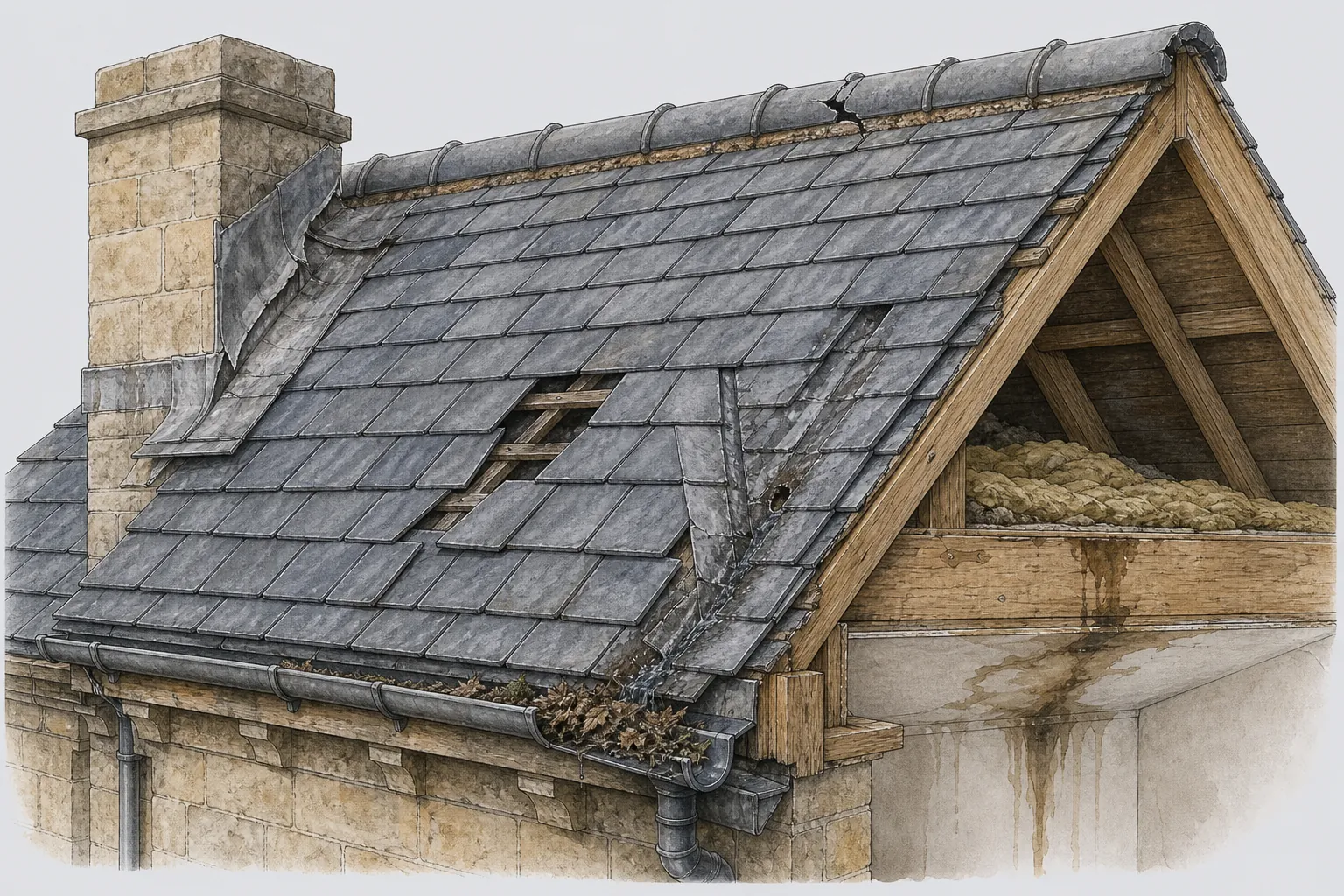
Felt that has outlived its tilesOn roofs of the 1950s, the tiles can be sound while the felt beneath has dried, cracked or sagged. We raise a few tiles at the lowest course, inspect the felt from the loft side and say whether a strip-and-relay is needed or an eaves repair will do.
Loose ridges and tired vergesRidge and verge mortar cracks with age on every estate in town. We look for gaps, hairline splits and tiles that move under a gloved hand, and we check whether the tiles are also mechanically held.
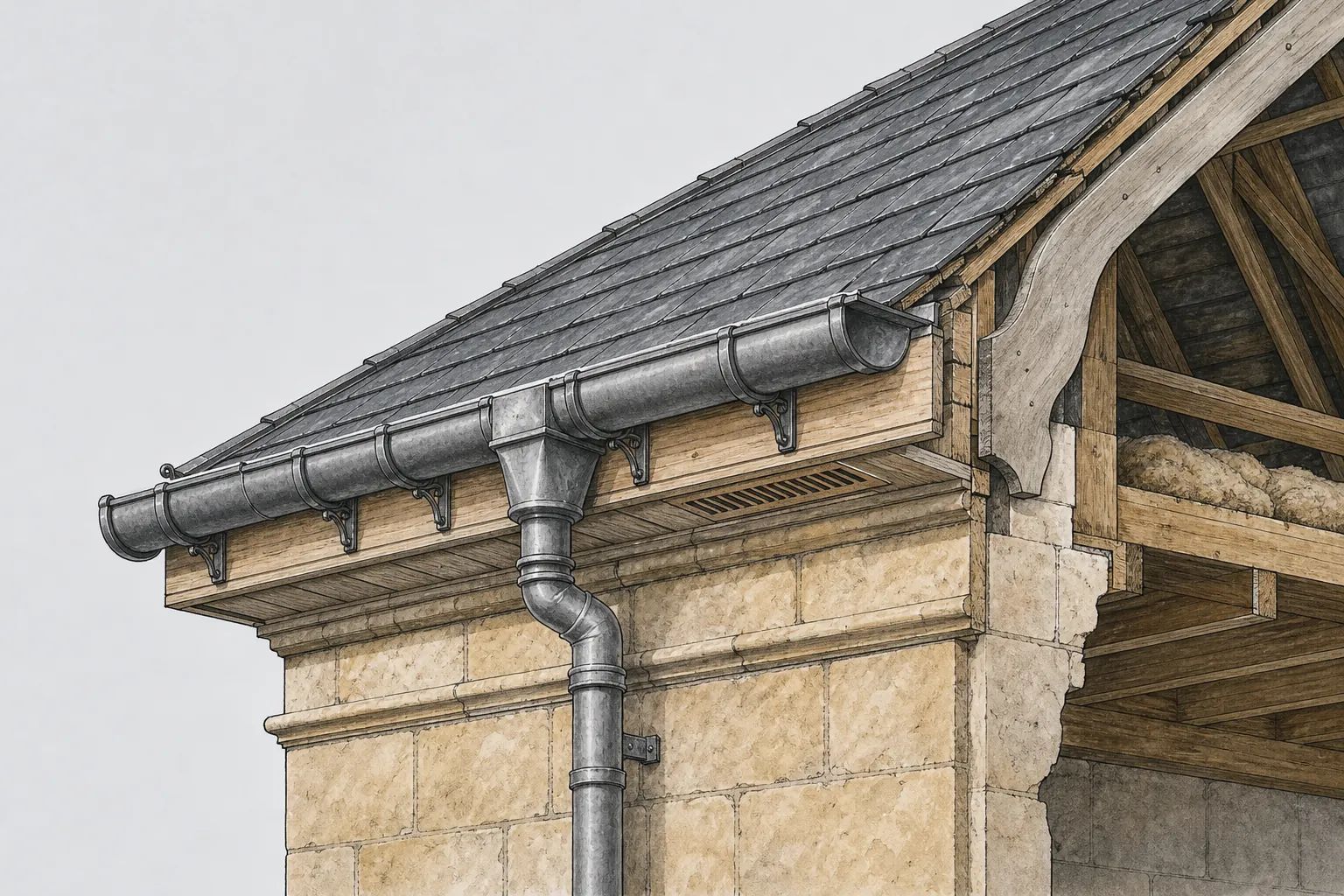
Gutters, moss and shaded slopesWherever trees or tall hedges stand close to a roof, moss builds on slopes that stay damp and leaves fill the gutters. We clear what has to be cleared and note what is causing it.

Moorland Road, the Ridge and the early estates

The 1920s and 1950s estates are now roughly a century and seventy years old, and their roofs are on their second or third life.

The Moorland Road estates behind Station Road, begun in the early 1920s, and the Ridge estate of the 1950s mark the start of Yate's major growth. A roof laid when either was built has had a long time to wear, and many of the houses will have been re-covered, patched or altered since. So the first question is not what the roof was, but what sits on it today.

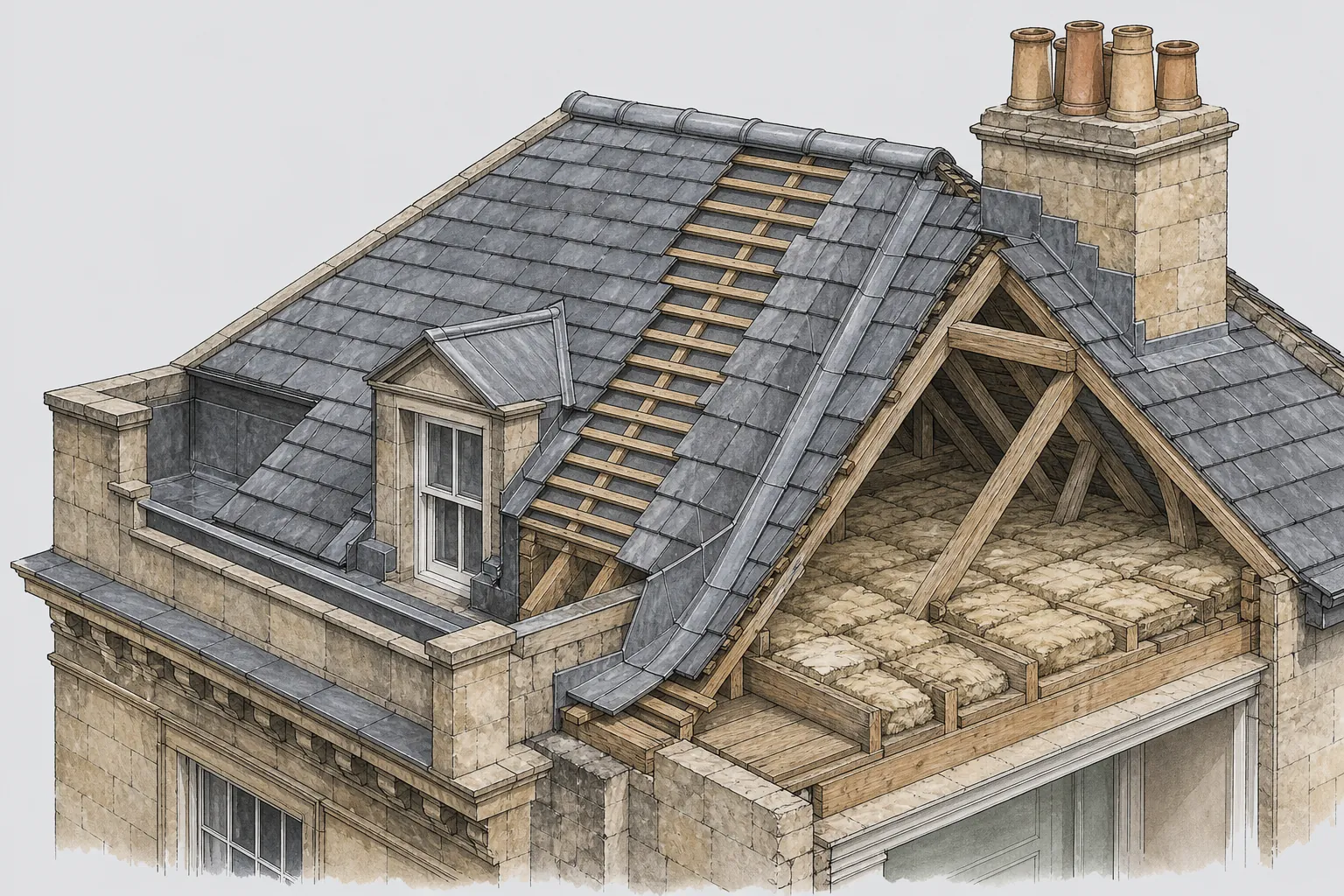
We look at three layers. On top is the covering, which may be original or a replacement, and may include repairs in tiles that do not quite match. Beneath it, the battens, the thin timbers across the rafters that the tiles hook onto, carry every nail, and where those have dried or split the tiles slip. Beneath the battens is the underlay, the sheet that drains off whatever the tiles let through, and on a roof of this age it is often the part that has failed first.

A roof can fail in its covering while the timbers are healthy, or the other way about. A tile covering over perished felt can look sound from the road and still leak at the eaves in heavy rain. Equally, a patchwork of old repairs on the surface can sit over a perfectly sound frame. We look at both and report which it is.

If the answer turns out to be a new covering, the rules come into it. A modest job can usually proceed without Building Regulations approval, but a bigger one cannot, and a roof renewed to that extent may need its insulation brought up to current standards. We explain which case you are in before pricing. The planning of a whole new covering is laid out under roof replacement, and repairs short of that sit under pitched roofing.

On a 1920s or 1950s house it is often cheaper to repair the eaves, reset the ridge and renew the flashings than to strip the whole roof. We say which route the evidence supports.

Radburn layouts and the problem of access

When green spaces and paths run at the front of the houses, getting scaffold and materials to the roof takes planning.

Much of Yate's 1960s housing in the south was planned on the Radburn model, with green spaces and linking paths at the front of the houses. The idea was to separate people from traffic, and it works as a place to live. It also changes how a roofer reaches a building, since vehicles may not be able to pull up at the door, and the route from lorry to roof may run across a path, a grass verge or a shared space.

Access is a real cost driver on any roofing job. Scaffold has to stand on safe, level ground and meet the edge of the roof. Materials have to be carried or lifted from wherever the lorry can stop. Waste has to come down and go away. On a Radburn layout, each of those questions has an answer that varies from house to house, and we work them out at the survey and not on the first morning of the job.

Neighbours are part of the plan too. In a closely linked layout, scaffold may cross a boundary, a path may need to stay open, and a skip may need a licence if it sits on a public highway. We tell you in advance what we need and who needs to be told, and we leave the site cleared and the waste taken away at the end.

The roofs themselves are of their time. Houses of the 1960s may have shallower pitches, flat or low-slope sections over porches and linking structures, and covering types that have since changed. If a section is flat, the work is a different trade with different materials, and our flat roofing service covers it. For pitched sections, the same survey applies as anywhere else.

Planning the logistics early is worth the effort. It is the difference between a job that runs smoothly and one that is held up by a path that cannot be closed or a lorry that cannot stop.

Plan access first

On a Radburn-style layout, settle where the scaffold stands and the lorry stops before you settle the price.

North Yate, Brimsham Park and the Newmans site

Streets laid out in the late 1980s and early 1990s now have roofs more than thirty years old.

When planners returned to traditional street design in the late 1980s and early 1990s, the new housing at North Yate, Brimsham Park and the Newmans factory site went up on ordinary traditional streets. The roofs there are now more than thirty years old, which is old enough for the weak points to have shown themselves.

The weak points sit at the edges and the joints. Ridge tiles and hip tiles, which cap the high line and the sloping corners of a roof, were commonly bedded in mortar, and that mortar crumbles. The British Standard for tiling, BS 5534:2014, expects bedded ridges and hips to have mechanical fixings, so when we re-bed we add them. Dry-fix, in which caps and clips hold the ridge, hips and verge and there is no mortar bed at all, is often the neater answer on a concrete-tiled roof.

The verge, where the tiles finish at a gable wall, gets the same treatment. Failed mortar there allows wind to get at the end tiles, and the damage spreads along the course. When a patch will do, and when a full system is the better use of money, is explained under ridge and verge repairs.

Moss is the other regular visitor. On slopes that stay shaded and damp, moss keeps the surface wet, and if left it lifts and cracks tile edges. Cleaning is sometimes the right call and sometimes only a delay, so we check the condition of the tiles first. Some hard methods can damage the surface of older tiles, so we choose gently.

The long-term answer on a 30-year-old roof is rarely drastic. It is a regular look at the ridge, verge and gutters, and early repair where something has moved. A roof kept in that condition can go a long way before it needs replacing.

Words you will hear

Hip
The sloping ridge-like line at an outward corner of the roof.
Verge
Finished edge of the tiling beside a gable.
Dry-fix
Ridge or verge held by caps and clips and no mortar, tested to BS 8612:2018.
Course
One horizontal row of tiles or slates.

St Mary's, Poole Court and larger roofs

Older civic buildings and large premises need a scope that a committee or a managing agent can agree.

Yate's older landmarks sit among its estates. St Mary's Church dates from Norman times, was altered in the 15th century and was extensively restored in 1970. Poole Court, the Victorian mansion where Yate Town Council meets, has been converted for its present use. Both are the sort of building where a roof is decided by a group of people and not one owner.

That changes how the work is prepared. A committee, a church council or a managing agent needs a written scope that anyone can read: what is wrong, where, what is proposed, in what materials, and what it costs. We provide that after the survey, with photographs referenced to the report, so each member can see the same evidence. A fixed price in writing helps a group make a decision and keeps the work from drifting.

Older roofs on civic and church buildings are often large and high, with lead valleys, parapets, steep slopes and stonework or brickwork that is hard to reach. Scaffold can be the largest single cost, which makes it sensible to combine repairs into one visit and not several. We list what can be done while access is in place.

Should a building be listed, South Gloucestershire Council is the body that grants consent for changes. A building does not need to be historic to be a larger project: commercial and shared roofs in the town are priced on survey, because system, access and edge detail vary so much. Our commercial roofing service describes how we approach a larger building.

Whatever the building, the principle is the same as on a house. We repair where repair works, match the existing material, and tell you directly where a repair would only delay the inevitable. Our workmanship carries a written ten-year guarantee.

1920s

Moorland Road estates begin the town's major growth

1970

Year St Mary's Church was extensively restored

Late 1880s

When celestine mining began in Yate

Figures: Wikipedia article on Yate

Map showing the location of Yate.

Nearby

Roofers near Yate

Roofing services in Yate

Local questions

Every stage of Yate, from the 1920s onward, asks

My house is on the Ridge estate. Is a roof from that era likely to need new felt or just a ridge repair?

It depends on what the loft shows. The tiles from that period are often sound, and the underlay beneath is what has aged. Where the felt is intact apart from the lowest course, an eaves repair and a reset ridge may be all it needs. Where it has gone across the whole slope, the covering has to be lifted so the battens and felt can be renewed beneath it.

Can you get scaffold and materials to a house with a footpath at the front?

Usually, with planning. On a Radburn-style layout we check where the scaffold can stand, where the delivery can stop and whether a path must stay open, then we tell you what we need. If a skip or scaffold will sit on a public highway, a licence is part of the plan.

Do roofs built in the late 1980s need attention yet, or is that too early?

Roofs of that age are usually due a proper inspection, not a replacement. Ridge and verge mortar, flashing and gutters are the first parts to show wear, and fixing them early often delays any bigger job for years. A survey will tell you which parts need work now and which can wait.

How is the price for a larger or commercial roof in Yate worked out?

Commercial roofs are priced on survey. System, access, insulation, edge detail and drainage vary too much to quote from the road. After the survey we give a fixed written price with a scope that a landlord, committee or managing agent can circulate.

Get your free survey

Get your free roof survey

Tell us what's happening and we'll call you back to arrange a visit. Prefer to talk? Call 01225 285181.

  • Photos of your own roof
  • A fixed price in writing
  • 10-year workmanship guarantee
Call Free survey