
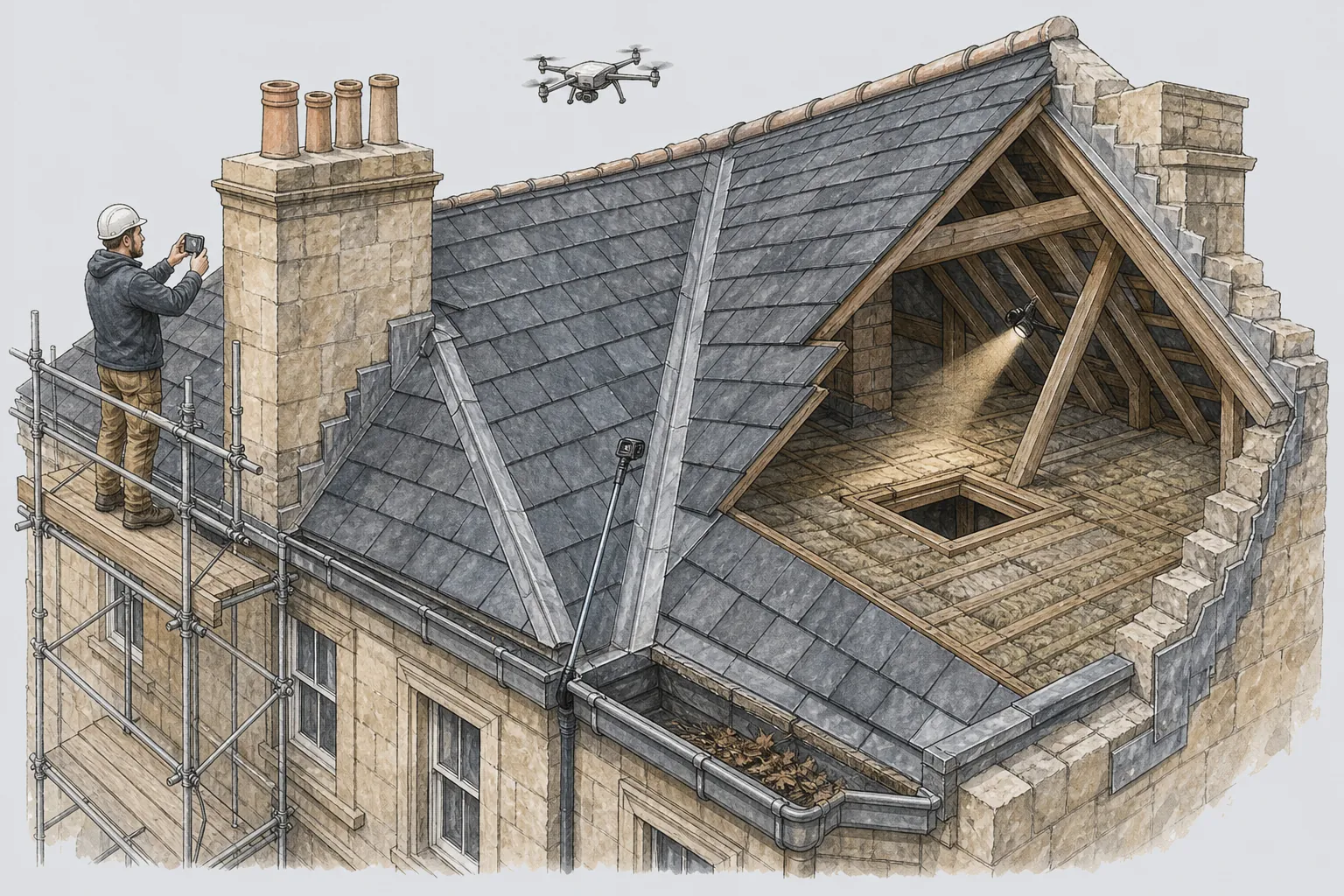

Georgian terrace of honey Bath stone with natural slate roofs and chimney stacks

Roofers in Lyncombe

Lyncombe is a valley district 0.6 road miles south-east of central Bath, named for the stream that runs through it. Water is the theme of its roofs: how it comes off them, where it goes, and what happens when the gutters cannot cope.

Local roofs

A valley, a stream and a spring

The name Lyncombe comes from the Celtic word cwm, a valley, and Lyn, the name of the stream that runs through it. That is a useful thing to know before you look at a roof here, because everything about the district follows from the shape of the land. Water falls on the hillside, runs down to the stream and, on the way, finds every weakness in the buildings it passes.

The valley has a long record of people putting that water to use. A mineral spring was found in Lyncombe Vale in 1737 by a cooper named Charles Milsom. In the Industrial Revolution the combined district of Lyncombe and Widcombe was noted for woollen cloth, with 565 men over the age of 20 working in the industry in 1831. When the parish of Widcombe and Lyncombe was divided in 1855, St Mark's became the parish church of Lyncombe.

The housing is a mixture of ages. The northern part of the Lyncombe ward is Bear Flat, where the largest block of modern housing stands by the shopping centre on land cleared of Second World War bomb damage and redeveloped. Older streets of terraced and detached houses run along the slopes either side of the stream, and the roofs on them have been mended and re-covered in many different ways over the years.

When we survey a Lyncombe roof we look at the whole path of the water: the covering, the valleys and abutments, the gutter, the downpipe and the ground it lands on. A roof that is sound in itself can still cause damp if the water it sheds has nowhere to go.

Council
Bath and North East Somerset Council
From central Bath
0.6 road miles, south-east
Name
From cwm, a valley, and the Lyn stream
Mineral spring
Found in Lyncombe Vale in 1737
Parish church
St Mark's, since the parish split of 1855

What we find

Overflows, choked valleys and stains that puzzle

Gutters that overflow at the cornersOn sloping streets, water arrives at the eaves quickly. We look at the fall of each run, the joints, the brackets and the outlet, and we find the point where the water leaves the gutter and runs down the wall instead of the pipe.
Moss and debris in valleys and behind chimneysWhere the slopes of a roof meet, or where a stack interrupts the covering, leaves and moss collect. Water backs up behind them and finds its way under the covering. We clear these channels as part of any repair.
Stains that do not match the rainA damp patch that spreads after dry weather is not always the roof. We trace it, checking the gutter, the flashings and the wall below, before deciding whether the roof needs work at all.

Gutters and downpipes on the valley slopes

A district named for its stream puts more water through its gutters than most, and on steep ground that water moves fast.

Lyncombe's streets run along and across the slope of the valley. A roof on a falling street sheds rain towards the lower end of the building first, so the gutter on that side takes much more water than the gutter on the high side. When the lower gutter is old, sagging or choked, the first signs are a green stain on the wall, a damp corner inside, or water pouring over the edge in heavy rain.

A gutter is simple, but it has to be right in four ways at once. It must fall gently towards the outlet, or water will sit and rot the metal or crack the plastic. It must be fixed firmly to the fascia (the board that carries it along the bottom of the roof), because a full gutter is heavy. Its joints must be sound, because that is where most leaks start. And the downpipe must lead into a drain that can take the flow, rather than ending in a puddle at the foot of a wall.

Materials vary in the district. Older houses have cast iron, which lasts well when it is painted and cleared and fails when a joint rusts through or a bracket gives way. Newer ones have plastic, which is light and quick to fit, and can sag or split at the joints. Aluminium is a third choice, in lengths with few joints. We tell you which suits your house and why, rather than assuming a replacement is needed. A single cracked length or leaking joint can be mended, and you pay only for that.

Soffits, the boards under the overhang of the roof, and fascias take the damage when a gutter leaks above them, because wet timber rots from the back. When we replace gutters we check the boards behind them at the same visit. Materials and options are compared under gutters, soffits and fascias.

Telling a roof leak from a damp wall

A valley with a spring in it has damp of its own, so the cause of a stain is worth proving before a roof is touched.

Lyncombe Vale gave Bath a mineral spring in 1737, found by a cooper mending a leaking fishpond. Even so, not every damp wall in the district is caused by the ground, and the cause of a stain should be established, not assumed, before a bill is run up on the wrong repair.

We work from the top down. Water entering at the roof tends to leave a pattern on the highest ceilings and the upper walls, often near a chimney, a valley or a skylight. Water from an overflowing gutter shows at eaves level and runs down the outer face of the wall, leaving a damp band inside at ground-floor window height or a green streak outside. Ground moisture works the other way, rising from the base of the wall. The three look different once you know what to look for, and a roofer can read the first two directly.

On the roof, we check the covering for slipped or broken pieces, the flashings (the strips of lead or other metal that seal a junction between roof and wall) for lifting or gaps, and the valleys and gutters for blockage. In the loft, we look at the underside of the covering for daylight, wet timber and staining, and check that the ventilation has not been blocked by insulation. If none of that shows a fault, we tell you, and suggest you look at the wall and drains instead. We would rather lose the roofing job than do the wrong one.

An inspection of this kind is described on our roof inspections page, with a note on what a written report contains. If you are buying or selling in the valley, or want to know where a stain comes from, it is the right first step.

Myth

In a damp valley, any wet patch on a wall comes from the ground.

Fact

Stains at ceiling height or in a band below the eaves usually trace to the roof or the gutter, so the roof is checked before the damp-proofing is quoted.

St Mark's and the bigger roofs of the valley

Churches, halls and larger houses have roofs with more valleys and longer gutters than a terrace.

St Mark's has been the parish church of Lyncombe since the parish of Widcombe and Lyncombe was divided in 1855. A parish church shows, in one building, most of what makes the larger roofs of an older district harder to look after than a house. The roof is high, so access is costly. It has several pitches meeting at valleys. It has long runs of gutter and many downpipes. And it often has lead, which is hard to reach for inspection.

Chapels, community halls and large detached houses share some of these features. A valley between two pitches carries the water from both, and the lead or other lining beneath the slates is the only barrier between the rain and the wall below. If the lining splits, or the slates beside it lift and let debris in, the backed-up water works through the nearest joint. The fault shows inside as a stain on a ceiling, a wall or a ledge, often a long way from the cause.

The way to look after a large roof is regular, light attention rather than occasional big repairs. A check after the autumn leaf fall and another after the worst of the winter will catch most of what matters. Look for slipped slates, open joints, blocked outlets and plants growing in the gutters. A short written note of what was found, with photographs, gives a building committee or a trustee something to act on.

On larger buildings the cost of access is a big share of the bill, so we plan repairs to share one scaffold or one platform where we can. If a roof is likely to need more than one thing doing in the next year or two, it is cheaper to do them together. Priorities, starting with whatever is letting water in now, are explained under roof repairs.

Gutter faults and the usual remedy

FaultLikely causeUsual remedy
Overflow at a cornerBlocked outlet or poor fallClear it and reset the run
Drip at a jointFailed seal or rusted jointReseal or replace the length
Sagging runWeak or missing bracketsRefix with new brackets
Green wall streakLeak behind the gutterRepair the gutter, then clean the wall

The rebuilt streets and the older terraces side by side

Post-war housing sits next to older terraces, and the two need different attention.

The northern part of the ward is Bear Flat, where Second World War bomb damage was cleared and the largest area of modern housing was built beside the shopping centre. Roofs from that rebuilding are younger than their older neighbours, but they are not maintenance-free, and they fail in different ways. The older terraces in the district have often been re-covered, patched or extended, and each stage left its mark.

On the later housing, the most frequent concerns are at the edges and the ends. Ridge tiles lose their bedding, verges let wind under the end tiles, and the felt beneath the battens ages at the eaves. A roof of this type can often be brought back with a tidy of the ridge, the replacement of a few cracked tiles and a clear-out of the gutters. Moss builds up on the shaded side, and while it does little harm to a sound tile in small amounts, a thick mat holds water against the surface and blocks the gutters when it falls.

For roofs that have collected moss, cleaning is a choice, not a necessity. Soft washing with a suitable treatment removes it without stripping the surface, whereas hard pressure on old tiles and slates can damage them. Our roof cleaning page covers the methods and the questions to ask before you agree to any of them.

On the older terraces the thing to know is what has been done to the roof before. A chimney stack that was rebuilt and flashed with a cement fillet, a run of slates in a different colour, or a flat-roofed rear extension added at some later stage can each hide a weak point. We check the repairs as well as the original work, and give you a written account of the whole roof, so that what you pay for matches what is wrong.

Clean or re-cover

Clean a roof when the covering is sound under the moss; re-cover it when slipped, cracked or porous pieces show up across the slope once the moss is gone.

Map showing the location of Lyncombe.

Nearby

Roofers near Lyncombe

Roofing services in Lyncombe

Local questions

Gutter and damp questions from the Lyncombe valley

Do the steep streets in Lyncombe mean my gutters need to be larger than normal?

Not necessarily larger, but they must be in good order. Rain runs off a sloping roof towards the lower end and arrives with force, so a run with a poor fall or a loose bracket overflows sooner on a hill than it would on level ground. We check the fall, the joints and the outlet, and we only recommend a different size or material if the existing run cannot cope.

A damp patch has appeared on an upstairs wall in my Lyncombe house. Is it the roof or the ground?

A mark on an upstairs wall or ceiling points to water from above, such as a gutter overflowing down the face of the wall, a failed flashing or a slipped slate. Ground moisture shows at the base of walls. We trace the stain from the inside, then check the roof, the gutter and the downpipe outside, and give you a written note of what we found.

Is there anything to look for on a roof near the Lyn stream and the Vale?

Trees and shrubs close to the roof drop leaves and seeds into gutters and valleys, so these are the first places to check in a wooded setting. Moss also builds up where air is still and the sun rarely reaches. We clear and check the channels first, since a blocked valley is one of the simpler faults to put right.

We look after a chapel hall near St Mark's. How often should its roof be checked?

Twice a year is a sensible habit, once after the autumn leaves and once after the worst of the winter. A larger roof has long gutters and several valleys, and the cost of access makes catching a fault early worth the trouble. We provide a short written note with photographs, which a committee can keep as a record of the roof's condition.

Get your free survey

Get your free roof survey

Tell us what's happening and we'll call you back to arrange a visit. Prefer to talk? Call 01225 285181.

  • Photos of your own roof
  • A fixed price in writing
  • 10-year workmanship guarantee
Call Free survey