

Bristol Victorian terraced houses with slate roofs and bay windows on a hill

Roofers in Oldland Common

Oldland Common, in South Gloucestershire, is 7.7 road miles north-west of central Bath, and was first recorded in the Domesday Book of 1086. That history produced a mixed stock of buildings, from old cottages and a school of 1837 to workshop-type structures, and each calls for a different roofing approach.

Local roofs

A village that made hats and dug coal

Oldland Common was first mentioned in the Domesday Book of 1086. In the 1800s the village had its own coal pit on Cowhorn Hill. Felt hat-making was the largest employment here in the late 18th and early 19th centuries, and by the 1841 census it accounted for half the working population.

Not all of that shows in the streets now, but the pattern does: a village that grew up around small trades tends to have a spread of building types. St Anne's Church of England Primary School was built in 1837 and was first called Oldland National School, so there are institutional roofs of the early Victorian period alongside the houses. The Avon Valley Railway, a three-mile heritage line, has its own station here, while the Bristol and Bath Railway Path passes through the village, which shapes where a roofer can park and where a scaffold can stand.

For roofing, the question is always the same: what is actually on the building? A cottage that was mended by several owners may carry three coverings on three slopes. A workshop that has changed trade may be roofed in sheet, felt or a membrane that bears no resemblance to its original covering. We start from what is there, record it with photographs and design the repair to match.

The council here is South Gloucestershire Council, which covers planning and building control. Where either applies, we tell you and handle the submission side.

Council
South Gloucestershire Council
From central Bath
7.7 road miles, north-west
Earliest record
Domesday Book, 1086
Local trade
Felt hat-making, half the working population in 1841
School
St Anne's, built 1837 as Oldland National School

What we find

Mixed coverings and old workshop sheets

Mixed coverings on one roofSeveral owners over several generations mean tile on one slope, sheet on another and felt on a lean-to. We map each section, note where one material meets the next and check those joins first, since a change of material is where water gets in.
Failing sheets and membranes on workshop-type roofsProfiled sheets crack at their fixings and membranes split along seams. We walk the roof on boards, look for ponding, check the rooflights and gutters, and test any old cement sheets for what they are before we touch them.
Roof structure from an earlier centuryWhere a roof dates from the 19th century, the rafters were sized for the covering of the day. We look for sagging between supports, rot at the wall plate and any later change that has added weight the frame was never meant to carry.

Cottages and early Victorian buildings

A village school of 1837 is a useful yardstick: roofs of that age have been mended many times over.

St Anne's school was built in 1837. A building of that age has lasted for almost two centuries, which is only possible because someone has kept re-covering and repairing the roof. Ordinary cottages of the same period have had similar handling, with varying care.

The trouble is that care varies. A slope that was re-covered in the 1960s in one material may sit next to one that was patched in the 1990s in another. Valleys have been relined. Chimney flashings have been redone with whatever was to hand. Over time, a roof becomes a record of past decisions, and the first job of a survey is to read it.

We read it in layers. From the ground, we look at the lines of the courses, any dips along the ridge and the state of the chimneys. From a ladder, we check the eaves, where water first shows its hand. Inside the loft, we study the roof's underside and the timbers: dark patches, daylight where there should be none, rafters that have bowed. Together these tell us whether a repair will hold or the roof has reached the end of what repair can do.

If a repair is right, it uses matching material. A natural slate stays slate and a clay tile stays clay, and where a section needs to be replaced, we source the nearest match in size, colour and texture. That keeps the roof reading as one roof, and it avoids the uneven weathering that comes from mixing old and new.

If the roof has reached the end of repair, we tell you directly and show the reasons in pictures. Our pitched roofing service describes how we approach both repair and re-covering.

A school roof of that period shows what long life looks like: not a roof left alone, but one repaired on time.

Workshop, shop and commercial roofs

Hat-making and the Cowhorn Hill pit are long gone, but small commercial roofs here still fail differently from house roofs.

Felt hat-making once employed half the working population of Oldland Common. A village with a trading past like that tends to end up with working buildings of every size: workshops, stores, yards, small units and shops. Their roofs matter to the people who rely on them, because a leak damages stock and stops work.

Commercial roofs are usually larger and lower in pitch than house roofs, and they are made of different things. Profiled metal or fibre-cement sheets are fixed with screws or bolts through the sheet, and the fixings loosen or the sheet cracks. Single-ply membranes, such as PVC or TPO, are welded at the seams, and a seam can open. Built-up felt blisters and splits. Rooflights, which let daylight through, have their own seals and frames, and these age faster than the sheeting around them.

Old cement sheeting needs particular care. Where the roofing sheets are asbestos cement, the HSE sorts the job by how it is done: carefully lifting sound sheets counts as non-licensed work, and reducing them to debris moves it into the notifiable category. That is a reason not to scrape, drill or pressure wash them, and a reason to have a roof identified before it is touched. What we offer is a proper assessment first and a clear plan for the sheets.

Planning a commercial job means working round the business. We agree access, phasing and safe routes so that stock, staff and customers are kept clear of the work. Commercial roofs are priced on survey, not on a guess from the street. Our commercial roofing page explains how the survey and the written specification work.

Fixings deserve a separate look on metal sheet roofs. Screws that have backed out or lost their washers let water follow the thread into the building, and the repair is to replace them and reseal, not to coat the whole sheet.

Words you will hear

Profiled sheet
A corrugated or ribbed roofing sheet, in metal or fibre cement, fixed across purlins.
Single-ply membrane
A flexible waterproof sheet, such as PVC or TPO, welded at the seams.
Rooflight
A glazed or translucent panel set in a roof to admit daylight.
Ponding
Water that stands on a low-pitch roof because the surface dips or the outlet is blocked.

Re-covering a house: what the rules and the numbers say

A full re-roof is a bigger decision than a repair, and three figures set the line.

When a house roof has gone past repair, the work is a strip and re-cover. Off comes the old covering, the timbers beneath get a proper look, and battens and underlay are renewed. Then the roof is covered again, with sound old material reused where it can be, or with new. On a cottage, we try to reuse what is good, because it preserves the appearance of the roof and saves material.

Two measures decide whether the Building Regulations apply, and the figures below are the Planning Portal's. One is extent: a small job that leaves most of the envelope and most of the roof alone is normally exempt, whereas a larger one is not, and it can bring an insulation upgrade. The other is load. A frame cut in the 19th century was never designed for a heavy concrete tile, so a heavier covering is a structural question as well as a regulatory one.

Approval comes from South Gloucestershire Council's building control team or from a private registered approver. Where it is required, we handle it; where it is not, the written scope records that too.

The practical side matters as much. A strip-out means scaffold, a skip and a few days when the roof is open. We strip and re-cover in sections so that the house is watertight each evening, and we remove the waste and clear the site at the end. The result carries a written 10-year workmanship guarantee.

For the full picture of how a re-roof is planned, see our roof replacement service. If only part of the roof is failing, a repair may be enough, and we tell you honestly where the line sits.

Sound slates and tiles are sorted into three piles as they come off: reuse, repair and reject. The reject pile shows exactly how much new material is needed, which keeps the quantity accurate before any order is placed.

25%

Of the building envelope: below this, re-covering is not normally notifiable

50%

Of the roof: below this, re-covering is not normally notifiable

15%

Added weight from a new covering that triggers approval

Figures: Planning Portal, Building Regulations for re-roofing, checked October 2026

Keeping an old roof going between big jobs

A roof that reaches 190 years gets there on small repairs made early.

No roof lasts by luck. The buildings in Oldland Common that have lasted since the early Victorian period have done so on a pattern of small repairs made at the right time. A slipped slate replaced the week it slipped does not become a wet batten. A cleared gutter does not become a rotten fascia. A re-pointed ridge does not become a collapsed one.

The routine is not complicated. Look at the roof from the ground after any storm. Check the gutters after leaf fall. Watch the ceilings under the roof for new marks. If a stain appears, find the source before it dries, because staining after the water has gone is much harder to trace. And book a proper inspection every so often, covering the slopes hidden from the street.

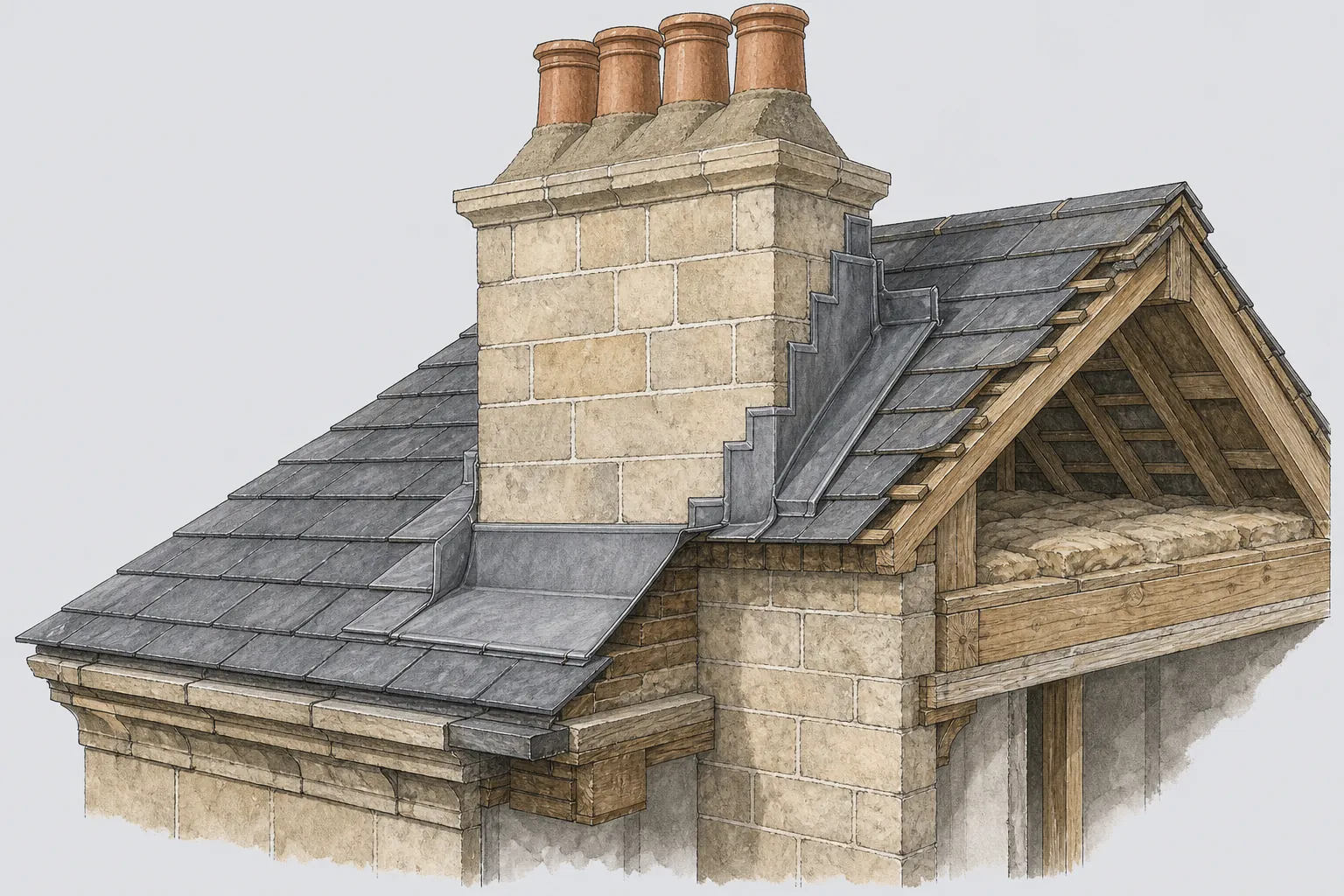
Chimneys deserve a mention. A stack stands high, takes weather on every face and sits on the line between the roof and the house. Cracked pointing, loose flaunching and lifted lead are the usual faults, and a small repair at the top costs far less than the damp patch it prevents on the breast below.

A village with a railway path running through it has plenty of walkers and cyclists passing the front of the houses, and a slipped tile is often spotted from the path before the owner sees it. If a neighbour mentions one, take it seriously.

When we survey, we give you the repairs in order of urgency, with photographs, so you can choose what is done now and what is left for later. Our roof replacement and pitched roofing pages explain when a larger job makes more sense than another round of patching.

A quick look through the loft hatch each autumn, with a torch, will show daylight through the covering and damp on the timbers long before the ceiling below is marked.

Patch or re-cover

Keep patching while the covering is sound and the repairs are few, and re-cover when new faults arrive faster than you can fix them.

Map showing the location of Oldland Common.

Nearby

Roofers near Oldland Common

Roofing services in Oldland Common

Local questions

Questions from the old hat-making village

How can I tell whether my Oldland Common cottage roof needs repair or a full re-cover?

Look for repairs that keep recurring. Odd slipped tiles on an otherwise sound roof are a repair. Slipping across several slopes, a sagging ridge, daylight in the loft or failed felt points to a re-cover. We confirm it at the survey from the ridge, the eaves and the loft, with photographs, and the written scope states which route we recommend and why.

Can a small commercial unit in Oldland Common be re-roofed while the business keeps trading?

Often, yes. We agree the phasing at the survey, working one section at a time, with safe routes for staff and deliveries and the roof closed in each day. Some jobs need a short closure of one area. We tell you before the work is booked, not on the day.

My garage here has corrugated sheets that may contain asbestos. What should I do?

Leave them alone until they have been identified. Do not drill, scrape or wash them. HSE guidance treats careful removal of undamaged cement sheets as non-licensed work, while breaking them up makes it notifiable, so the method matters. We arrange for the sheets to be assessed first and set out the options in writing.

How do you manage scaffolding and deliveries beside the Bristol and Bath Railway Path?

We look at the frontage and the route in at the survey and plan around it. Where a scaffold, skip or delivery would block a public path or road, we check what is needed from the highways authority before booking dates, and we keep material off the path at all times.

Get your free survey

Get your free roof survey

Tell us what's happening and we'll call you back to arrange a visit. Prefer to talk? Call 01225 285181.

  • Photos of your own roof
  • A fixed price in writing
  • 10-year workmanship guarantee
Call Free survey