

Bristol Victorian terraced houses with slate roofs and bay windows on a hill

Roofers in Wick

Wick lies north-west of central Bath, 7.2 road miles away, with the River Boyd running past its watermeadows and the A420 carrying traffic between Bristol and Chippenham. Roofs here sit among trees, damp ground and a nature reserve, so we spend as much time on gutters, moss and wildlife as on the covering itself.

Local roofs

Watermeadows, a quarry and a Victorian church

The old village of Wick stands on the River Boyd, and its watermeadows face St Bartholomew's Church, begun in 1845, completed in 1850 and listed Grade II*. The village sits on the A420 between Bristol and Chippenham, south of the Cotswolds, and the parish of Wick and Abson takes in the surrounding ground. The ward is called Boyd Valley, which tells you the shape of the place before you arrive.

Two features set it apart from a village that simply sits on a road. Wick Quarry is a former limestone quarry that is no longer operational, and part of it is managed as the Golden Valley Local Nature Reserve. The valley runs north from Wick alongside the Boyd, with the historic Bury Manor lying next to it. Between them, the reserve, the river and the meadows mean that a good number of Wick's houses stand close to water, trees and open green space.

For a roofer, that mix reads as a list of questions. Where do the leaves go in autumn? How long does a roof stay damp after rain? Is there a bat roost in the eaves? Is the building old enough to need a conservation conversation before anything is lifted? None of the answers is dramatic, and all of them are quicker to settle with a proper look than with guesswork.

We climb, photograph and write down what we find, then give you a price for what the roof needs. Planning and building control for the village sit with South Gloucestershire Council, and we work to that council's requirements.

Council
South Gloucestershire Council
From central Bath
7.2 road miles, north-west
Church
St Bartholomew's, Grade II* listed, built 1845 to 1850
Nature reserve
Golden Valley Local Nature Reserve, on part of the former Wick Quarry
Main road
A420, between Bristol and Chippenham

What we find

Leaf litter, green growth and nesting in the eaves

Gutters loaded with leaf litterWhere trees overhang the roof, outlets block with leaves and seed. We clear a run, pour water into it and watch it empty, because a gutter that holds water is already tipping its load onto the fascia behind.
Green growth on slow-drying surfacesRoofs close to water and shade stay damp for longer. We look at how far moss has spread, whether it is lifting the tile edges, and whether the felt beneath is wet where the growth is thickest.
Signs of wildlife in the eavesWith a nature reserve a short walk away, we check for droppings, staining at gaps, old nests and openings under the eaves before anyone lifts a tile. If we see signs, we stop and say what the next step should be.

Living near the Boyd and its watermeadows

A roof close to wet ground has to shed water well and dry out afterwards.

A river does not soak a roof, but it changes the air around it. In a valley with a watercourse running through the village and open meadows beside it, ground and air stay moist, and mist and dew settle on the roof as well as rain. A pitched roof copes with this if its covering is sound, its underlay is intact and its loft can breathe. A roof that has been neglected shows the damp early.

The first sign is usually green. Moss and algae colonise a roof that stays wet, starting on the shaded side and the lowest courses. A thin film is only cosmetic. A deep cushion is another matter: it keeps the surface wet and works into the overlaps between tiles. We lift a corner of the moss to see what is beneath: a clean, intact tile means a clean will do the job, while a pitted or flaking surface means the roof is wearing out faster than it should.

The second sign is inside. Condensation in a loft looks like a leak and is often mistaken for one. Moisture-laden air drifts up from the rooms below, meets cold timber and condenses, and the drips soak the insulation and mark the ceiling. The cure is ventilation and sealing the ceiling below the loft, not a new covering. Our guide to loft condensation explains how to tell the two apart.

The third is the underlay. Where felt has gone brittle or sagged, a drop that slips past a tile can only land on the timber. We check it at the eaves, where it should run into the gutter, and from the loft, where daylight or dark staining shows the weak spots.

Dealing with damp early is cheaper than dealing with its effects later. Our roof inspections are designed for exactly that: an honest survey with pictures, before a small fault becomes a big one.

Myth

A stained loft ceiling always means the roof covering is leaking.

Fact

Warm, moist air condensing on cold timber produces the same stain, which is why we look at ventilation before we look at the tiles.

Trees, leaf fall and the gutters beneath them

On a tree-lined plot the gutter works hardest, and it is the first part of the roof to fail.

Trees are one of the pleasures of living in a village beside a nature reserve. They also drop leaves, twigs, catkins and seed straight onto the roof, and from the roof into the gutters. The debris builds up slowly and then all at once: a storm brings down a season's worth, and an outlet that was half blocked is now blocked completely.

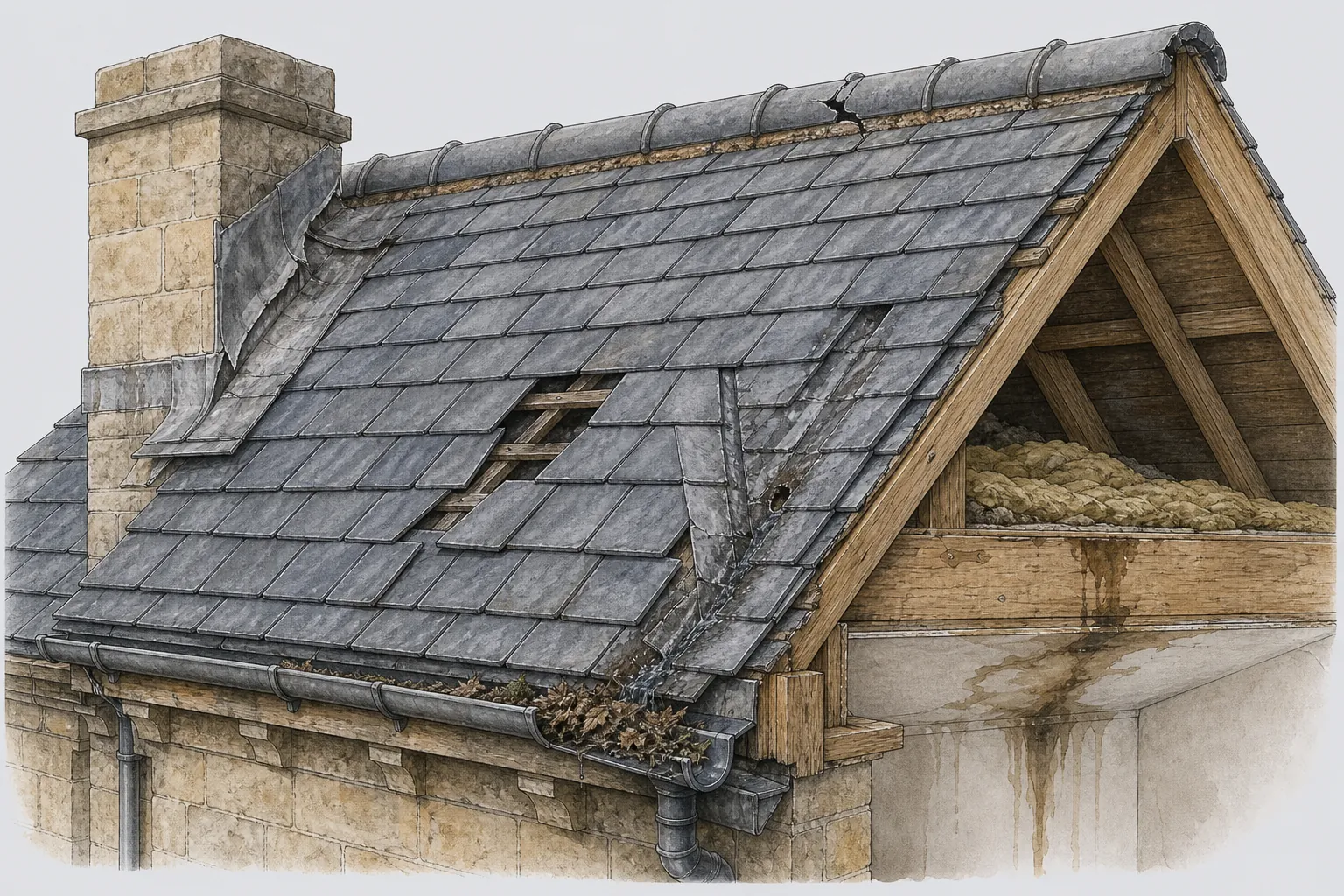
When a gutter overflows it does not do so politely. Water spills behind the run, soaks the fascia board and runs down the face of the wall, where it can stain brick or stone and reach the damp-proof course. On a flat roof, a blocked outlet leaves water standing on the surface, and standing water finds every small flaw in the covering. In a valley, where two slopes meet, leaves lodge in the lead or tile channel and dam the flow, so the water backs up under the edge of the slates.

Maintenance is simple but must be regular. We recommend a clearing after leaf fall and another in spring, and a check after any storm. Between visits, a guard over the outlet helps, though it cannot replace a look. If a branch rubs the roof, cutting it back is the owner's job, and we point it out in the survey.

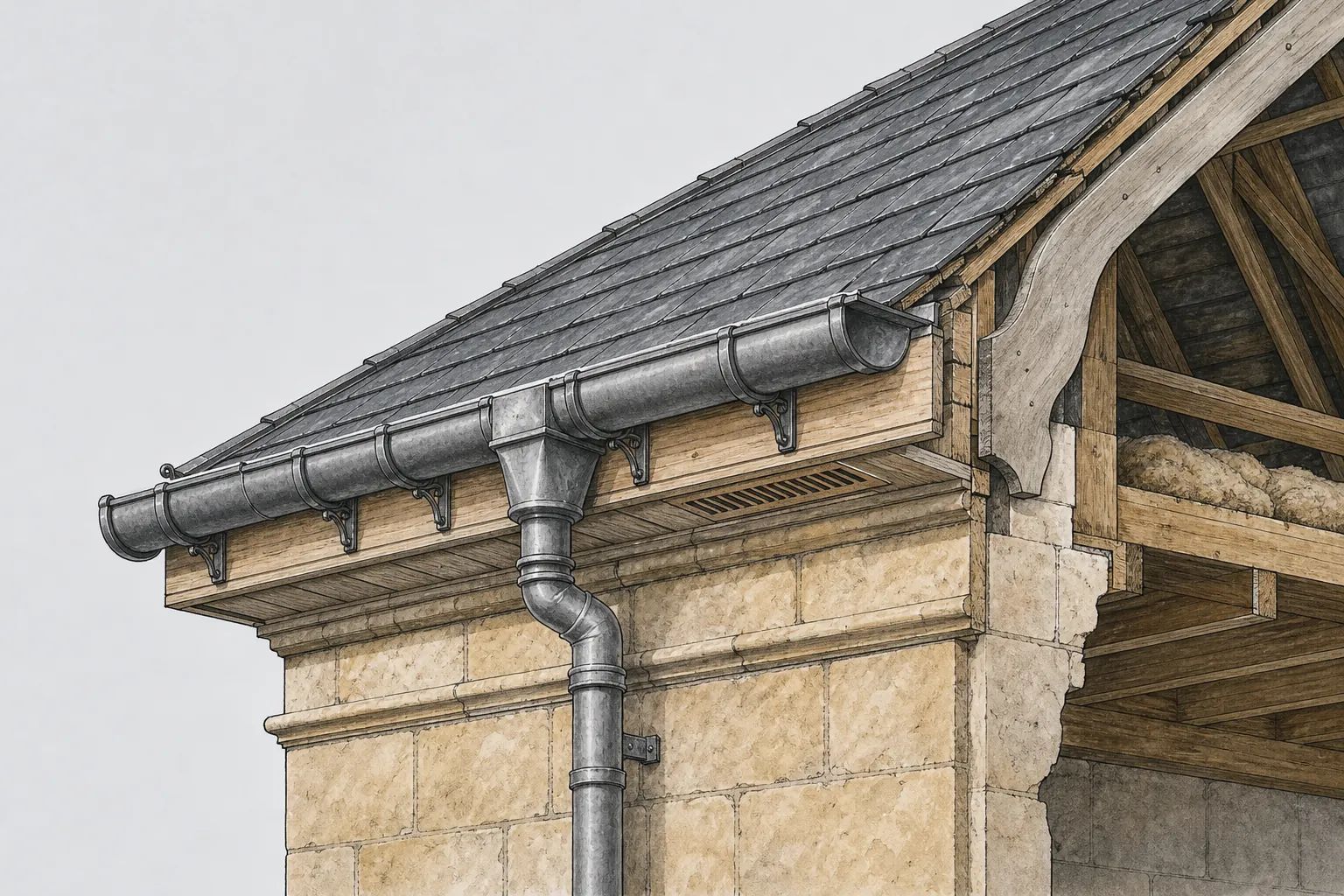
Where the gutters themselves have failed, the choice is between repair and replacement. Cracked sections, loose brackets and open joints can be mended. Runs that have sagged, rusted or split along the seam are better renewed. Mending or renewing a run is explained in the gutters, soffits and fascias service notes.

Many of the roof leaks that we trace turn out to start in the drainage, not in the covering, so it is worth ruling the gutters out first.

Where ivy or climbing plants reach the roofline, we advise cutting them back, because stems work in under tiles and lift them.

A simple gutter calendar for a tree-lined plot

Time of yearWhat to doWhy
After leaf fallClear the gutters and test the outletsAutumn debris blocks winter drainage
After a stormLook for slipped tiles and displaced runsWind moves the weak parts first
SpringCheck brackets, joints and moss growthFrost opens joints that autumn left tight
SummerCut back branches that touch the roofDry weather is the time to do the access work

Bats, nesting birds and work beside a nature reserve

Wildlife is a fact of life near Golden Valley, and a roofer has to plan around it.

The Golden Valley Local Nature Reserve occupies part of the old Wick Quarry, and the valley runs north from the village next to the river. A roof near open green space and water is a roof that wildlife may use, and the older the building, the more gaps there are in the eaves, the soffit and under the tiles.

Two rules apply. All bat species, their breeding sites and resting places are fully protected by law, and licences for any work that would disturb them come from Natural England. It is also an offence to take, damage or destroy a wild bird's nest while it is in use or being built. Neither rule stops roof work. Both mean the work has to be timed and planned.

In practice we do three things. We look for signs at the survey: droppings below a gap, staining round an opening, old nests in the eaves. If we find nothing, the work goes ahead. If we find evidence, we stop and explain what the next step is, which may mean waiting out a nesting season or asking a qualified ecologist to assess the roof. And we keep the work tidy, with gaps closed only once we are sure they are empty.

This also affects loft conversions and new roof windows, which open up parts of the roof space that were never disturbed. If your plans involve either, it helps to mention a wildlife concern early so that the survey covers it. For roof windows and the planning side of them, our roof windows page is the place to start.

Birds also settle on chimneys and in valleys. A nest in a flue is a fire risk and a blockage, but removing one while it is occupied is not allowed, so a chimney check is best done before the nesting season, not during it.

Buildings from the 1850s and what they ask of a roofer

St Bartholomew's was completed in 1850. A roof of that age has long outlived its first covering.

The listed church in Wick was completed in 1850. A house, a school or a chapel from that era has now been standing for well over a century and a half. Its roof has been repaired, re-covered or both, and the structure under it has aged in the way all timber ages: dry sections last, wet sections do not.

On an older roof, the most useful thing is a record of what has been done. We photograph each slope, note the covering, the underlay if there is one, the state of the battens and any change in material between sections. A patchwork of different tiles tells us where past repairs were made, and those joins are where we expect the next problem.

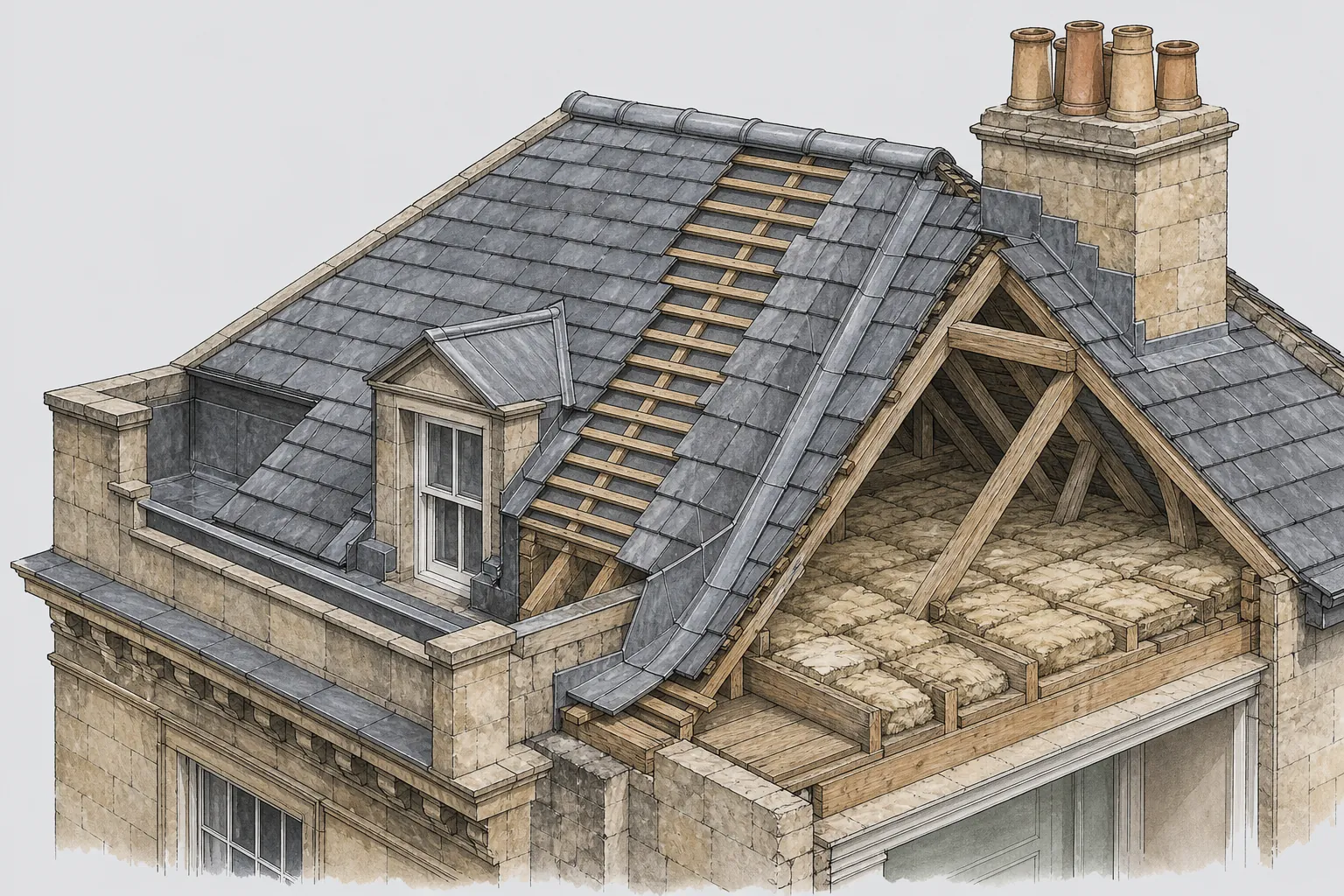
Details are what age a roof. Lead flashing where the roof meets a stack, a wall or a dormer has often been renewed once already and may be due again. The mortar on ridges and verges is fixed with lime or cement and has often failed. The bargeboards at a gable are timber, and the paint on them has been peeling for a while.

For a listed house, the first job is listed building consent from South Gloucestershire Council, because the roof is covered by the listing. If it is not, the usual rules for re-roofing apply, and we explain them at the survey. Either way, the rule we work to is the same: put right what has failed, keep what is sound, and match what we replace.

A sensible repair is often all that is needed. Our roof repairs service is built around that idea, and a re-cover is only recommended once the evidence points to it.

Photographs of each slope are kept with the written scope, so if a fault returns, you and we can look at the same picture of the same tile.

Words you will hear

Bargeboard
The board fixed along the sloping edge of a gable to cover the ends of the roof timbers.
Flashing
Metal strip, usually lead, that seals the joint where a roof abuts a stack, wall or dormer.
Verge
The side edge of a slope where it finishes at a gable end.
Underlay
A sheet beneath the battens that carries away any water getting past the tiles.

Map showing the location of Wick.

Nearby

Roofers near Wick

Roofing services in Wick

Local questions

Trees, bats and gutters, Wick asks

My Wick roof stays green all winter. Is moss on a roof beside the watermeadows a real problem?

A thin film does little harm, though a deep cushion keeps the surface wet and lifts tile edges. We lift a corner to see what is under it. If the surface is sound, a clean does the job. If it is flaking, the roof is wearing out and cleaning will only delay the work, so we say which it is in writing.

I have bats near Golden Valley. Can I still have work done on my Wick roof?

Usually yes, with planning. Bats and their roosts are fully protected, so we look for signs at the survey and stop if we find any. A qualified ecologist can advise on timing, and Natural England issues the licences. Work to other parts of the roof can often go ahead while that is settled.

How often should gutters be cleared if a tree overhangs my Wick house?

After the leaves fall and again in spring is a good rhythm, with a quick look after any storm. If the tree is close, the outlets block faster, and a guard over each outlet helps but does not replace a visit. We note branches that touch the roof so you can have them cut back.

Should I have a roof inspection before buying an older house in Wick?

It is a sensible step on any house with a century or more of repairs behind it. The inspection covers the covering, flashings, chimneys, gutters and what can be seen from the loft, with photographs. You come away with evidence to put to the seller and a list of what the roof will need.

Get your free survey

Get your free roof survey

Tell us what's happening and we'll call you back to arrange a visit. Prefer to talk? Call 01225 285181.

  • Photos of your own roof
  • A fixed price in writing
  • 10-year workmanship guarantee
Call Free survey