
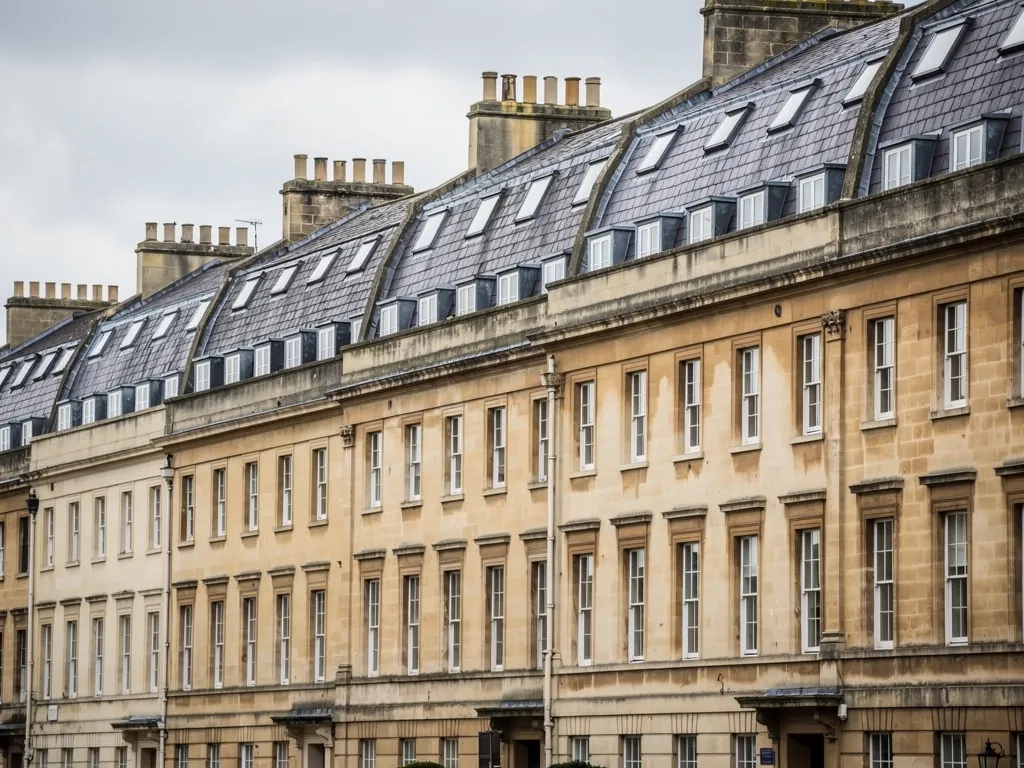
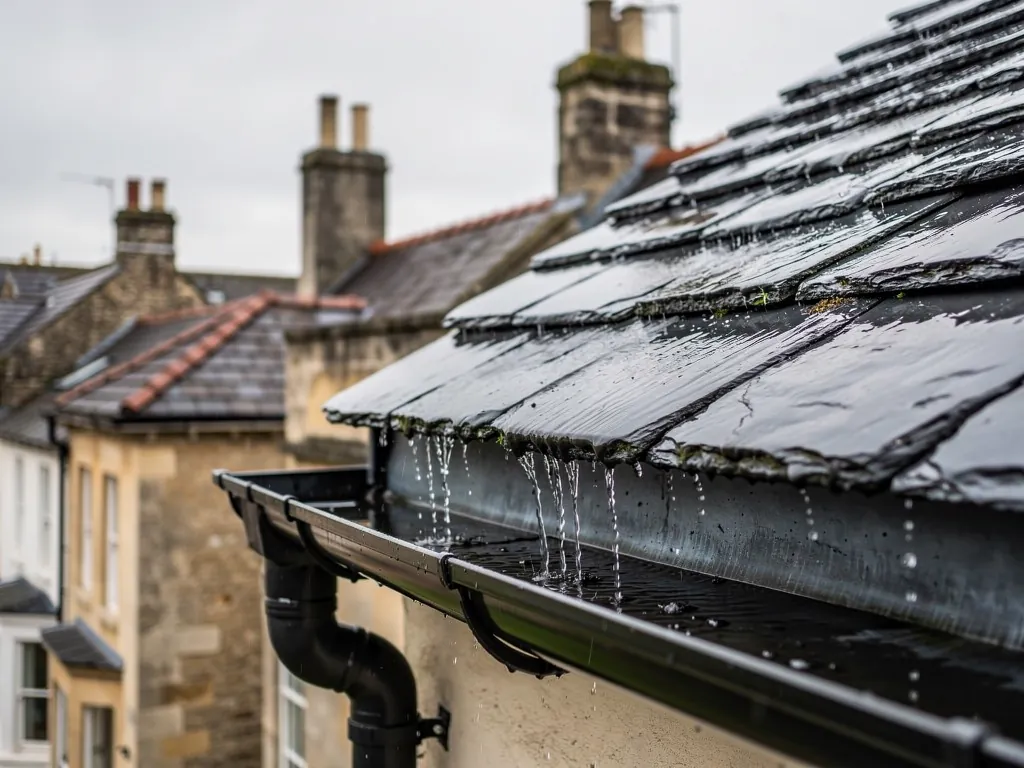
A Mendip village of grey limestone cottages with clay tile roofs

Roofers in Street

Street lies at the end of the Polden Hills, south-west of Bath by 29.1 road miles and close to the edge of our 30-mile radius. It is a stone-quarrying town turned shoe-making town turned outlet village, and the roofs reflect all three, from Blue Lias walls to the big converted sheds of Clarks Village.

Local roofs

Blue Lias, a causeway and a shoe town

Street stands on a dry spot in the Somerset Levels at the end of the Polden Hills, with the River Brue marking its northern boundary with Glastonbury. Its oldest industry was stone. Quarries of the local Blue Lias, a sequence of limestone and shale layers, were worked in Street from as early as the 12th century to the end of the 19th. In the 12th century a causeway was built from Glastonbury to carry stone from Street for rebuilding Glastonbury Abbey after a major fire in 1184.

The Grade I listed Holy Trinity parish church dates from the 14th century, with a chancel built about 1270, and had extensive restoration in the 19th. On Pages Hill, Ivythorn Manor was rebuilt in 1488 for Abbot John Selwood, restored around 1904 after lying largely ruined, and is Grade II* listed.

The modern town is known for something quite different. In 1993 redundant Clarks factory buildings were converted into Clarks Village, the first purpose-built factory outlet in the United Kingdom. A town with that history has three sorts of roof to look after: old stone houses and churches, conversions of industrial buildings, and the ordinary homes of a working town.

At 29.1 road miles Street is just inside our radius, and Somerset Council is its authority for planning and consent. Whatever the building, we climb up, work out what the roof needs and report in pictures with a written price.

Council
Somerset Council
From central Bath
29.1 road miles, south-west
Local stone
Blue Lias, quarried from the 12th century to the end of the 19th
Parish church
Holy Trinity, Grade I, 14th century
Outlet village
Clarks Village, 1993, from former factory buildings

What we find

Factory outlets, Lias copings and storm-worn ridges

Large conversion roofs with many outletsA converted factory has long gutters, rooflights, parapet details and often several types of covering joined together. We walk each section, mark the ponding, the lifted laps and the blocked outlets, and report by area so that the repair order is clear.
Lias walls, copings and stack headsBlue Lias is a layered limestone, and it weathers along its layers. We look at coping joints, stack heads and the walls under the eaves for flaking faces, open beds and cement repairs that are holding water in.
Storm-exposed ridges and edgesWhere a hill range ends, the wind reaches ridge, verges and eaves before anything else. We test each for loose or missing fixings and note any ridge or hip tile held by mortar alone.

Blue Lias walls and the lime that suits them

The town's own quarried stone has habits that a roofer has to respect.

Street was a quarrying place long before it was a shoe town, and its stone was carted to Glastonbury Abbey. Blue Lias is a sequence of limestone and shale layers, worked in the town's quarries from the 12th century onward. Layered stone behaves in particular ways. It splits along its beds, it flakes where water gets in behind the surface, and it responds badly to hard, dense repairs.

On a roof, this matters at the points where stone and covering meet. A chimney stack in Lias is exposed to wind and rain on every face. The top of the stack is where water enters first, so the cap, the flaunching and the upper courses are the likeliest to fail. Below the cap, the pointing and the lead flashings at the roof junction are the next concern. Gable copings and parapets are alike: horizontal faces that must shed water but are made of a material that does not like holding it.

Lime mortar is the long-standing answer. It is softer than the stone, so when the building moves a little the joint takes the strain, not the face of the stone. It is also more open, which lets moisture work its way out through the joint. A cement mortar does the opposite, locking moisture in and speeding decay of the stone round it. When we see a stack that has been patched with grey cement and is shedding flakes beside the repair, that is the cause.

Repointing is not complicated work, but it needs a mix matched to the stone and a joint finish that follows the original. Where a stone is too decayed to hold a joint, it can be cut out and replaced. A MyBuilder guide for 2026 puts typical UK chimney repointing at about £750, within a general repair range of £500 to £2,000, and the scaffold adds to that. Your own price follows the survey.

The chimney repairs service sets out how we handle stacks of every age.

Myth

Cement repointing is stronger, so it protects soft limestone better than lime.

Fact

Stronger is the problem: a hard joint forces moisture out through the stone, and the face of the Lias flakes first.

Clarks Village and the roofs of converted factories

Industrial buildings given a second life carry big roofs, shared outlets and mixed coverings.

In 1993, redundant Clarks factory buildings were converted into Clarks Village, the first purpose-built factory outlet in the United Kingdom. A conversion of that kind keeps the shell of the old building and fits a new use inside. The roof, usually, is one of the things that stays, with repairs, patching and sometimes whole sections replaced over the years.

That history produces roofs with their own pattern of trouble. Different areas have been covered at different times, in different materials, and the joins between them are where leaks start. A sawtooth or north-light roof, a common industrial form, has glazed or sheeted faces and gutters between each pair. Those valley gutters collect leaf litter and fail if they pond. Rooflights fitted into an older roof can crack, lose their seals or be set too low to the sheeting around them.

Flat sections on such buildings may be covered in felt, in a rubber sheet called EPDM, in single-ply plastic membranes or in lead. Typical UK costs for a flat roof quoted by one third-party guide in 2026 run at about £70 to £150 per square metre for felt, EPDM and GRP, and at £150 to £200 or more for lead. The commercial roofing figures available are thin, and many tenants and landlords find that the only reliable approach is a priced survey.

That is how we work on larger buildings. We walk the roof, mark defects on a plan, and give each a priority, so that a landlord, managing agent or tenant can decide what is urgent and what can wait. Because units often share a roof, the report is written to be passed between parties. If you are responsible for a retail or industrial unit, our commercial roofing page goes into the work at greater length.

Temporary protection is part of planning. A roof that is stripped for a day must be dry by night, so work is arranged in sections.

Flat roof systems and UK cost ranges per m²

SystemRangeSource note
Bitumen felt£70 to £100MyBuilder, 2026
EPDM£90 to £130MyBuilder, 2026
GRP£95 to £150MyBuilder, 2026
Lead£150 to £200 or moreMyBuilder, 2026

Holy Trinity, Ivythorn Manor and roofs with a restored past

A church with 19th-century restoration and a manor rebuilt after near-ruin both show how many hands a roof can pass through.

Holy Trinity is a 14th-century church whose chancel was built about 1270, and which saw extensive restoration in the 19th century. Ivythorn Manor on Pages Hill was rebuilt in 1488, lay largely ruined, and was restored around 1904. Both are listed, Holy Trinity at Grade I and the manor at Grade II*.

A building with that sort of record has had its roof worked on repeatedly. Medieval timbers may sit under a Victorian covering, and early twentieth-century repairs may sit beside later ones. When we survey a roof like this, we try to read it as a sequence. Which parts are original? Which are replacements, and in what material? Where has lead been renewed, and where has it been patched with mastic or bitumen? The answers tell us where the weakest points are, and they show what a repair should match.

Matching is not a luxury on a listed building. The covering, the lead and even the fixings are part of what is protected. Altering them without listed building consent from Somerset Council is an offence, and the council's planning team is the place to start. Historic England's online list will confirm whether a building is listed and at what grade. Deciding what the law requires is for the council; our part is to write the proposed work up in the detail a planning officer will want.

Lead is the metal we expect to meet on roofs like these. It lines gutters, covers hips and ridges, and forms flashings round chimneys and walls. Lead moves with temperature, and where it has been fixed too rigidly it cracks at the corners. The flashing seals a junction in sheet lead, and the soakers sit beneath the covering where it abuts a wall. Our lead roofing page shows the details we work on.

We do not quote a lead weight without seeing the detail. We tell you what has failed, whether it can be patched and what a proper repair involves.

Words you will hear

Chancel
The eastern part of a church, where the altar stands, usually roofed separately from the nave.
Flashing
A strip of lead dressed across a junction to keep water out.
Soaker
A small lead piece placed under a course of tiles or slates at a wall.
Lead code
The grade that sets the thickness of rolled sheet lead, chosen to suit the detail.

The end of the Polden Hills and a roof in a storm

The open Levels around the town mean gusts reach a roof without much warning.

Street sits where the Polden Hills run out onto the Levels, and the ground on several sides is open. A wind crossing that open ground meets the ridge and the verges of a house directly, so a gale does its work at the edges first. Tiles lift, ridge pieces shift, and verge pointing breaks away.

When a storm does its worst, the first need is to keep water out. We put leaks and storm damage first, making a leaking roof safe before the permanent repair is planned. That can mean a temporary cover, a few refixed tiles or a sealed junction. The permanent repair comes afterwards, when the weather allows and the extent of the damage is clear.

Insurance is a separate matter, and claims are yours to make. Insurers commonly define a storm by wind speed, with gusts of at least 55 mph a frequent threshold, and a standard policy can exclude general wear and tear, such as rain entering a poorly maintained roof. Dated photographs and a written roofer's report can support a claim without guaranteeing it. Which? has cited FCA data showing that just 32% of storm claims made in 2024 were paid out.

Prevention is cheaper than repair. A roof in good order at the edges is much less likely to lose tiles. That means ridge and hip tiles fixed mechanically, in line with BS 5534:2014, and verges that are secure. Dry-fix is one option when those parts need renewing: ridge and verge are clipped and capped, with no mortar bed, to a system tested under BS 8612:2018.

For minor repairs, a MyBuilder guide for 2026 suggests typical UK costs of £100 to £300 to fix a small leak or replace a few tiles, and £500 to £1,500 for storm-damage fixes. The roof repairs page describes how we approach both.

55 mph

Gust threshold many insurers use to define a storm

32%

Share of storm claims in 2024 that resulted in a payout

29.1

Road miles by road from Bath

Figures: Which?, 20 November 2025, citing FCA data; Empire Roofing Bath route data

Map showing the location of Street.

Nearby

Roofers near Street

Roofing services in Street

Local questions

Shoe town questions at the end of the Poldens

Blue Lias chimney stacks flake in places on my Street house. Is that the stone or the pointing?

Often it is both, with the pointing the cause. Lias is a layered limestone, and a hard cement joint pushes moisture out through the stone face instead of the joint, so the layers flake beside the repair. We look at the mortar type, the flaunching and the flashings, then tell you whether a lime repoint will do or the stack needs rebuilding in stone.

I manage a unit in a converted factory building. Do all tenants share one roof survey?

A survey of a shared roof is usually commissioned by the landlord or managing agent, and tenants can ask to see it. We prepare a report that can be passed between parties, with defects marked by area and ranked by urgency. That helps each party see what concerns them and what is the building owner's responsibility.

Our cottage near Holy Trinity is listed. Can we replace slipped tiles ourselves?

Replacing one or two like-for-like tiles is a minor repair, but it is worth asking Somerset Council if you are unsure, because consent applies to works that affect a listed building's character. A roofer can show you whether the problem is a few loose tiles or a sign of failing battens, which is a bigger matter.

Will a storm-damaged roof be covered by my insurer if the roof is old?

That is for your insurer to decide. Wear and tear is commonly excluded from cover, and wind-speed thresholds vary by insurer. A written report from us with dated photographs of the damage may support your claim. The claim itself stays with you, and no outcome can be promised.

Get your free survey

Get your free roof survey

Tell us what's happening and we'll call you back to arrange a visit. Prefer to talk? Call 01225 285181.

  • Photos of your own roof
  • A fixed price in writing
  • 10-year workmanship guarantee
Call Free survey