The short answer
To re-felt a shed roof, strip the old felt, repair or replace any soft boards, then lay new roofing felt in overlapping strips from the eaves upwards, fixing it with clout nails and sealing the laps. Finish the edges with a drip and fold-over. Where you want a longer life, an EPDM rubber sheet or a torch-on system is worth the extra outlay.
Start with the deck, not the felt
Felt does not make a roof sound. It only keeps water out of a deck that is already sound. Before any new covering goes on, the old felt comes off and the boards beneath are looked at properly. Most sheds have a deck of tongue-and-groove boards, plywood or OSB. Water that has crept under old felt leaves dark patches, soft spots and boards that flex when pressed. Anything soft is cut out and replaced, because new felt laid over a spongy board will tear at the next gust or frost.
The shed itself matters too. If the walls have racked or the roof sags between the supports, the new covering will pond water in the dip. A shed roof needs a slight fall so rain runs to the lower side and out into a gutter or off the edge. The BS 6229 figures quoted by manufacturers give a recommended minimum fall of 1:80, so a roof that is flat or reversed needs the fall put right before anything else.
Finally, take off or note anything fixed to the deck, such as a vent, a satellite bracket or a wire. Each of these needs a neat, sealed detail afterwards.
How a shed is re-felted, step by step
Once the deck is ready, the method is straightforward, and the order matters more than the speed.
- Dry run. Roll the felt out and let it relax. Cold felt is stiff and cracks when it is bent, so it is easier to work on a mild, dry day.
- Start at the eaves. The first strip goes along the lower edge with a small overhang, so water drips clear of the wall. Each strip above it overlaps the one below, so rain always runs over a lap and never into it.
- Fix it. Clout nails go in along the laps and edges at close spacing. Galvanised nails are the norm because ordinary steel will rust through.
- Seal the laps. Bitumen adhesive, brushed or applied from a tube, bonds the overlaps so wind cannot lift them.
- Finish the edges. The felt is folded over the fascia or the edge trim and fixed, and a drip strip, a small metal lip, helps water fall clear.
Roll direction matters. On a mono-pitch shed the rolls normally run parallel to the eaves. Where a gable or a ridge is involved, the rolls are laid so the laps face away from the prevailing weather.
Which felt, and why the cheap roll fails early
Shed felt is sold in grades, and the lightest grade is the one that fails first. A thin, single-layer felt can crack, blister in the sun and open at the laps within a few seasons. Heavier mineral-surfaced felt, with a gritty top layer, resists sun and wear far better. Felt shingles, which are small tiles of the same material, are another option and look neater on a small pitched roof.
Sources differ on how long it lasts. One cost guide puts a well-laid felt roof at around 20 years and a badly laid one at under 10. Trade figures for built-up and torch-on felt tend to sit between 10 and 20 years, and longer where a good multi-layer system is laid. The variation tells you the same thing as our experience: workmanship and layer count count for more than the name printed on the roll.
The same logic applies to a garden room, a studio or a workshop. If the building has electrics, tools or a lot of valuable stuff inside, a leak costs far more than the felt. In that case, a better covering is a sensible step up, not an indulgence.
When a better covering is worth it
Re-felting every few years is cheap for the outlay but it is repeated work. There comes a point where a longer-lasting covering is the better value.
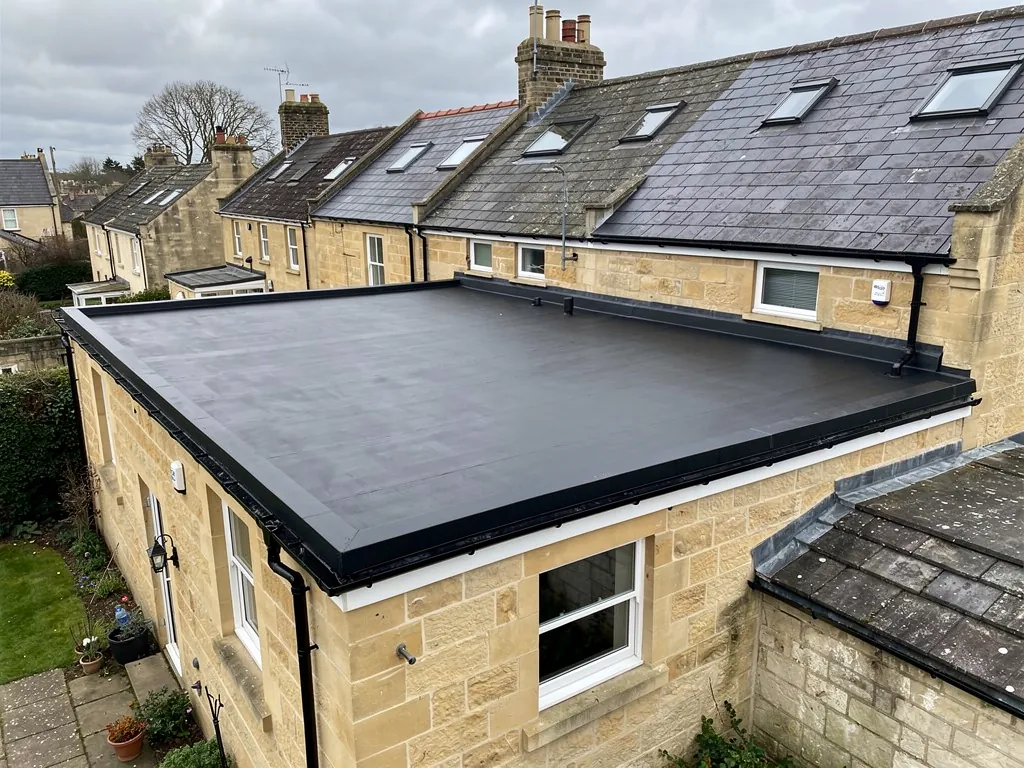
EPDM rubber is the usual upgrade. A single sheet, cut to the roof, leaves no laps in the field, so there is nothing for wind to lift or water to find. Sources put EPDM life at about 20 to 30 years or more. GRP fibreglass makes a tough, continuous skin and is worth considering on awkward shapes, though it needs dry weather and a firm deck. Torch-on felt, built up in several layers, sits between plain shed felt and the single-ply systems.
Which one to pick depends on the shed. A garden store with a few boxes in it is fine on good felt. A home office with a laptop, a studio or a workshop justifies EPDM. A building that is close to a house, for example, is also more likely to be seen and used, so a neat finish counts. Our page on dormer flat roofs shows how the same coverings are used on a small roof with more demanding edges.
Edges, gutters and cost
The weak points on a shed are the same as on any small flat roof. They are the edges, the corners and any place the roof meets a wall or fence. Where the shed butts up against a house or a tall boundary, the felt is turned up the wall and covered with a flashing so rainwater cannot run behind it. A gutter helps as well, since a shed with no gutter dumps its whole roof of water in a line along one wall, which can rot the shed base or splash the cladding.
For anything attached to a house, such as a lean-to store or porch, the roof is held to a higher standard. See our answer on how to re-roof a porch for the detail at that junction. For the general question of build-up, warm and cold deck roofs explains why an insulated shed or garden room needs a different layout.
On price, MyBuilder's 2026 guide reports typical UK flat roof rates of about £70 to £100 per square metre for bitumen felt and £90 to £130 for EPDM. For garage roofs it gives about £700 to £1,000 for a single flat roof. A shed is smaller, but small jobs cost more per square metre. Before you call, measure the length and width of the shed roof and note whether it overhangs at the front, since the overhang adds felt and timber to the job. Our overall pages on flat roofing in Bath cover the larger jobs.