
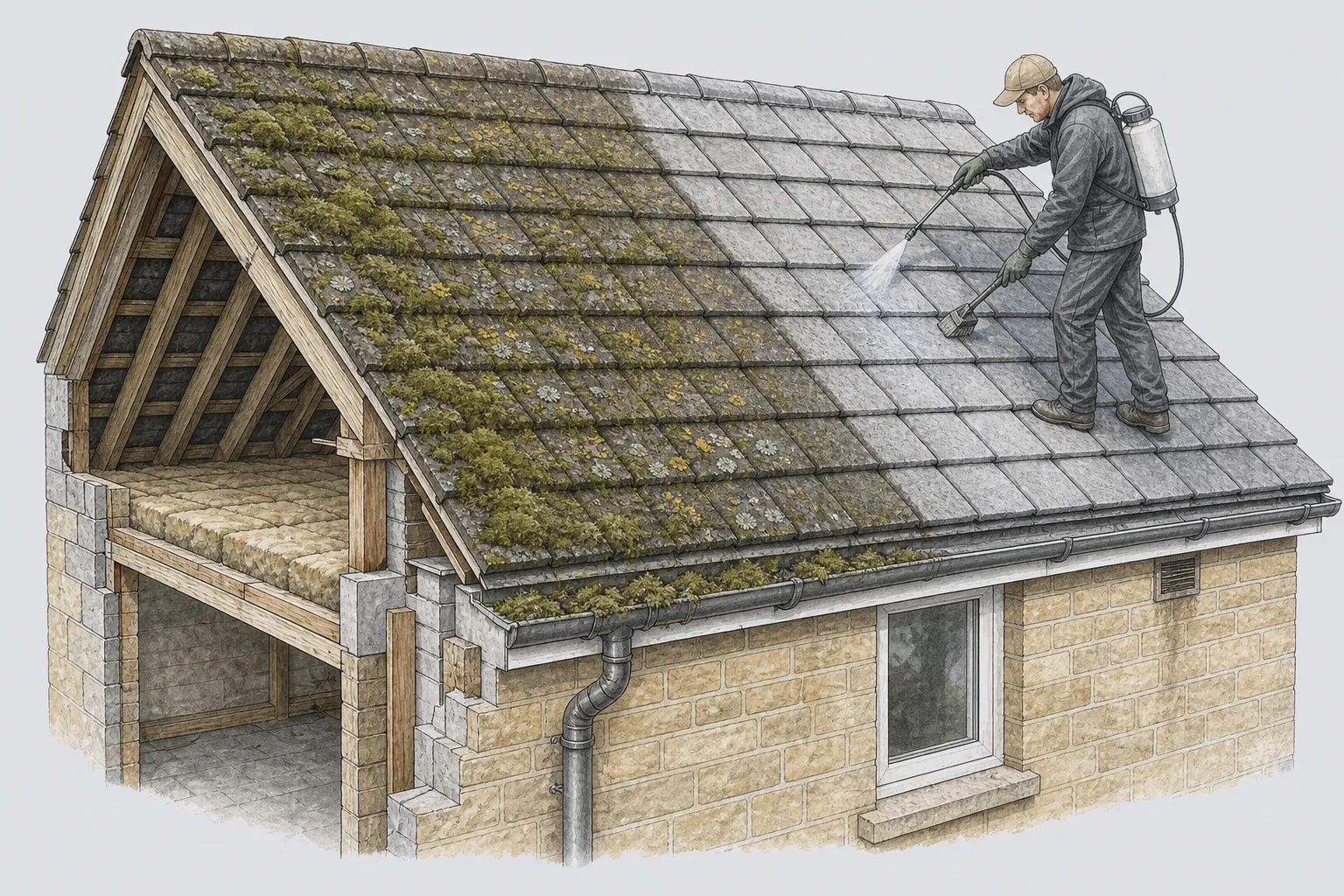
Georgian terrace of honey Bath stone with natural slate roofs and chimney stacks

Roofers in Widcombe

Widcombe is only 0.4 road miles from central Bath, across the Avon to the south-east, and its roofs are among the oldest and most protected we work on. A Georgian crescent, a seventeenth century manor and a parade of shops each ask for a repair that respects what was built.

Local roofs

A district between the canal, the river and the hill

Widcombe sits just over the river from the city centre, on the ground where the Kennet and Avon Canal drops into the Avon. At that point Bath Deep Lock lowers boats through a chamber 19 ft 5 in deep, the second deepest canal lock in Britain, and the streets climb away from it up the hillside.

The buildings span a wide range of dates. Widcombe Manor House on Church Street was built in 1656 and is Grade I listed. Widcombe Crescent, a terrace of 14 houses built around 1805 and attributed by Historic England to Charles Harcourt Masters, is listed Grade I. Widcombe Parade is lined with Georgian and Victorian buildings, some dating back as far as 1750, and Crowe Hall is a Grade II listed Georgian house of around 1780 that had to be restored after a serious fire in 1926. St Matthew's Church, built in 1846 to 1847, has one of the tallest spires in Bath.

For a roofer, that list is a map of what can go wrong and what must be protected. The older houses carry roofs with long histories of repair, often with several generations of lead, slate and mortar layered on top of each other. Some of the shops on the parade have flats or storerooms above them, and their roofs are used by tenants as well as owners. How a roof is reached matters as much as how it is mended.

Everything here sits within the City of Bath World Heritage Site, and a great deal of it is listed. We treat every job in Widcombe as one that needs a clear note of what is proposed.

Council
Bath and North East Somerset Council
From central Bath
0.4 road miles, south-east
Grade I listed
Widcombe Crescent (c.1805) and Widcombe Manor House (1656)
Widcombe Parade
Georgian and Victorian buildings, some from 1750
Bath Deep Lock
Chamber depth 19 ft 5 in, second deepest in Britain

What we find

Parapet lead, old patches and parade roofs

Splits in lead behind a parapetOn a terrace the gutter often sits behind a stone wall at the front, out of sight from the street. We check the lead for splits along its folds and at the points where it steps down, because a hidden gutter that leaks does its harm inside the wall.
Roofs patched over many yearsOld roofs here carry mixed repairs: a slate in one colour, a run of cement along a joint, a daub of sealant at a flashing. We separate what is holding from what is only hiding the fault and leave the roof in a state that can be read.
Shop roofs and rear extensionsAbove and behind the parade, small flat roofs and lean-tos join the main building at awkward angles. We trace staining on shop ceilings back to the junction, rather than treating the surface of the flat roof that is easiest to see.

The Crescent, the Manor and the listed roofs

A house listed for its architecture is listed with its roof on.

Widcombe Crescent was built around 1805 as a terrace of 14 houses, and it is Grade I listed, which is the highest category. Widcombe Manor House, older again at 1656, shares the grade. A house in either category, or any of the other listed buildings in the district, has a roof that counts as protected character, from the slate and stone to the lead and the line of the ridge.

Start with what needs doing and what the council will want to hear. B&NES wants owners to raise it with the council first, treats listed building consent and planning permission as two separate matters, and warns that unauthorised work to a listed building is an offence. A ruling on your own house is for the council. What we supply is a simple account of the job, with the materials and the method, that you can put in front of the conservation team.

The easiest job to explain keeps the slate, lead and detail already there. A different covering, a new opening or a stack coming down needs agreement beforehand. Where you are unsure, the B&NES website lists the conservation team, and a short call settles it.

On a listed roof we put back what was there. Slate is replaced with slate of similar size and colour, and lead is renewed in lead, not swapped for a modern membrane. Sound original material is kept, the roof is photographed before and after, and flashings follow the pattern of the originals. The hidden parts of an old roof get fuller treatment under lead roofing.

14

Georgian houses in Widcombe Crescent

1805

Approximate year Widcombe Crescent was built

1656

Year Widcombe Manor House was built

Figures: Historic England list entry 1395754 and Widcombe, Bath entry, Wikipedia, checked October 2026

Lead behind the parapet

Georgian terraces were built to look flat-fronted, and the drainage was hidden to keep it that way.

Georgian builders in Bath liked an unbroken line along the head of the front wall. A parapet, which is a low wall running above the eaves, lets the roof sit behind that line, and the water that falls on it is collected in a gutter behind the wall rather than in a visible one on the front. That is the parapet gutter. When the roof is a pair of slopes meeting in a trough between two terraced houses, the same idea is called a valley gutter or a box gutter if it is boxed in between walls.

Lead is the traditional material for these gutters because it can be dressed into shape and does not rot. It does move, though. Sheet lead swells in warmth and shrinks in cold, and over the years that movement tears the metal at its folds and fixings. A gutter laid in lengths too long, or without enough drips (the small steps that shed water down the fall) will split, so the first warning is often a damp patch on an inner wall rather than a drip.

We lift the slates along the edge of the gutter, look at the lead along its full length, and clear what has collected. Leaves, moss and old nesting material can hold water against the metal and block the outlet, and a blocked outlet is a common reason for water to find its way into the wall. Sound lead needs only a mend where it has split or lost its fixing. Lead that has failed through is replaced by the length, which is not always the whole gutter.

We do not publish thicknesses or weights for lead sheet here, because the right specification depends on the gutter, its length and its fall, and is settled after we have seen it. What we will tell you is what the work involves and why. Parapet repairs also touch the stone coping on top of the wall, where open joints let rain behind the lead.

Words you will hear

Parapet
A low wall along the edge of a roof, above the eaves line.
Box gutter
A gutter built into the roof between walls or slopes, usually lined with lead.
Drip
A step built into a lead or flat roof so water drops to the lower level.
Soaker
A folded piece of lead worked in under the slates beside a wall or chimney.

Widcombe Parade and the roofs above the shops

A shopping street is a row of small businesses on top of other people's homes, and the roof is shared between them.

Widcombe Parade is a commercial street of Georgian and Victorian buildings, some of which date back as far as 1750. At street level there are shops and other businesses. Above some of them are flats and storerooms, and above those the roofs, which may belong to the freeholder, a leaseholder or the occupier. A roof like that has more than one set of interests, so a repair needs a clear scope that everyone involved can read.

The roofs on a parade tend to be a series of linked parts: the main pitch to the street, a rear pitch, a range of single-storey extensions at the back where shops have grown into their yards, and the flat roofs that cover them. The junctions between those parts are the weak points. A flat roof that meets a wall of the main building needs a flashing, and when that flashing lifts, water runs behind it and shows up in the ceiling of the shop below. The cause is up the building, and the symptom is a stain at the till.

Access is the other practical issue. Working above a trading shop means scaffold in a pavement area and planning around the hours the business operates, and the arrangements are best made at the survey, when we can see the ground. We record what we find with photographs from the roof, and the fixed written price can be passed straight to a managing agent or landlord. Work on shared roofs or in the service lanes behind the parade is scheduled so that the shops can keep trading.

For a commercial owner the question after a leak is whether to repair or to renew. A single failed flashing is a repair. A flat roof that has been patched more than once is usually near the point where renewing it will cost less than the patching. Our commercial roofing page explains how we survey and price work of this kind.

Old timbers, tall towers and a roof rebuilt after fire

Widcombe's history includes a serious fire, and its landmarks include one of the tallest spires in Bath.

Crowe Hall, the Grade II listed Georgian house of around 1780, was badly damaged by fire in 1926 and needed substantial restoration afterwards. A building with that history shows what a roof is made of in a way that most houses do not: parts of the structure date from different periods, and the timbers have been cut, spliced and replaced over the years. Houses with such a past are among those where the first task is simply to find out what is up there.

When we survey an older roof, the covering is only half of the picture. We look at the rafters and the purlins, the horizontal timbers that carry the middle of the slope, for signs of damp, of insects and of old repairs that were done in the wrong material. A slate roof can look sound from the garden while the timber beneath has been softened by years of slow leakage. Seeing that early means a repair to a small area rather than a re-roof.

Height is the other feature of the district. St Matthew's Church, built in 1846 to 1847, has one of the tallest spires in Bath, and the ground rises behind it. Working at height next to tall structures means planning for wind and for the line of the scaffold, and we do that on survey.

The canal and river are the other local factor. Where trees stand close to a roof beside the water, leaves fall into gutters and valleys and block them, and the water then has nowhere to go but through the joints. Clearing and checking those channels is the cheapest piece of roof maintenance in Widcombe, and one of the most useful. How a leak is made safe first and mended properly second is set out on roof repairs.

Repair or renew a gutter

Patch the lead when one split is the only fault; renew the run when the metal has cracked along its folds in several places.

Map showing the location of Widcombe.

Nearby

Roofers near Widcombe

Roofing services in Widcombe

Local questions

Questions from the Crescent, the Parade and the canal

Our Widcombe Crescent house has a parapet gutter that leaks. Do we need consent to re-lead it?

Possibly not, but check first. The Crescent is Grade I listed, and B&NES asks that you speak to the council before work begins. Re-leading in the same material and pattern is a like-for-like repair that is easier to explain than a change. We write the scope and the method with enough precision for the conservation officers to reply before any scaffold goes up.

Can you repair a shop roof on Widcombe Parade without closing the business?

Usually, yes. We plan access with the occupier at the survey, put scaffold where it blocks the least, and arrange the noisiest work around opening hours. If the roof is shared with the flats above, we give a single written scope that the freeholder and the shop can both agree, so that nothing is done twice.

Why does my Widcombe ceiling show a stain when the roof looks fine from the street?

On a terrace the water often enters at a junction you cannot see from the road, such as a gutter behind the parapet, a flashing at a rear extension or the foot of a chimney. The stain appears where the water finally gets through the structure, which can be some distance from the entry point. We follow it back from the ceiling and look at the likely points one by one.

Is it worth keeping the old timbers in a house like Crowe Hall that was restored after a fire?

Where they are sound, yes. Sound old timber is often better than modern replacements, and it is part of what makes a historic building what it is. What we do is test the timber, find the soft or damaged lengths and replace only those. Anything that touches structure or the listed fabric is agreed with the conservation team before we start.

Get your free survey

Get your free roof survey

Tell us what's happening and we'll call you back to arrange a visit. Prefer to talk? Call 01225 285181.

  • Photos of your own roof
  • A fixed price in writing
  • 10-year workmanship guarantee
Call Free survey