


Salt air and exposed fixings
On the shore, a roof's metal parts wear out before its covering does.
Severn Beach sits behind sea defences on a low stretch of shore, and a house here has no hills or hedges to blunt the wind. Salt travels in that wind. It settles on tile, slate, lead and every metal fixing, and it speeds up the rusting of anything made of ordinary steel. The covering itself may be perfectly good while the parts that hold it down are not.
The nail is the first suspect. Slates and tiles are fixed with nails, and a nail that has rusted through lets its slate slide a little at a time until a gap opens. From the ground, you see one missing slate. Up close, you often find the courses either side are hanging by corroded stubs. When we find that pattern, we say openly that patching one slate will not hold, and we explain what a proper refix involves, with corrosion-resistant nails or clips chosen for a coastal setting.
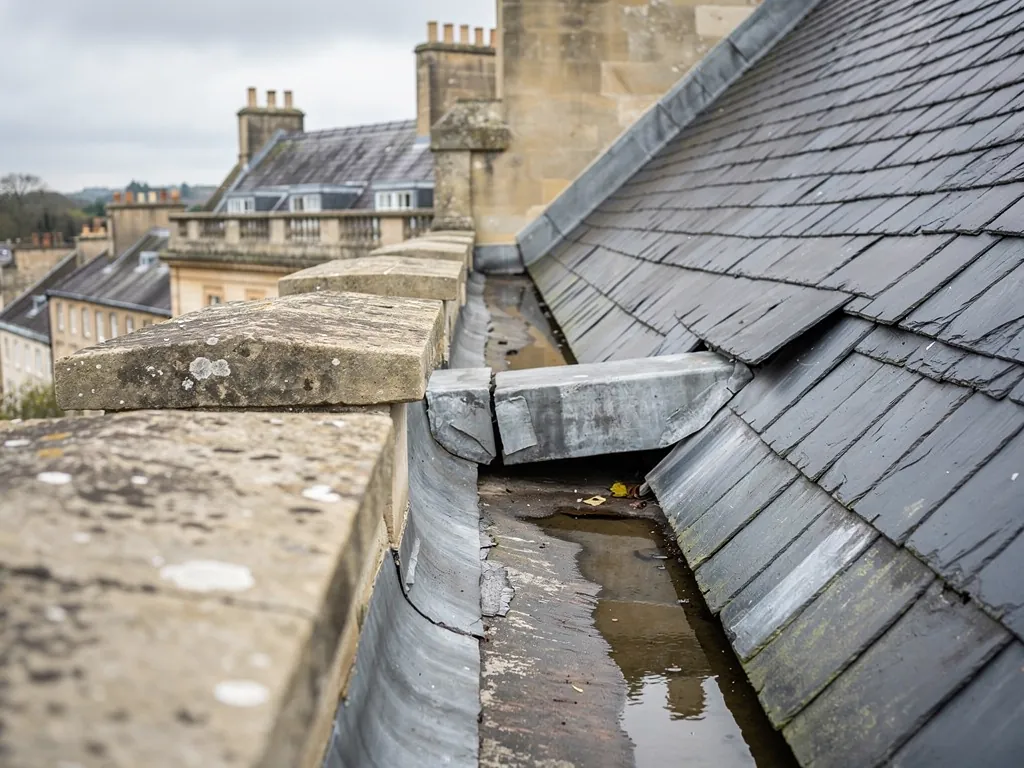
Lead flashings carry the same risk in a different form. Lead is durable, but its fixings and the mortar that holds its edges in a joint are not, and a flashing that has pulled out of its chase lets wind-driven rain run behind it. The sealing details around chimneys, walls and dormers are therefore as important as the roof slope.
Gutters and downpipes are cheap to ignore and costly to lose. Brackets that rust and snap let a full gutter drop, and the water that follows runs straight down the wall. We test each bracket by hand, count the supports along the run and look at the fixings rather than just the plastic or metal between them.
That is the logic of our roof repairs work: find the true cause, mend what has failed, and leave sound material alone. A sound roof with bad fixings needs the fixings, not a new roof.