

Bristol Victorian terraced houses with slate roofs and bay windows on a hill

Roofers in Charfield

Charfield lies to the north of Bath, 22.3 road miles from the city centre, near the Little Avon River. Older estates sit near homes finished in 2018 and 2019, and two houses on one street can carry quite different coverings, so the survey looks at the roof itself before anyone assumes what is up there.

Local roofs

A village of seven housing areas

Charfield lies near the Little Avon River, south-west of Wotton-under-Edge, and its housing falls into seven main areas. Farm Lees, Longs View, Manor Lane and Woodlands have existed for some time. Two newer developments, St James Mews and Charfield Village, were built in 2018 and 2019. Out at Churchend stands the old Church of St James, which dates from the 13th century, is a Grade I listed building and is now in the care of the Churches Conservation Trust.

That variety is what shapes our approach here. A village with this many separate housing areas does not have a single kind of roof. Each estate was built at its own time, to its own specification, by its own builder, and the roofs have aged accordingly. We make no assumptions from the postcode. On the survey we identify the covering, the underlay, the fixings and the state of the timber, and we describe what we find in ordinary language.

The village also has a railway past. The station on the Bristol to Birmingham main line closed in January 1965 but still stands, and the survival of a building like that is a reminder that Charfield has a mix of uses as well as ages, with old structures standing among homes.

For any roof here, the questions are the same. What is it covered with, how is it fixed, where does the water go and what is it going to need in the next few years? We put the answers in writing, with images of your own roof taken on site, and we point out what can wait as readily as what cannot.

Council
South Gloucestershire Council
From central Bath
22.3 road miles, north
Housing areas
Seven main areas, including Farm Lees, Longs View, Manor Lane and Woodlands
Newer homes
St James Mews and Charfield Village, 2018 and 2019
Old church
St James, Churchend, 13th century, Grade I

What we find

Ageing estate fixings and moss by the Little Avon

Ageing fixings on the older estatesOn a roof that has been up for a long time, the covering is often sound while the things holding it are tired: mortar beds, old felt and corroded nails. We test them by hand and tell you which are still doing their job.
Small faults on the 2018 and 2019 homesYoung roofs tend to fail at the details, not across the slope: a slipped tile, a loose ridge piece or a flashing that was never fully dressed. These are quick to put right and cheaper to fix early.
Damp, shade and moss near the riverLow ground and trees keep roofs and gutters wet for longer. We look for moss on the north slopes, silt in the gutters and green staining below the eaves.

Seven housing areas, several ages of roof

Farm Lees, Longs View, Manor Lane and Woodlands have all been there a while, and a roof ages in step with its estate.

A roof is not a single item that wears out at one moment. It is a set of parts, each with its own life, and on a housing estate that has been standing for some time those parts reach the end at different dates. The tiles may be sound for many more years. The underlay beneath them may not.

Underlay is the sheet laid across the rafters under the covering. It catches any rain or snow that the wind drives past the tiles and guides it down to the gutter. Older felt dries, cracks and sags between the rafters, and at the eaves it can rot away where it should lead water into the gutter. A loft that smells damp after wind-driven rain, or a stain on a rafter near the eaves, points to underlay that has stopped working.

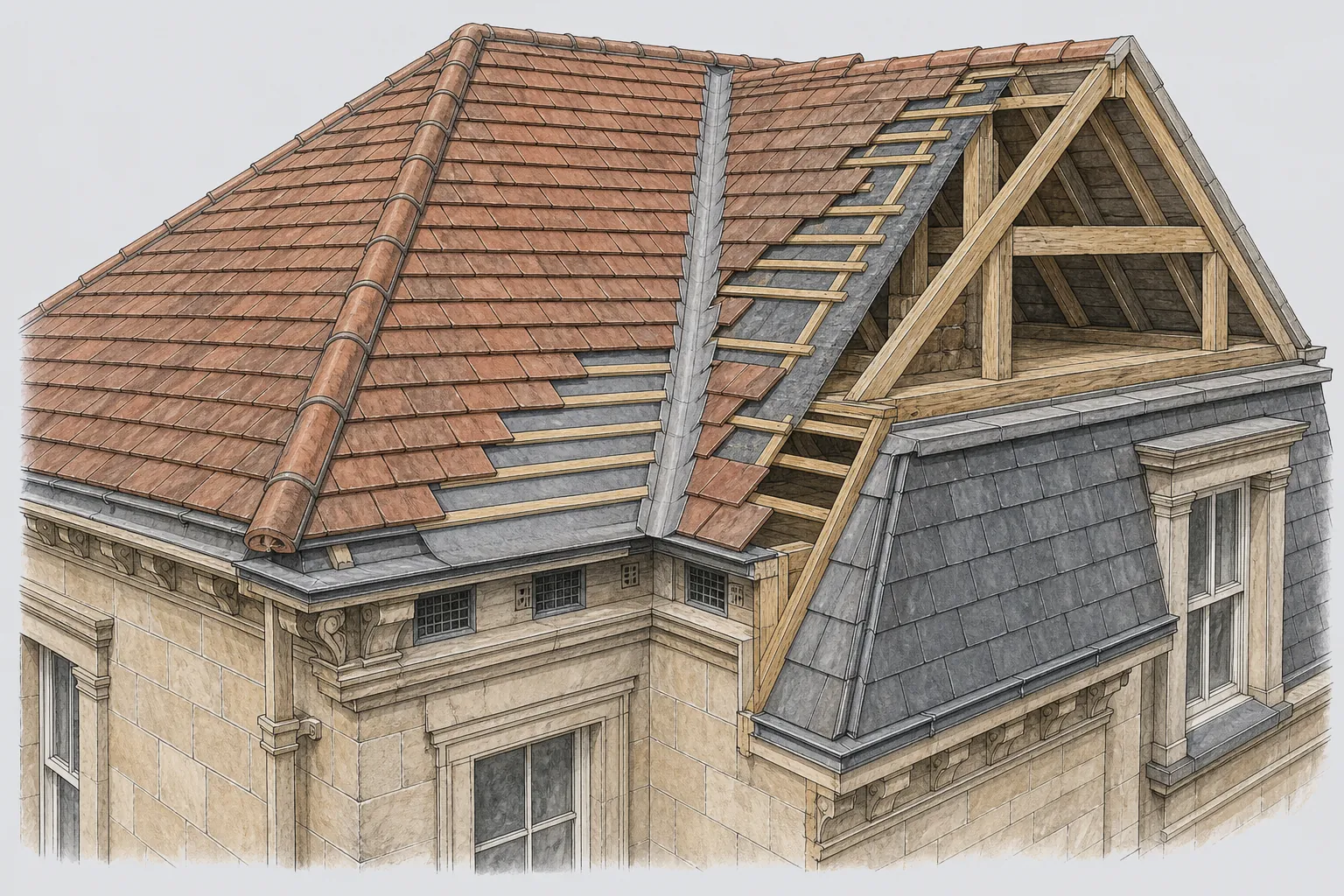
Mortar is the second item. Ridge and hip tiles on older roofs were bedded in it, and over time the beds crack and the tiles shift. Modern practice adds mechanical fixings to the tiles, and a dry-fix system, which clips and caps ridge and verge without mortar, is a neat way to do it on concrete tiles. The verge, the edge over a gable wall, fails in the same way.

Third come the timbers at the eaves: fascia, soffit and the first batten. Water that has run behind a gutter for years softens them, and a probe tells us more than the eye. If you are unsure which of these applies to your roof, a roof inspection is the starting point. Our roof inspections page describes what a survey covers and what you receive afterwards.

Where the faults are limited, the work comes under roof repairs, and we say clearly when the sums point the other way.

Parts of an older tiled roof and what we check on each

PartTypical faultWhat we do
UnderlayBrittle, torn or sagging at the eavesPatch the eaves or renew across the slope
Ridge and hip bedsCracked mortar, loose tilesRebed with mechanical fixing or fit dry-fix
VergePointing lost, end tiles rockingRefix the end tiles and make good
Eaves timbersSoft fascia, soffit or battenCut out the rot and renew

Homes built in 2018 and 2019

St James Mews and Charfield Village have young roofs, which fail in small and specific places.

Newer homes make different demands on a roofer. The covering is modern, the underlay is a breathable membrane, the battens are treated and the ridge may be dry-fixed from the start. None of that makes a roof maintenance-free, but it does move the likely faults to the details.

On a roof built within the last few years, the most common calls are for a tile that has slipped, a ridge piece that has come loose after a storm or a flashing that has lifted at a chimney or a wall. A flashing is the lead or other metal that bridges the join between roof and wall. If it was dressed carelessly, the join opens in the first winters, and water goes where the builder did not intend. Another detail is the valley, the channel between two slopes, which collects what runs off both and shows any fault in the lining quickly.

Ventilation can also be a factor. A loft roof needs air to move through it, and a vent that is blocked by loft insulation pushed too far into the eaves causes condensation, which can be mistaken for a leak. We look at both the roof and the loft when we survey, so that we do not repair the covering to cure a problem that is really about airflow.

Many of these faults are minor, and the sensible response is a small, quick repair. They are worth dealing with promptly, though. A tile that has moved on a young roof lets water reach the batten and the underlay, and over a wet winter that can turn a small job into a larger one. If you notice a gap or a stain, ask for a survey and keep any paperwork from the original build to hand, so we know what was fitted.

Whatever the roof's age, we give a firm price after the survey and do not start work until you have agreed it.

Myth

A roof built in the last few years cannot need any attention.

Fact

New roofs fail at junctions and fixings, such as flashings, valleys and ridge pieces, so a quick check after the first winters catches faults while they are small.

Churchend and the Church of St James

A 13th-century Grade I building brings the strictest rules, and the most careful repair.

The Church of St James in Churchend dates from the 13th century and is a Grade I listed building, which is the highest category of listing. For a roof like that, repairs are not routine. They are decisions, taken by the Churches Conservation Trust, which looks after the building, and they are made with its long future in mind.

For a listed house or hall in the village, listed building consent is the permission that applies. It is separate from planning permission, and unauthorised alteration of a listed building is a criminal offence. South Gloucestershire Council deals with applications here, and the first step is a conversation with the council's conservation officer before work begins. A good scope helps that conversation, and we write one: the covering, the lead, the fixings, the mortar and the method, each set out so the council can see what is proposed.

The roofs of an old church carry a number of materials. There will be a main covering, lead in the valleys, parapet gutters and flashings, and often a stone verge or coping at the gable. Lead gutters hidden behind a parapet are among the most failure-prone parts of any roof, because a split, even a small one, feeds water into the wall head, where it does damage unseen. We check the lead, the falls and the outlets, and we look at the stonework around them.

Old churches are just the sort of building where bats and nesting birds make their homes, and the law shields both. Any survey of a roof like this includes a look for signs, and if we find any we stop and tell you what that means for the timing.

Not everyone who reads this is a churchwarden. If you own a listed house in Charfield, the same principles apply, and our roof repairs work on listed property follows the same route of survey, scope, consent and then the work.

Listed roofs

Speak to the council before starting on a listed roof, and ask your roofer for a written scope you can send them.

Low ground by the Little Avon

Damp air, shade and trees keep a roof wet for longer, and the old station is a reminder of how much else sits beside the homes.

Charfield lies near the Little Avon River, and low ground near water holds moisture. On a roof, that matters in a few ways. Slopes that face away from the sun stay damp, moss takes hold in the gaps between tiles and gutters fill with whatever the nearest trees drop.

Moss is not the cause of most leaks, but it is worth removing for three reasons. It holds water against the covering, it can lift tiles as it grows and it eventually blocks gutters when it falls. How it is removed matters. Pressure washing may harm softer coverings, so the method has to suit the material: a soft wash and a biocide on tiles, a gentler hand on slate. A roof that has just been cleaned should also be checked for the things the moss was hiding, such as cracked or slipped tiles. Our roof cleaning page explains how we decide.

Gutters are the second concern. Leaves and silt build up in the gutter and at the outlet, and a blocked outlet sends water over the front of the gutter and down the wall. Cast iron, aluminium and uPVC each have different failure points, and on any of them a cleared and levelled run is the first thing we want to see.

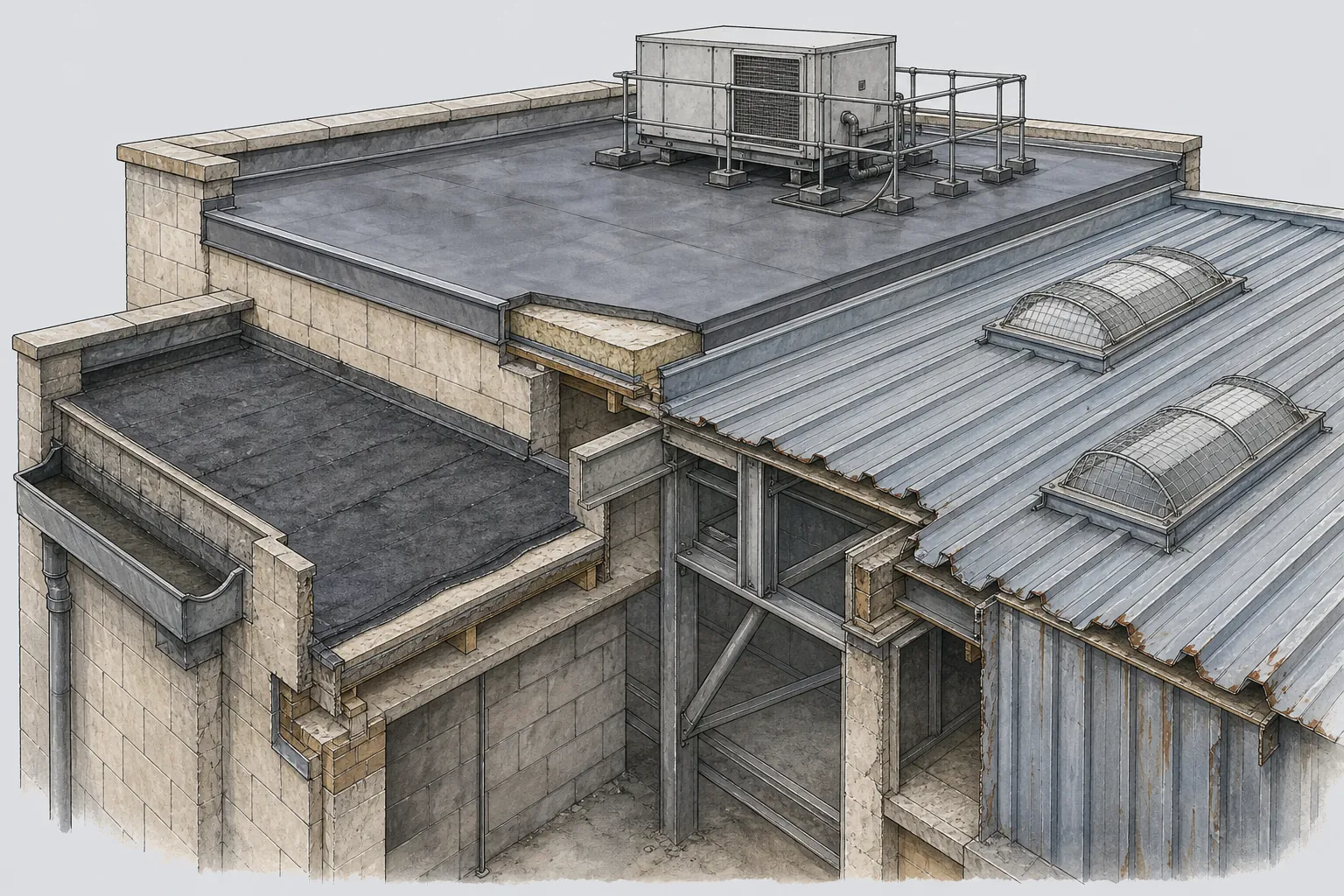
The old station, closed in 1965 but still standing, is a reminder that this village has non-domestic structures too. Canopies, outbuildings, sheds and workshops often have flat or low-pitched roofs, covered in felt, EPDM or GRP, and they need the same attention as the houses. Where an older flat roof is ponding water, we check the deck and the falls before deciding whether to patch or recover.

If water is coming in now, stopping it comes first, and leaks and storm damage go to the top of our list.

Map showing the location of Charfield.

Nearby

Roofers near Charfield

Roofing services in Charfield

Local questions

Seven housing areas, many Charfield questions

My house is on one of Charfield's older estates and the loft smells damp after rain. Is it the tiles?

Probably not the tiles themselves. On an older roof the underlay is the more likely culprit: it dries out, tears or sags, and then fails to carry blown-in water to the gutter. We look at the underlay, the eaves timbers and the ventilation in the loft, and we show you photographs of whatever we find so you can decide between a local repair and a bigger job.

I have a home from the 2018 or 2019 developments and a tile has slipped. Is that a worry?

It is a small fault, but worth fixing before winter. A slipped tile lets water reach the batten and underlay, and the damage grows if it is left. We check the tiles around it for the same movement, look at the ridge and flashings, and put the tile back or replace it. If the cause is a fixing problem in the original build, we tell you.

Do you work on the roof of a listed church or hall in Charfield?

Yes. We write a scope that describes the covering, lead and fixings so that a church council, trust or committee can take it to whoever grants consent: South Gloucestershire Council for a secular listed building, the diocese where the building is a working Church of England church. Because bats and nesting birds are protected, the survey looks for signs of both before any work is planned.

Moss is growing on the north slope of my roof near the river. Should I have it cleaned?

Usually, yes, though the method depends on the covering. Aggressive pressure washing can damage tiles, so we use a gentler approach and treat the roof afterwards. We also look at what the moss was hiding. If the tiles beneath are cracked or the gutter is full, cleaning alone is not the answer, and you will hear that from us.

Get your free survey

Get your free roof survey

Tell us what's happening and we'll call you back to arrange a visit. Prefer to talk? Call 01225 285181.

  • Photos of your own roof
  • A fixed price in writing
  • 10-year workmanship guarantee
Call Free survey