


Hills on both flanks: shade, run-off and access
Wotton Hill and Tor Hill shape the weather on the roofs, and the way a scaffold goes up.
A roof in a hollow between hills behaves differently from one on an open plain. In Wotton-under-Edge the hills sit close to the town on two sides, so the sun goes behind them earlier in the day, trees stand on the slopes above and rain that runs off the hillsides finds its way down through the streets. None of this causes a leak by itself, but it creates the conditions in which small faults grow.
The first condition is damp. A north-facing slope that dries slowly is where moss gets hold. Moss is a plant that grows in the gaps between tiles and slates, and it holds water against the covering. A thick growth can lift the edge of a tile, and when it dries and falls it heads for the gutter and blocks it. We look at roofs like this for the moss, but also for what it has been covering: cracks, slipped courses and worn edges that a clean surface would reveal.
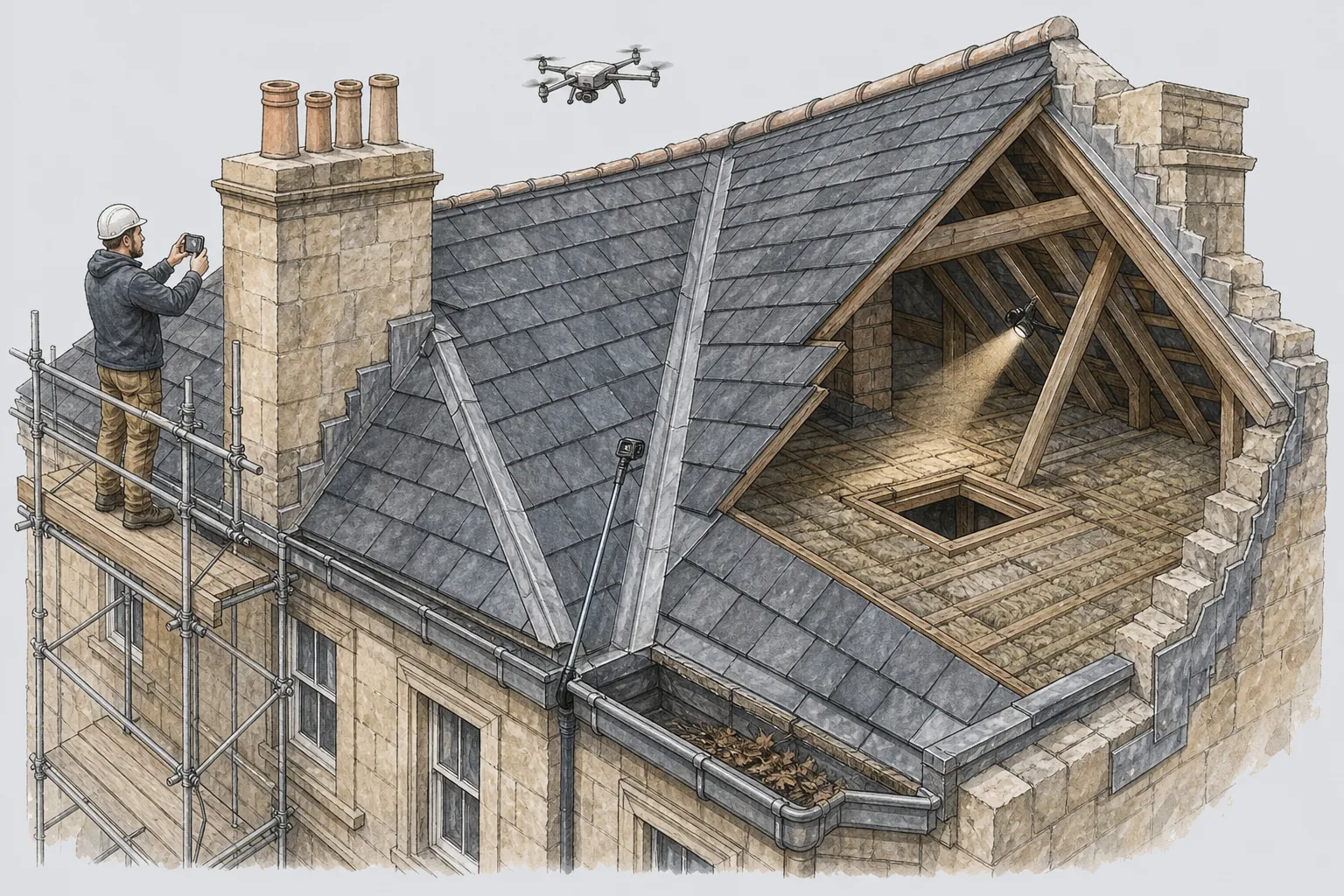
The second condition is leaf fall. Trees close to the roof drop leaves, seed and twigs into gutters and valleys, and a valley is the channel between two slopes that gathers most of it. A blocked valley overflows under the tiles. Clearing it is simple and quick, and it prevents a leak that is difficult to trace afterwards.
The third is access. A house on a hillside may have a front that is two storeys high and a back that is three, or a drive that cannot take a lorry. Scaffold has to be planned for the lie of the land, and the cost depends on it. We look at it on the survey and tell you what the access involves, so the quote has no surprises in it.
If moss is the main issue, the methods we use, and when we advise against them, are set out on our roof cleaning page.