
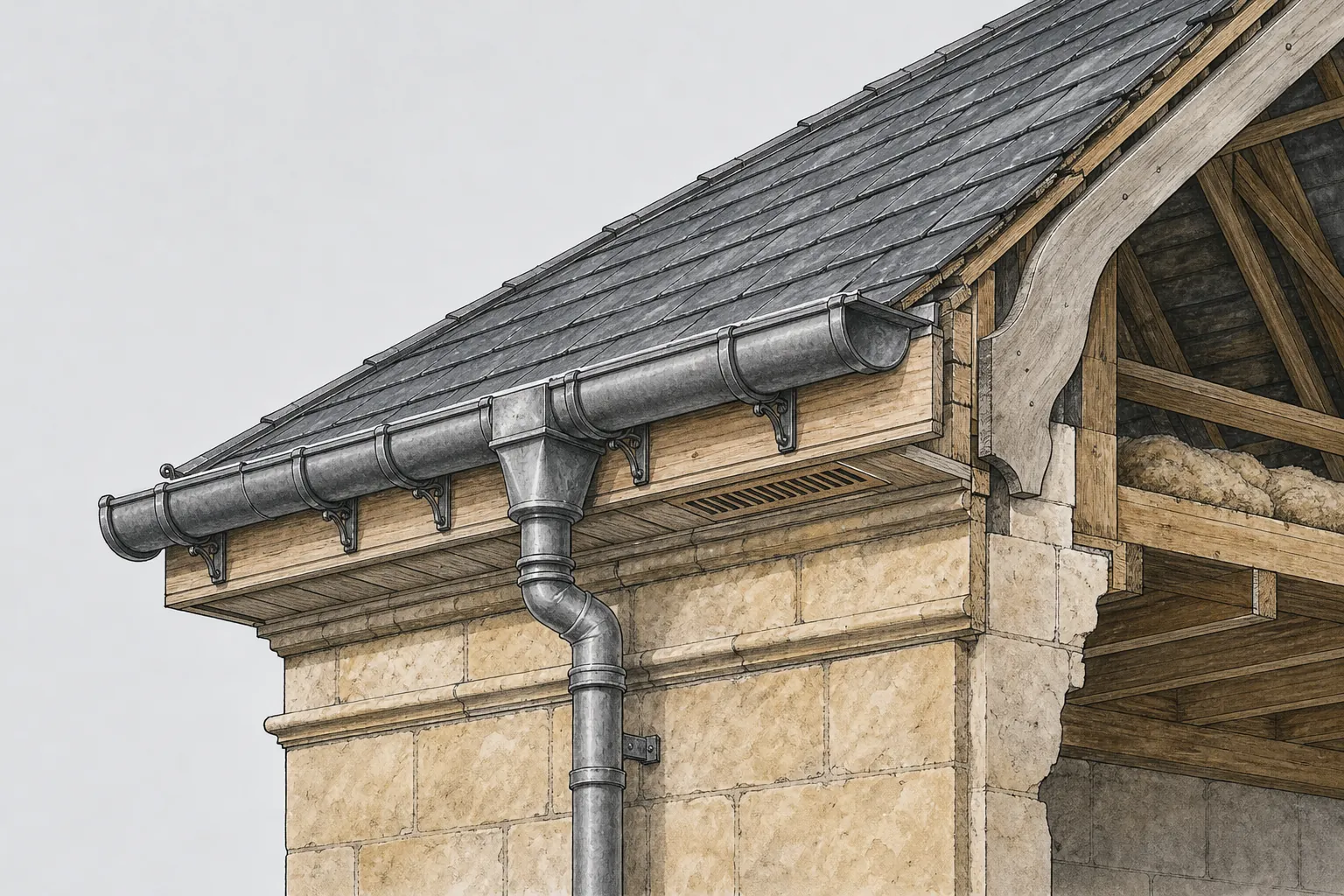
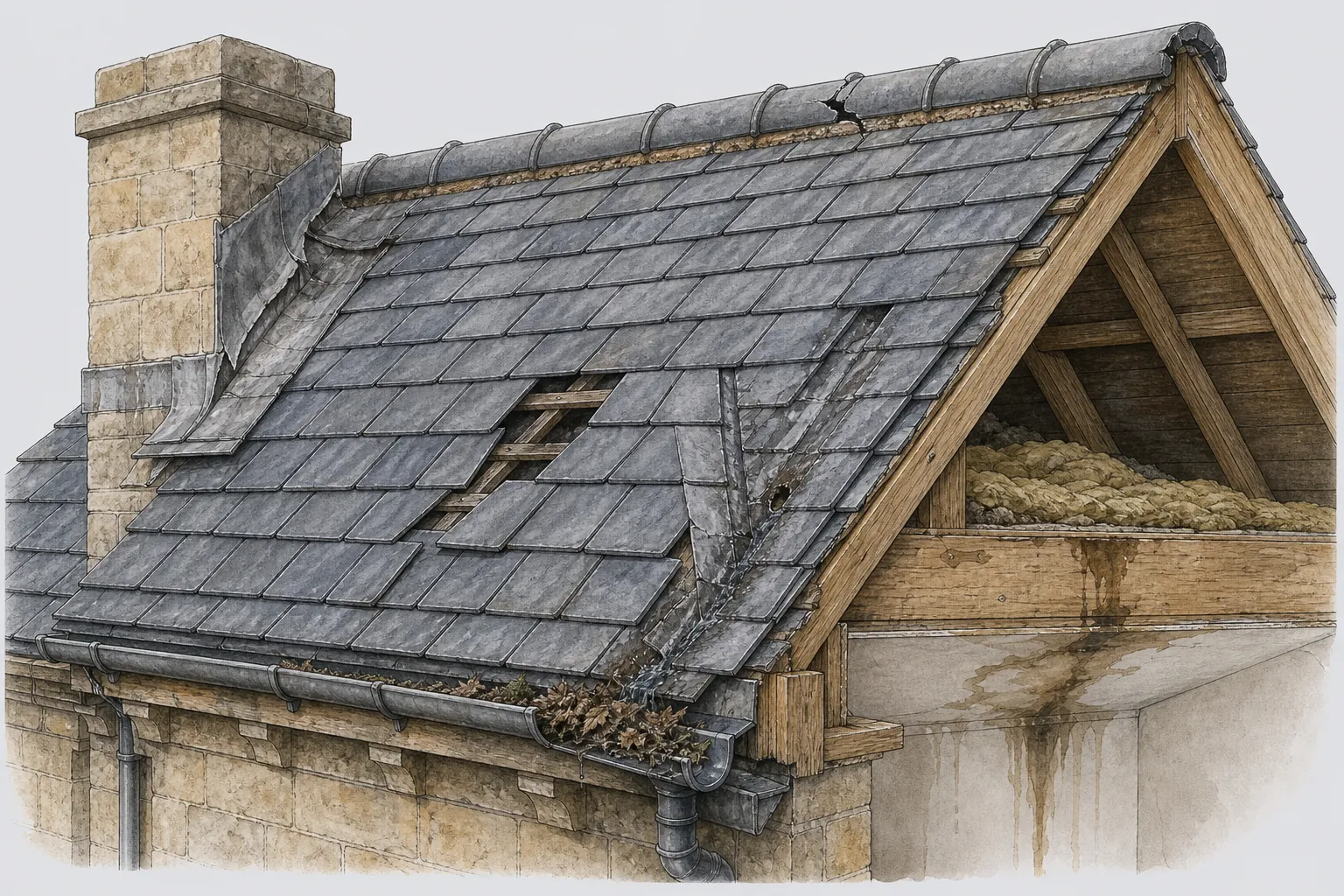
Georgian terrace of honey Bath stone with natural slate roofs and chimney stacks

Roofers in Claverton Down

Claverton Down is a high, open plateau, 2.7 road miles out from central Bath to the south-east. Its roofs are the flat and low-pitched ones of a university campus, offices and clubhouses, with a scattering of houses and farm buildings, nearly all of them twentieth century. The work differs from city terraces, and so does the survey.

Local roofs

A plateau of limestone, buildings and open ground

Claverton Down is primarily a rural area with relatively few houses. It is better known for what stands on it: the University of Bath, the headquarters of Wessex Water and Bath Golf Course. The ground is a generally flat plateau of Great Oolitic Limestone, and because the rock is porous the plateau has no significant natural watercourses. Rain does not run off in streams here. It soaks into the stone.

The buildings are young by Bath standards. Apart from a few farm buildings, the buildings on Bathampton Down and Claverton Down all date from the twentieth century, and most of the non-residential ones were put up from the 1960s onwards. That sets the kind of roof you find. Large buildings of the second half of the century were often built with flat or low-pitched roofs, bitumen felt or later single-ply membranes, and many have by now been recovered or patched.

The area's older history survives mostly in the landscape. Parts of Claverton Down include medieval parkland, and the original Bath racecourse stood on the plateau east of the University. An isolation hospital was built here in 1876, first with temporary wooden ward blocks and two fever tents, and permanent buildings followed in 1931 to 1934. Below the Down stands Claverton Manor, now the American Museum, designed by Jeffry Wyatville in 1819 to 1820 and listed Grade I.

For roofing, the area is about large institutional roofs and the people who manage them: estates teams, building managers, club secretaries and owners. We write our surveys for that reader.

Council
Bath and North East Somerset Council
From central Bath
2.7 road miles, south-east
Landform
Flat plateau of Great Oolitic Limestone
Notable sites
University of Bath, Wessex Water headquarters, Bath Golf Course
Claverton Manor
Grade I, designed by Jeffry Wyatville, 1819 to 1820

What we find

Worn upstands and big outlets on Claverton Down

Worn edges and upstands on flat roofsThe surface of a flat roof usually outlasts its details. We check where the covering turns up a wall (the upstand), where it ends at an edge, and around outlets, rooflights and plant, because those junctions are where the first leak starts.
Blocked outlets on large roofsA big flat roof depends on a few outlets, and if one clogs the water ponds. We look for standing water, staining and debris, and we test the outlets and gutters before we go on to anything else.
Old repairs and overlaysRoofs of the 1960s onward have often been patched and overlaid more than once. We find out how many layers are on the deck and what is trapped beneath them, because that decides whether a repair or a full renewal makes sense.

Flat and low-pitched roofs from the second half of the twentieth century

A campus built from the 1960s onward has roofs now reaching the age when the first renewals fall due.

The character appraisal for Bath records that most of the non-residential buildings on Claverton Down were put up from the 1960s onwards. The roofs of those buildings were designed for the materials of their day. Many were laid with built-up bitumen felt, a system of layers fused together with hot bitumen. Others have been renewed since with single-ply membranes.

Each system ages in its own way. Built-up felt tends to craze, blister and split at laps and upstands as the bitumen dries out. EPDM is a single-ply synthetic rubber sheet supplied in large pieces; it resists cracking better but depends on its seams and edge adhesive. GRP is glass matting and resin built up wet on the roof and left to harden, which gives a joint-free skin that can still crack where the deck beneath it moves. Whichever of the three is already there decides what can be stuck over it and what has to be stripped.

A flat roof is also rarely truly flat. It is laid to a gentle fall towards the outlets, and when the fall is too slight or the deck has sagged, water sits in pools. Standing water ages the surface, supports moss and adds weight. We measure the fall and mark ponding at the survey, and note it in the report.

The decision most owners face is whether to repair, overlay or strip. A repair suits a roof that is basically sound with a localised fault. An overlay adds a new layer over the old, which is quicker but only works if the existing layers are dry and attached. Stripping to the deck takes longer but shows the condition of the structure and insulation underneath. Our flat roofing page describes these options and the typical costs of each.

Myth

A flat roof only needs attention once it starts to leak.

Fact

Edges, upstands and outlets wear before the surface fails, so a routine inspection finds the fault while it is still a small repair.

Estates, offices and the planning of a large roof

Buildings with a manager need records and a programme, as well as a repair.

The big buildings on the Down are run by organisations with budgets, timetables and responsibilities to the people inside. A roof that fails on a teaching block, an office or a clubhouse means closed rooms and disrupted use, so the useful approach to such roofs is planned maintenance, not emergency repair.

We begin with a survey that records the roof as it is: the covering and its age, the number of layers, the position of every outlet and rooflight, the condition of the edges, the state of the insulation where we can see it. We photograph each area and mark the faults on a plan. From that record, work can be split into what is urgent, what should happen in the next season and what can wait. A building manager can then budget in stages rather than facing a single large bill.

Access on a commercial roof needs attention in its own right. Edge protection, safe routes across fragile rooflights and the arrangements for plant and services all affect how and when work is done. Working near occupied rooms means noise and fumes (from hot-applied systems) have to be planned around the use of the building. We agree the hours and the method at the outset, and we tell you where a roof will need a second visit, such as a cure time between coats.

Where a roof is old enough to need renewal, the specification is usually the biggest decision. Adding insulation to meet current standards changes the build-up and the details at the edges, and the choice of membrane determines the maintenance that follows. We lay out the options with their trade-offs in writing. Surveying and pricing of this kind is covered under commercial roofing, where a roof is priced after inspection rather than from a list.

Common flat roof systems compared

SystemHow it is laidWhere it suits
Built-up feltLayers fused with hot bitumenRoofs with simple outlines and good access
EPDMRubber sheet, adhered or ballastedLarge, plain areas with few penetrations
GRPResin and glass matting built up wetSmaller roofs with awkward shapes
LeadSheet dressed to the roof and its detailsValleys, edges and heritage buildings

Farm buildings, golf and the few houses

Away from the campus, the Down has working buildings and clubhouses with roofs of their own.

Claverton Down is described as primarily rural, and the few farm buildings that predate the twentieth century are the oldest structures on the plateau. A barn or outbuilding of that kind may have a roof of clay tiles or stone slates on heavy timbers, or may have been re-covered in sheeting at some point. Each needs a different eye. The sheeting may be fibre cement, and if it is, it needs care in handling. Asbestos cement is non-licensed work when the sheets are carefully removed without breaking them up, and becomes notifiable if they are broken. Nothing is touched until we know what the sheet is.

The golf course and the buildings around it also have roofs to keep dry. A clubhouse typically has a mixed roof of pitches, flat sections and a porch or veranda, and the points where these join are the weak spots. Outbuildings, sheds and stores need little, but a failing felt roof on a store can ruin what is inside it before anyone notices.

Houses on the Down are few, but the ones that exist share the exposure of the plateau. On a high, open site, gusts reach every part of a roof, and the edges, the ridge and the gable ends take the force. If you live on the Down and a slate or tile has been lost in a gale, check the ridge and verge as well as the gap. Where one piece has slipped, its neighbours are often loose.

The same survey process applies to all of these. We examine the roof, record it with photographs, then put a fixed price on paper for the repair. For a roof on a farm building or an outbuilding the question is often whether to repair, replace the sheeting or re-cover, and we set out what each involves. For help with a general leak, our roof inspections page describes how a survey is carried out and reported.

Porous rock, no streams and where roof water goes

On a plateau where rain soaks away, drainage design is something a roofer needs to think about too.

A plateau of porous limestone has no streams to carry rain away. Water falls on the roofs and the car parks, and it is then up to the drainage to deal with it. On Claverton Down this is a matter of pipes, soakaways and the ground itself, and a roof outlet that discharges onto the surface can leave a pool at a wall or cause damp where there was none.

That makes rainwater goods important. Gutters, downpipes and hoppers on a large building collect from a very large area, so a blocked outlet at one corner can overload the neighbouring one. We clear and flush the outlets as part of any survey of a large roof, check that the pipes lead to a drain or soakaway, and look at the base of the wall beneath each downpipe for signs of splashing or staining.

The plateau is high and open. The golf course, the medieval parkland and the open ground around the campus leave little to shelter a roof from the wind. Open ground affects roofs in two ways. Wind lifts the edges of membranes and the sheets of cladding, so fixings and edge details are worth checking after storms. And in autumn, leaf-fall from the few trees on the Down still blocks outlets quickly, especially at the parapet of a flat roof.

A written maintenance routine is the best defence. Clear outlets and gutters in autumn, check the roof after any storm, and have the membrane, flashings and edges looked at every year or two. The record from each visit shows which problems are recurring and which are one-off. Our roof inspections and flat roofing pages explain what a visit includes, and the survey is free for your own roof, with a written price to follow.

Inspect or renew

Inspect and repair a flat roof whose layers are dry and attached; renew it when water is trapped beneath the surface or the repairs outnumber the sound areas.

Map showing the location of Claverton Down.

Nearby

Roofers near Claverton Down

Roofing services in Claverton Down

Local questions

Questions about large flat roofs on the plateau

How can a building manager on the Claverton Down campus plan roof maintenance across several flat roofs?

Start with a written survey of every roof, so each has a record of its covering, its drainage and its faults. From that, rank the work into urgent, next season and later. We provide photographs and a plan marking each defect, and a fixed written price for the works, so work can be staged to fit the building's use and the budget cycle.

Is Claverton Manor's Grade I listing relevant to roofs on the Down?

Only to the Manor itself, which stands below the Down. Listed building consent from B&NES applies to listed buildings, so a roof on the Manor is a conservation matter. The twentieth century buildings on the plateau are not covered by that listing, though any building could be affected by other designations, and B&NES planning can say whether yours is.

Our clubhouse roof on the Down keeps ponding after rain. Does that need renewal?

Not always. Ponding means the roof is not draining fully, and the cause might be a blocked outlet, a sagging deck or too slight a fall. We find which, then repair the outlet or the fall, or recommend renewal where the deck or the layers underneath have been affected. We mark the extent of ponding at survey so the quote matches the problem.

We have a barn near Claverton Down with old cement sheeting. Can it be removed safely?

It can be, once the material is identified. Where asbestos cement sheeting is carefully removed without being broken up, HSE guidance treats it as non-licensed work, and it becomes notifiable if it is substantially broken. We identify the sheeting first and plan the removal, handling and disposal before any work starts, and we discuss the replacement covering with you.

Get your free survey

Get your free roof survey

Tell us what's happening and we'll call you back to arrange a visit. Prefer to talk? Call 01225 285181.

  • Photos of your own roof
  • A fixed price in writing
  • 10-year workmanship guarantee
Call Free survey