
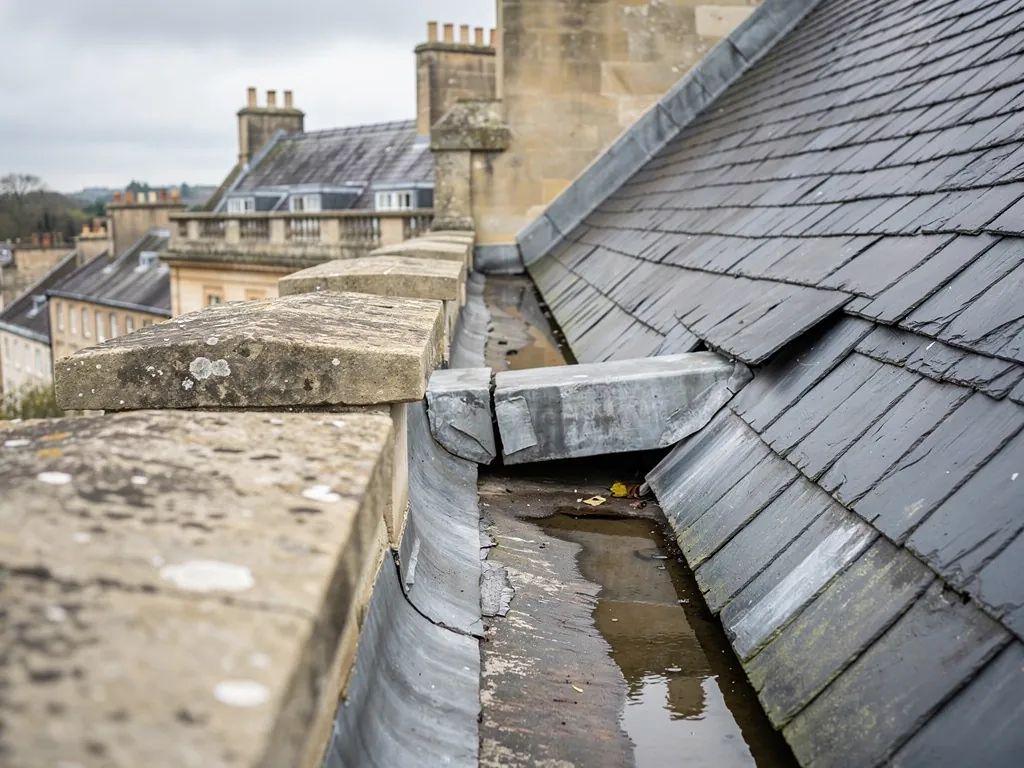
Georgian terrace of honey Bath stone with natural slate roofs and chimney stacks

Roofers in Combe Down

Combe Down sits on its ridge 1.9 road miles south of Bath, and its roofs carry the weather the city centre is spared. The Georgian and Victorian houses keep their original coverings and Bath stone stacks, Foxhill and Mulberry Park bring newer roofs, and any repair on either side of the village is made in the material already there.

Local roofs

A village built over its own stone

Combe Down grew up over the stone it was built from. The village stands on a ridge above Bath, looking south across the Midford Valley, and under its streets run the old workings of 18th and 19th century stone mines. Those mines were filled, for the most part with foam concrete, and stabilised in a government-funded project that ran from 2005 to 2010 and took in about 760 properties. Above ground stand Bath stone villas, terraces and workers' cottages from the 18th and 19th centuries, with the post-war Foxhill estate and the 21st century Mulberry Park development on the village's edge.

That mix sets the work. A Georgian or Victorian house here is a Bath stone box with a timber roof, and the things that let water in are the joints between the two: the stack, the abutments, the valleys and the gutters behind any parapet. The ridge position matters too. A roof on the top of the hill takes wind and driven rain from the open valley side, and a slate that would sit quietly for years in a sheltered street will lift sooner up here once its nail has rusted.

The stone has not gone away either. Upper Lawn Quarry, off Shaft Road, is the one working quarry left on the edge of the village and still supplies Bath stone. When a chimney cap, coping or stack needs new stone, the material is still being cut on the edge of the village.

Combe Down has 79 listed buildings, Grade I and Grade II, the oldest from 1729 and the youngest from 1909, so on many houses here consent is a question to settle alongside cost. We answer both, and we put what we find in writing with photographs of your own roof.

Council
Bath and North East Somerset Council
From central Bath
1.9 road miles, south
Listed buildings
79, Grade I and Grade II (1729 to 1909)
Stone mines
Filled and stabilised, 2005 to 2010
Working quarry
Upper Lawn Quarry, off Shaft Road

What we find

Slipped slates and stone stacks along the ridge

Slipped slates on exposed slopesOn the ridge-top streets, a slate held by a corroded nail is the first thing the wind finds. We check the courses for gaps, refix with a tingle (a small copper or lead strap) where the roof is sound, and look for the pattern that says the whole roof has nail sickness.
Tired joints on Bath stone stacksStone chimneys here need lime, not cement. We look at the flaunching (the bed of mortar the pots stand in), the pointing and the lead flashings where the stack passes through the slope, because that junction is where a dry loft first turns damp.
Valleys and parapet guttersWhere two slopes meet, the valley carries all their water, and on a terrace with a parapet the gutter behind the wall does the same job out of sight. We lift the slates at the edge, check the lead for splits at its laps, and clear what the trees have dropped.

Slate and stone on the older houses

The 18th and 19th century villas and cottages were built to be mended, provided the repair matches the roof.

The Georgian and Victorian houses of Combe Down are Bath stone walls carrying a timber roof, and the covering on that roof is whatever the builder could get and afford at the time. It may be natural slate, laid on battens (thin timber strips that take the slate nails). It may be stone tile, heavier and laid in courses that shrink towards the ridge. Or it may have been re-covered with concrete tiles or man-made slate at some point, and that change needs to be found before anything else is planned.

The slate itself is rarely the weak point. What fails is the nail, the batten and whatever sits underneath. Many older roofs have no underlay at all (the sheet beneath the battens that turns any rain blown past the slates back to the eaves), or carry an early felt that has gone brittle at the eaves. Once the nails corrode, slates slide out of their courses one at a time, and the gaps are easy to spot from the garden on a bright day.

Our first job is to tell you which kind of failure you have. A handful of slipped slates on a sound roof is a repair. Slates slipping across every slope, with old tingles dotted about from earlier repairs, means the fixings have reached the end, and the lasting fix is a re-slate that keeps the good slate and replaces what holds it.

Matching matters on these streets. Natural slate stays natural slate, and we bring in new or reclaimed slate in a matching size and colour when there are not enough sound ones to go round. Stone tiles are sorted by length so the diminishing courses read as they did. Our slate roofing service sets out how we approach both, and the work on a pitched roof that is not slate, from plain tiles to the timbers below, sits under pitched roofing.

Bath stone chimneys and lime

A village that still quarries its own stone has no excuse for patching a stack in grey cement.

Chimney stacks on the older Combe Down houses are built of the same Bath stone as the walls, and they weather the same way: slowly, from the surface, and faster wherever water is trapped. The stack is also where the roof is most exposed. It stands above the ridge line, takes the wind on every face, and relies on lead and mortar to keep water out where it meets the slope.

Three parts deserve attention. The flaunching, a sloping bed of mortar crowning the stack, grips the pots and sheds the rain; once it cracks, water runs straight down inside the stone. The pointing between the stones loses its face over time and needs raking out and refilling. And the flashing, the lead dressed over the junction between stack and roof, lifts or splits with age, while the soakers (lead pieces slipped between the slates, one per course, along the side of the stack) can rot unseen beneath it.

The material for each repair matters as much as the repair itself. Bath stone needs a lime mortar that is softer and more open than the stone around it, so that moisture leaves through the joint rather than through the face. Cement does the opposite. Bath Preservation Trust casework on one listed stack in the city noted that the cement could have made the decay to the stone worse, and urged lime for both the pointing and the flaunching.

Replacement stone is not a problem here. Upper Lawn Quarry, on the edge of the village, still supplies Bath stone, so a cracked cap or a decayed course can be replaced in kind rather than filled with mortar. On a listed house, altering or rebuilding a stack must have listed building consent agreed with B&NES before work starts, and we will tell you at the survey when that applies. The full range of stack repairs, from repointing to a rebuild, is described on our chimney repairs page.

Myth

Hard cement mortar makes a Bath stone chimney last longer.

Fact

Cement traps moisture in soft limestone, so the stone around a hard joint decays first, which is why lime is used for pointing and flaunching on these stacks.

Listed buildings and consent in the village

Seventy-nine listed buildings means many Combe Down roofs need a conversation with the council before a ladder goes up.

Combe Down's listed buildings run from 1729 to 1909, and they take in houses, terraces and parts of the old De Montalt paper mill on the village's southern slopes, which was converted to housing in 2007. If your house is one of them, the roof is part of what was listed, and changes to it need listed building consent, which Bath and North East Somerset Council grants.

Consent is not the same as planning permission, and B&NES is plain that altering a listed building without consent breaks the criminal law. It asks owners to contact the planning authority ahead of any work. In practice, a like-for-like repair that keeps the existing slate, lead and stone may raise few questions, while a change of covering, a new roof window or a rebuilt chimney is the kind of work that needs agreeing first. We cannot give you a legal ruling on your own house, but we can tell you what the work involves and what to ask the conservation team.

The city's World Heritage status follows the city boundary, and roughly half of that ground also falls within the conservation area. Whether your particular street falls inside the conservation area is worth checking on the B&NES policy map, along with any Article 4 direction, before you plan a change you will see from the road.

Building Regulations are a separate question. Re-covering normally needs no approval where it touches less than 25% of the building's envelope and less than 50% of the roof. Bigger re-roofs need it and may bring a thermal upgrade, and so does any new covering heavier than the old by 15% or more. Where the work is notifiable we handle that side for you, through B&NES Building Control or, if you prefer, a registered private approver.

79

Grade I and Grade II listed buildings in Combe Down

1729

Date of the earliest listed building in the village

760

Properties, approximately, over the stabilised stone mines

Figures: Combe Down entry, Wikipedia, checked October 2026

Foxhill, Mulberry Park and the newer roofs

Not every roof in Combe Down is old, and the post-war and modern houses fail in their own ways.

Alongside the stone villages, Combe Down includes the post-war Foxhill estate and the 21st century Mulberry Park development. These roofs were built to different methods and they need a different eye. We do not assume a covering from the age of the house; we look at what is actually there, because a post-war roof may already have been re-covered once.

On a post-war pitched roof, the usual faults sit at the edges. Mortar-bedded ridge and hip tiles crack and loosen, and verges (the edge of the roof over the gable wall) lose their pointing and let wind under the end tiles. Today's standard for tiling work, BS 5534:2014, no longer relies on mortar alone to hold ridge and hip tiles, so when we re-bed or replace them we add a mechanical fixing. A dry-fix system (clips, caps and seals that hold the ridge and verge without mortar, tested under BS 8612:2018) is often the neater long-term answer on a concrete-tiled roof.

Underlay is the other common age issue. Early bitumen felt sags between rafters and breaks down at the eaves, where it should carry water into the gutter. When only the bottom course of felt has failed and the tiles above are sound, an eaves repair may be enough. If it has perished across the slope, the tiles come off, the battens and underlay are renewed, and the sound tiles go back.

Mulberry Park is new enough that the work there tends to be maintenance: a cleared gutter, a loose ridge cap, a check after a storm. Even on a new roof, a slipped tile left over winter lets water reach the battens, so small faults are worth catching early. For Foxhill and the older post-war houses, the work falls under pitched roofing, and the same survey applies to every one: we go up, photograph the roof and give you a fixed price in writing for what it needs.

Words you will hear

Verge
The sloping end of a roof, finished over a gable.
Dry-fix
A mortar-free system of clips, caps and seals holding ridges and verges in place.
Underlay
A sheet laid over the rafters, beneath the battens, that leads stray water down to the gutter.
Battens
Horizontal timber strips nailed to the rafters, which the tiles or slates hang from.

Map showing the location of Combe Down.

Nearby

Roofers near Combe Down

Roofing services in Combe Down

Local questions

Asked in the village above the stone mines

Does the stone mine stabilisation under Combe Down change how my roof is repaired?

Not directly. The project that ran from 2005 to 2010 filled and stabilised the old workings below about 760 properties; it dealt with the ground, not the roof. What we do on any older house here is look for signs of past movement before blaming the covering. A dipped ridge, a cracked stack or a slope out of true can point to the timbers or walls, and we check those first so you are not paying to re-slate a roof whose real fault is underneath.

Can new Bath stone be matched to a chimney on my Combe Down house?

Usually, yes. Upper Lawn Quarry, off Shaft Road, still supplies Bath stone, so a decayed cap or course can be replaced with new stone rather than filled with mortar. We set it in lime to suit the stone around it. If the house is listed, rebuilding or altering the stack needs B&NES to grant listed building consent first, and we will tell you before the work is priced whether we think that applies.

Do I need consent to re-slate a listed cottage in Combe Down?

Speak to the conservation officers at B&NES before work begins. A listed building's roof is part of the listing, and unauthorised work is a criminal offence, so consent is the first question for anything beyond a small like-for-like repair. We can describe the work in detail for that conversation, including the slate we would use and how the lead and fixings would be done, so the council has something specific to respond to.

We own a flat in the converted De Montalt mill. Can you work with our managing agent?

Yes. Shared roofs on converted buildings need a clear scope that everyone can agree, so we survey, photograph what we find and give a fixed written price that the agent can circulate. Parts of the mill are Grade II listed, so any change to those roofs needs consent from B&NES, and we will flag where that applies before the work is scheduled.

Get your free survey

Get your free roof survey

Tell us what's happening and we'll call you back to arrange a visit. Prefer to talk? Call 01225 285181.

  • Photos of your own roof
  • A fixed price in writing
  • 10-year workmanship guarantee
Call Free survey