
Georgian terrace of honey Bath stone with natural slate roofs and chimney stacks

Roofers in Foxhill

Foxhill is 2.4 road miles south of Bath, on a plateau where a planned estate went up after the war. Mansards on prefabricated houses, concrete tiles and flat sections are all part of that post-war estate, and a repair or renewal here goes back in the material that first covered each one.

Local roofs

An estate drawn on paper before it was built

Foxhill did not grow along a road or around a green. Its formal, geometric street pattern comes from the 1945 Abercrombie Plan for Bath, and you can read the plan in the way the roads curve and repeat. Nearly everything here is post-war. The one exception is a small pocket of earlier housing next to North Road on the eastern side.

The B&NES character appraisal says many of the buildings were put up as prefabricated panels or in reconstituted Bath stone, under concrete tile or flat roofs. The prefabricated Cornish unit houses are the ones people notice, because they have distinctive mansard roofs. A mansard bends each slope in two, steep at the bottom and flatter at the top, which lets a small house carry a full storey under its roof.

For the most part the estate sits on a plateau; its ground is layered Oolitic limestone with clay, and the appraisal records localised landslips and slumps in places. That is background for a roofer rather than a worry, though it is a reason to treat cracking and dropped ridges as questions rather than conclusions.

Foxhill had nearly 900 homes when Curo, the housing association that owned many of them, planned a redevelopment that would have demolished up to 542. In 2018 Curo decided against demolition and chose to improve its existing rented properties instead. Rented and owner-occupied houses now sit in the same streets, and both need roofs that work.

Council
Bath and North East Somerset Council
From central Bath
2.4 road miles, south
Layout
Planned under the 1945 Abercrombie Plan for Bath
Older housing
A small pocket beside North Road, on the east
Estate size
Nearly 900 homes at the time of Curo's plans

What we find

Mansards, flat sections and concrete tiles on Foxhill

The covering on a mansardThe steep lower slope and the near-flat top of a mansard are often different materials, and each ages differently. We check both, plus the line where they meet, because that is where rain tends to find a way in.
Flat sections and their edgesOn a flat roof the membrane rarely fails in the open field first. We look at the upstands, the outlets and the edge trims, and at any place where water has stood after rain.
Concrete tiles at the ridge and vergePost-war tiled roofs lose their mortar fillets before they lose their tiles. A loose ridge or a gappy verge is the first sign that the next storm will do more.

Cornish unit houses and their mansard roofs

A prefabricated house with a mansard roof is a particular kind of building, and it is repaired best when the repair starts from what is actually there.

The Cornish unit houses are the signature of Foxhill. They are prefabricated, which means large parts of the structure were made elsewhere and assembled on site, and the mansard roof that tops each one gives a compact house a full upper storey without a conventional gable. For a roofer the first question is a simple one: what is on it now? After many years and perhaps several rounds of repair, the covering can be quite different from the one the house was built with.

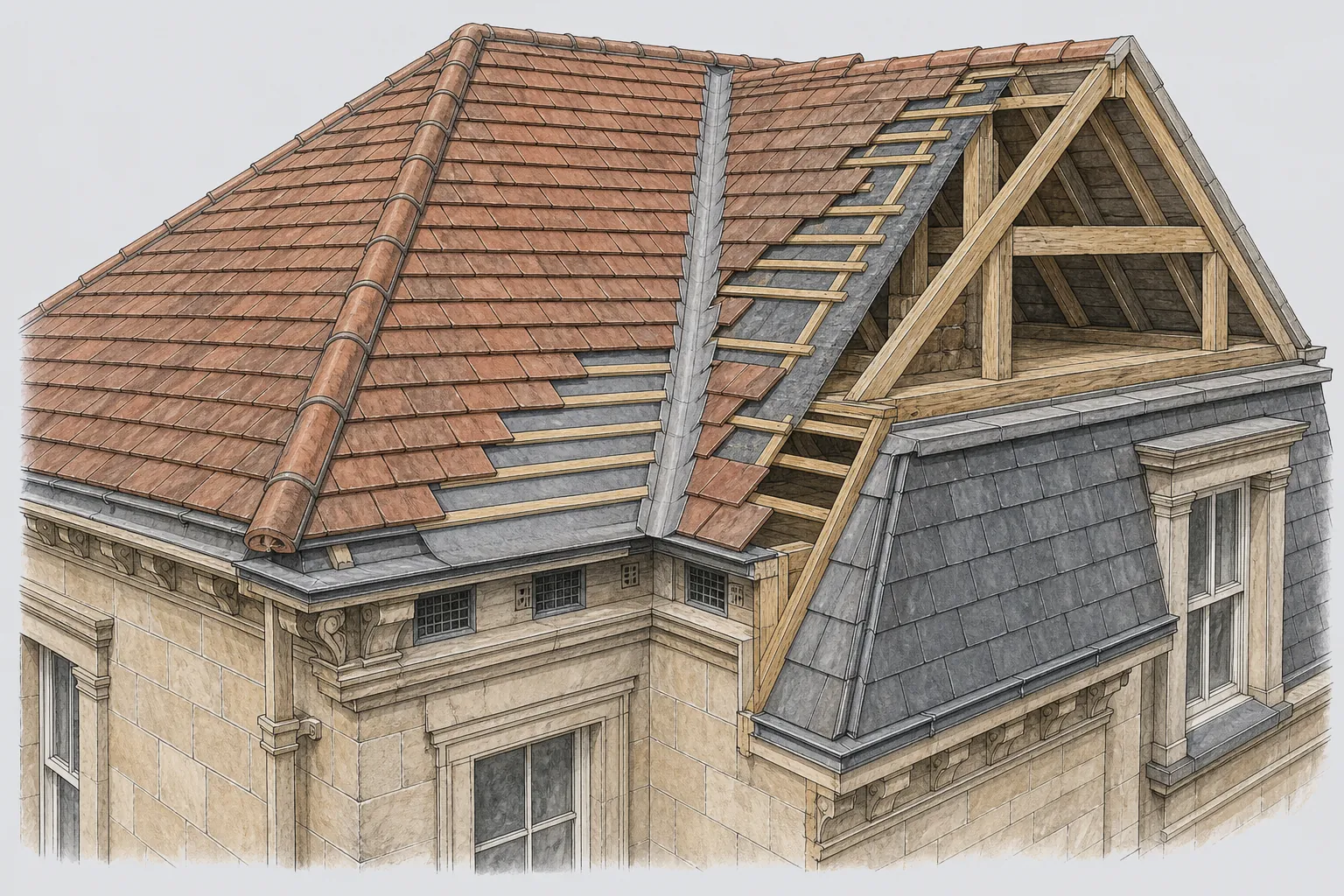
A mansard has two zones. The lower slope is steep, and it can carry tiles, slates or a sheet material. The upper part is shallow, sometimes nearly flat, and it sheds water slowly, which makes the covering there more sensitive to age and to blocked outlets. The line between them, the break in the pitch, gets our longest look. Water running down the upper slope has to pass over the join, and any lifted edge or split lap gives it a way under the lower covering.

Fixings need thought too. A house built from prefabricated panels does not take a screw or a nail in the same way as a masonry wall, so we find out what is behind the surface before we fix anything to it. Boards, soffits and sheet materials from the post-war years are a further reason for care. If any of them might be asbestos cement, we have it identified before we cut it. Under HSE guidance, taking such sheets away whole and carefully is non-licensed work, and breaking them up substantially makes it notifiable.

If a mansard needs more than a patch, the answer is a covering matched to the roof's profile and a well-detailed break line. Our roof repairs service covers the first, and a re-cover follows the same survey.

Flat roofs: membranes, upstands and ponding

The flat parts of an estate roof come in felt, rubber and fibreglass, and the right choice depends on what lies beneath.

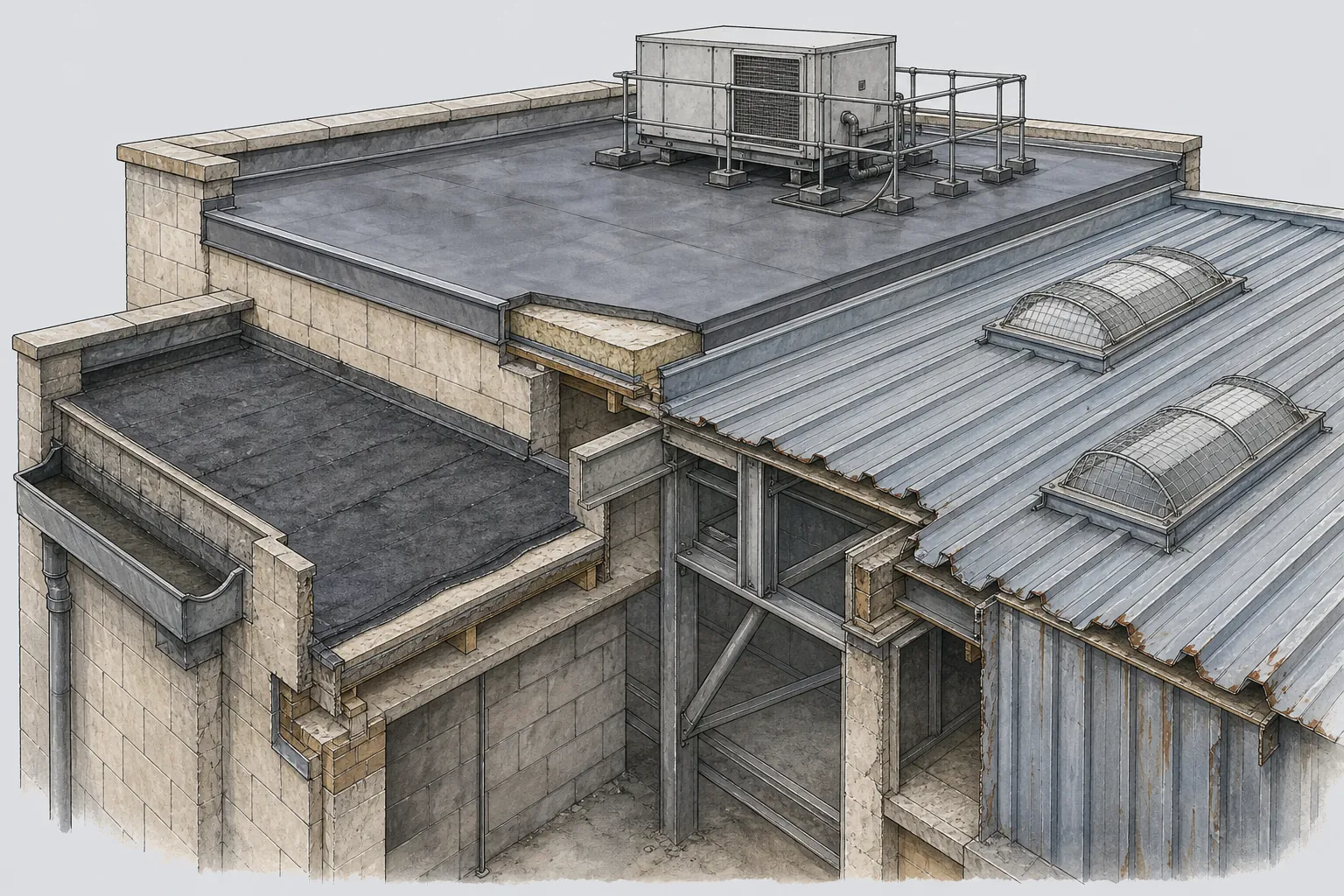
Where a Foxhill house has a flat roof, whether on an extension, a porch, a garage or the upper part of a mansard, the covering is a membrane laid over a deck. The common choices are bitumen felt in layers, EPDM (a synthetic rubber sheet), and GRP, which is fibreglass matting set in resin that hardens on the roof. Each has its place, and none is a cure for a deck that is wet underneath.

That is why we open up before we quote. Insulation matters, because a roof that does not breathe or drain properly collects condensation inside the build-up, and a membrane laid over soaked boards will fail early. In a warm-deck design, the insulation sits above the deck and below the membrane, which keeps the structure inside the warm side of the roof. Replacement may bring an insulation requirement under Part L of the Building Regulations, and we explain this before the price is fixed.

Flat roof faults gather at the edges. An upstand is the turned-up membrane where the roof meets a wall, and if it has pulled away or cracked, water runs behind it. Outlets clog with leaves and grit. Edge trims lift. Ponding, where water sits for days after rain, adds load and speeds up wear. Repair works when the rest of the membrane is healthy and the damage is confined to one spot, and we say clearly when a small patch will do. Our flat roofing page goes through each option.

The figures below are national ranges from a published cost guide, not our prices, and the fixed quote comes after the survey.

£70 to £100

per m², bitumen felt (typical UK range)

£90 to £130

per m², EPDM rubber membrane

£95 to £150

per m², GRP fibreglass roofing

Figures: MyBuilder flat roof cost guide, 2026

Concrete tile roofs, and the older houses by North Road

Most of the estate is one era, with a small exception, and the survey treats each roof as its own.

Away from the mansards, many of the tiled roofs are concrete. They are durable, but they age in predictable places. The tile surface weathers and loses its coating, moss settles in the lap of each tile, and the ridge and hip tiles, once bedded in mortar, crack along their joints. When the mortar fillet goes, tiles can shift, and rainwater and wind-blown moisture reach the timbers below.

The remedy depends on how far the problem has travelled. A few loose tiles can be refixed or replaced. A ridge with failed mortar can be re-bedded and fixed mechanically, and many owners choose a dry-fix ridge (a system of clips and a ventilated cap that holds without mortar) for a lower-maintenance finish. If the verge fillets have washed out, we rebuild or replace them with a mechanical edge. Our work on ridge, hip and verge repairs follows exactly that sequence.

Underneath the tiles sits the underlay, which on a post-war roof may be an early bitumen felt. It sags, tears at the eaves and lets daylight through where it has been caught by a nail. If the tiles are sound, an eaves repair can extend the roof's life. If the felt has perished across the slope, lifting and relaying the tiles on new battens and underlay is the proper job.

Beside North Road, on the eastern edge, the appraisal notes a small pocket of earlier housing. What covers those roofs is something we check rather than presume. A house of a different age can have a different covering, different timbers and different flashings, so it gets its own look.

Repair or re-cover

A concrete tile roof with sound tiles and a failing ridge needs a repair, and one with perished underlay across the slope needs lifting and relaying.

Tenants, landlords and owners in the same streets

On an estate where rented and owned homes sit side by side, the route to a repair depends on who is responsible for the roof.

Because Curo chose to improve rather than demolish, many of Foxhill's rented houses are being kept going alongside privately owned ones. That mix shapes how a roof problem gets solved. An owner-occupier can book a survey, read the report and decide. A tenant has a different job: tell the landlord clearly and in writing, with dated photographs of the stain, the drip or the loose tile, so the repair can be scheduled without argument over what was reported and when.

If you own a house here and a neighbour rents the adjoining one, the roofs often share ridge lines, party walls and sometimes gutters. A fault at the junction can show up on both sides, and each owner needs to know where their responsibility ends. We describe the junction clearly in the survey and mark it in the photographs, so a conversation with the neighbour or their landlord can start from what the roof looks like rather than from guesswork.

For leaseholders and anyone managing a small block, the survey also becomes a working document. It lists defects by location, rates their urgency in simple language, and attaches a fixed price to each. Leaks take priority, and a roof letting water in is stopped as a temporary measure before the lasting repair is discussed.

Everything on the estate is judged on its present condition, whether it sits in a prefabricated house, a block of flats or an older cottage near North Road. A roof inspection gives you the facts to act on, and roof inspections sets out what a report covers.

Words you will hear

Mansard
A roof whose slopes each break into a steep lower part and a gentler upper part.
EPDM
Single-sheet rubber roofing, supplied in rolls and fixed down by adhesive or ballast.
GRP
Fibreglass matting set in resin on site, which hardens into one skin.
Upstand
The vertical lip of membrane that runs up the face of an adjoining wall.

Map showing the location of Foxhill.

Nearby

Roofers near Foxhill

Roofing services in Foxhill

Local questions

Tenants, landlords and owners in Foxhill ask

What should I check on the mansard roof of a Cornish unit house before booking a roofer?

Look from the ground at the break between the steep lower slope and the shallow top. Stains on the ceiling under that line, a lifted edge, or water marks on the fascia point to a problem at the join. Note where the damp appears inside and when, because that helps us trace the route the water takes.

Can a leaking flat roof section on my Foxhill extension be patched?

Sometimes. Where the sheet is healthy apart from one split and the deck beneath is dry, a patch or a new upstand can hold for a while. If water has got into the build-up, the insulation or boards may be wet, and covering over them only hides the fault. We open the roof to check before we recommend either.

I rent a house on the estate and the roof leaks. What should I do first?

Report it to your landlord in writing, with dated photographs of the damage and where it shows inside. Keep a copy. If a temporary fix is needed to stop the water, say so in the report. A roofer's own survey can follow if your landlord asks for one.

Does replacing the flat roof on my post-war Foxhill house count as notifiable building work?

It depends on how much is replaced. Repairs and small areas of re-covering are normally exempt, but a full replacement may need approval, and the finished roof may have to reach today's insulation limits. You hear which applies before the price is set, and where an application is needed we prepare it for the council's building control or a private approver.

Get your free survey

Get your free roof survey

Tell us what's happening and we'll call you back to arrange a visit. Prefer to talk? Call 01225 285181.

  • Photos of your own roof
  • A fixed price in writing
  • 10-year workmanship guarantee
Call Free survey