

A Wiltshire market town street with stone and brick houses and clay tile roofs

Roofers in Heytesbury

Heytesbury stands beside the River Wylye, 22.2 road miles from central Bath, in a village which fire nearly destroyed in 1766 and that was built again. Houses put up after that fire give the village its second-generation roofs, and repairs on them are matched to the rebuilt fabric of the street.

Local roofs

A village that burned and was rebuilt

According to the Imperial Gazetteer of 1870 to 1872, Heytesbury was nearly all destroyed by fire in 1766 and afterwards rebuilt. That single event explains a good deal about the village you see today. Houses went up again in the years that followed, and two of the village's best-known buildings date from that period of rebuilding.

The almshouse, the Hospital of St John and St Katherine, burned down around 1769 and was rebuilt in two storeys around three sides of a courtyard. It was designated Grade II listed in 1968. Heytesbury House, rebuilt in 1782 and Grade II* listed, was converted along with its stables into several residences in the early 21st century. The parish church, from the 13th century, is Grade I listed, and on the High Street stands a small octagonal lock-up, or blind house, probably of the 18th century.

The setting matters too. The village faces the Wylye from its north bank, and the A36 now bypasses it to the north. Roofs in a low river valley live in damp air, which affects moss growth and the way gutters cope with run-off. Wiltshire Council is the authority for applications, listed building consent and building control alike.

Council
Wiltshire Council
From central Bath
22.2 road miles, south-east
Fire
Village nearly all destroyed in 1766, then rebuilt
Almshouse
Hospital of St John and St Katherine, Grade II listed 1968
Heytesbury House
Grade II* listed, rebuilt 1782

What we find

Rebuilt roofs, inward slopes and shared coverings

Fixings on late 18th-century coveringA roof laid soon after the 1766 rebuilding has had well over two centuries to rust. We test the nails by lifting a slate or tile, since a clean unit on a rusted fixing is the commonest reason a sound-looking roof starts to slip.
Gutters on inward-facing slopesA courtyard building drains onto its own yard, and a failure there wets the walls that face it. We trace each channel from the slope to the downpipe, including the length hidden behind a parapet or eaves board.
Shared roofs over several homesWhere one building has been divided into flats or houses, a leak in one lot may start in another. We survey the whole roof, not the portion above the complaint, then split the findings by area.

After the fire: roofs of the 1766 rebuilding

A village rebuilt within a short span carries its roofs' age in the nails, battens and underlay, not in the slates.

Heytesbury was rebuilt after the fire of 1766. That has a consequence two and a half centuries later. A covering laid within a few years of its neighbours tends to age at about the same pace, so the faults arrive together: nails that have corroded through, battens that have softened where water sits against them, and slates or tiles that have begun to slide in their courses.

The covering itself is rarely the first thing to give out. In the field, a sound slate sitting on a rotted nail is a common sight, and a slipped course shows up from the road as a gap or a dark line. What matters is the distinction between local failure and general exhaustion. A few slipped units among many sound ones can be dealt with individually, each secured with a tingle, which is a thin copper or lead strap standing in for the failed nail. When the nails have gone across a whole slope, patching is a false economy, because the next row will follow.

The decision is made from under the roof as much as from over it. Old roofs often have no underlay, only the back of the covering. Light shining between slates from inside, soft battens and dark stains at the foot of the rafters give a more reliable picture than the surface does. Where a roof has to be stripped, we sort and keep the good slates, fit fresh battens and underlay, and bring in replacements that match for size, colour and thickness. Our slate roofing page explains how that works for natural slate.

For listed buildings in the village, the nature of the repair decides whether consent is needed. A straight match, material for material, is one conversation with Wiltshire Council. A change of covering is a different one.

The almshouse courtyard and roofs that face inwards

A building rebuilt around three sides of a yard has valleys, returns and gutters that all drain into the same space.

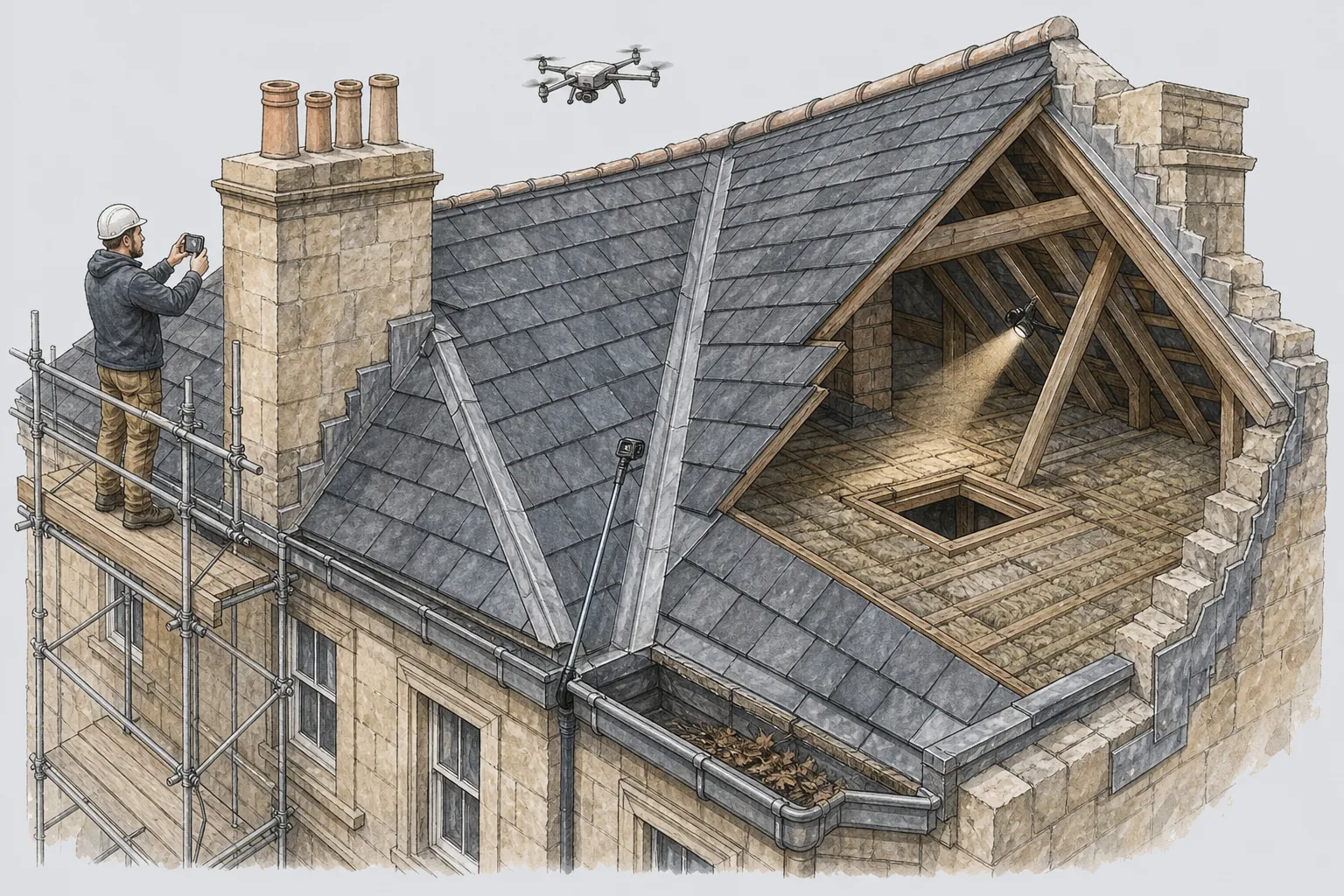
The Hospital of St John and St Katherine was rebuilt after its fire of about 1769 in two storeys around three sides of a courtyard. A plan of that shape creates a roof full of internal corners. Wherever two ranges meet, a valley forms, a channel in the angle where the slopes join, which carries the run-off of both. Where the ranges step down, there are flat or low-pitched stretches, and between them gutters that have to take the water to the outside through the building, not round it.

These are the parts that are hardest to see and easiest to neglect. A gutter that runs along the foot of a slope but behind the front wall, or a downpipe that passes through a corner, can leak for years without a drip showing in the yard. The damp then appears in the wall. For that reason we trace every channel from its start to its outlet, and run water through it, if the roof allows, to see where it goes.

Courtyard buildings also have a particular problem with leaf and moss build-up. A sheltered yard keeps debris where it falls, and the gutters fill. A blocked outlet will overflow at the lowest point of the edge, which is rarely the point where it was meant to. Maintenance is a matter of regular looking, not heroics. Guttering, fascias and soffits each have their own repairs, listed under gutters, soffits and fascias.

Because this building is listed, the guttering material matters as much as the fit. A change from cast iron to plastic alters the look of the building and needs agreeing with Wiltshire Council. Like for like in cast iron or aluminium is the safer route.

Myth

A gutter that is not overflowing is working properly.

Fact

A gutter can leak at a joint behind the fascia or discharge into a wall for years before any water shows at ground level.

Heytesbury House and the shared roof

A country house divided into several residences has one roof and many owners, and that needs organising.

Heytesbury House was rebuilt in 1782 and is listed Grade II*. In the early 21st century it was converted, with its stables, into several residences. Whatever the details of the tenure, the physical fact is that a single large roof now covers several households. A fault over one front door may start over another.

This is the situation where a survey of the whole roof earns its keep. We go over every slope and every valley, then divide the findings by area: what is the owner's own responsibility, what is shared, and what affects everyone. The aim is a clear scope that all the parties can read once, with photographs that show each fault in place, so that decisions are made on the same facts. A managing agent or a residents' committee can then circulate one document instead of six conversations.

Large country house roofs also carry details that small houses lack: parapet gutters of great length, lead-lined valleys between ranges, cupolas or lanterns, tall stacks and extensive flashing. The lead work deserves a specialist's care. Lead sheet is dressed in bays with allowance for the metal to expand and contract; if the bays are too large the sheet creeps and splits. The slate roofing approach to matching covering applies here too, and if the covering is replaced, the aim is the same size and colour as the original.

Where a Grade II* building is involved, the scope of consent is wide, and nothing beyond like-for-like should be assumed. Wiltshire Council's conservation officers are the people to ask. We write the proposed work in terms they can assess without a site visit.

Shared roof

Survey the whole roof once, split the cost by who it serves, and agree the scope in writing before any scaffold goes up.

The Wylye side: damp, moss and the small roofs

A river-valley village needs its gutters clear and its smaller roofs looked at as closely as the large ones.

Heytesbury looks across the Wylye from its northern side, and a village in a river valley sits low and often damp. Moss thrives on slopes that stay shaded or wet, where it keeps the covering damp for longer. It can also lift slates and tiles as it swells, and when it drops it blocks gutters. A roof in a place like this needs looking at in autumn and spring, and a gutter that is cleared before the leaves come down does its job through the winter.

Then there are the small roofs. The octagonal lock-up on the High Street, probably of the 18th century, is the kind of structure whose roof is a small, many-sided shape. Small roofs of that kind need exact cutting, because each section meets the next at an angle, and hips (the sloping ridges where sections meet) are the first place for water to find. The same applies to porch roofs, outbuildings and garden structures: they are small, so they get overlooked, and damp gets in unnoticed.

The 13th-century parish church, listed Grade I, anchors the village and is a reminder of what a well-detailed roof can survive. We apply that lesson at every scale. Ridge and hip tiles are screwed or clipped as well as bedded, since BS 5534:2014 stopped accepting mortar as the only fixing. For a covering that has gone green or black with growth, there is a gentler way than blasting it clean, and a surface that has gone green can sometimes be brushed and treated by hand. A pressure wash on delicate tiles can do harm, so we avoid it unless the roof will take it.

If the roof needs more than cleaning, the repair work is described on our pitched roofing page.

Words you will hear

Tingle
A small strap of copper or lead that holds a single slate in place where the nail has failed.
Valley
The trough at an internal corner where one slope runs down into another.
Hip
The angled meeting line of two slopes on a projecting corner.
Underlay
A second skin of membrane over the rafters, beneath the battens, in case rain gets past the slates.

Map showing the location of Heytesbury.

Nearby

Roofers near Heytesbury

Roofing services in Heytesbury

Local questions

What Heytesbury owners ask about the rebuilt village

Our Heytesbury house was rebuilt after the 1766 fire. Could the original nails still be holding the slates?

Some may be, and they are usually the weak point. We lift a few slates in different places and look at the nail shanks. If they have rusted to a stub, the fixings are spent even though the slate is fine. In that case we advise re-laying the sound slates on new battens.

We are one of several owners under a single roof at the old house. Who arranges a repair?

The owners and any managing agent together. We survey the full roof and write the findings by area, so each party can see what applies to them and what is shared. A single scope with photographs makes it easier to agree. We can then quote for the whole job or for phases, as you choose.

Can the cast-iron gutters on a listed building be replaced with plastic?

Only with the council's agreement, and probably not. Gutters are part of how a listed building looks, and a change of material usually needs consent. Cast iron can often be repaired or matched, and aluminium is sometimes accepted as an alternative. Ask the conservation officers at Wiltshire Council first.

Does living beside the River Wylye mean more moss on my roof?

It can, because damp valley air and shade encourage growth. Moss is a problem when it holds water against the covering or fills a gutter. We remove it by hand where the roof is delicate and treat the surface afterwards, and we recommend a regular look from the ground each autumn.

Get your free survey

Get your free roof survey

Tell us what's happening and we'll call you back to arrange a visit. Prefer to talk? Call 01225 285181.

  • Photos of your own roof
  • A fixed price in writing
  • 10-year workmanship guarantee
Call Free survey