
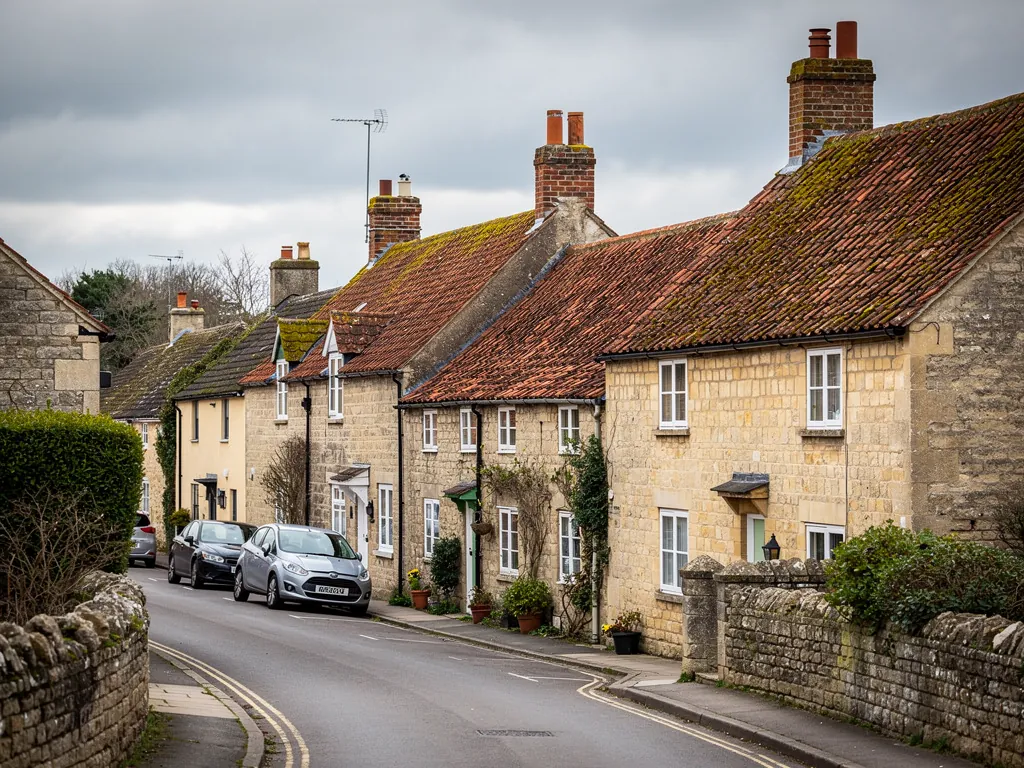
A Somerset village street of stone cottages with clay pantile roofs

Roofers in Radstock

Radstock, a former coalfield town on the south-west side of Bath and 9 road miles from its centre, has Victorian civic roofs, shop and flat roofs in the centre and miners' housing on the edge at Haydon. We work on homes and commercial buildings alike, and we match the covering to what each building has.

Local roofs

A coalfield town of halls, shops and terraces

Radstock is a town, not a village, and its roofs reflect the difference. Coal was discovered here in 1763, and the last two pits in the coalfield, Kilmersdon and Writhlington, closed in September 1973. For the best part of two centuries the town was organised around the mines, and it built what a mining town needed: churches, a market hall, a working men's club and housing for the workforce.

Several of those buildings still stand. St Nicholas, the Anglican parish church, keeps a 15th-century west tower; William Willcox rebuilt the remainder in 1879 in the Geometric style, and the church is Grade II listed. Radstock Museum occupies the restored Victorian Market Hall, a Grade II listed building dating from 1897. Victoria Hall was built in 1866 as a working men's club and substantially rebuilt and extended in 1897 for Queen Victoria's Diamond Jubilee.

Haydon, an outlier of Radstock, was built to house the miners for the local pit. It is a reminder that the town's housing came in layers, from the civic centre to the estates the colliery needed. Alongside that sits the commercial heart of the town, with shops, offices and workshops whose roofs are as important to their owners as a house roof is to a family.

The ground is part of the story. Most of the upland around Radstock is Lias limestone, and the steepest slopes of the Kilmersdon and Snail's Bottom valleys have frequently slipped. We are roofers, not ground engineers, but on a sloping plot we pay attention to the signs a roof gives of wider movement.

Council
Bath and North East Somerset Council
From central Bath
9 road miles, south-west
Coal
Discovered 1763; last pits closed September 1973
Market Hall
Radstock Museum, Grade II listed, 1897
Parish church
St Nicholas, 15th-century tower, rebuilt 1879, Grade II

What we find

Shop flat roofs, civic valleys and miners' rows

Worn flat roofs at the back of shopsSingle-storey extensions and shop backs are usually flat, and their membranes fail at the edges, upstands and outlets. We check for blistering, ponding and open laps.
Big-span valleys on civic roofsHalls and large Victorian buildings have long valleys and wide gutters that collect a lot of water. We check linings, outlets and the fall, and look for staining on the ceilings below.
Terrace roofs with patched coveringsMiners' terraces have been repaired by many hands, so a roof may carry several coverings. We look for slipped courses, perished felt and flashings that have been sealed over.

Shops, offices and commercial roofs in the town centre

A commercial roof has a different brief from a house roof: it must keep the business dry and be easy to inspect, with as little disruption as possible.

The centre of Radstock has the usual mix of a small town: shops with flats above, offices, workshops and community buildings. Their roofs vary as widely as the buildings do. Some are pitched and tiled, some are flat and covered with felt or a single-ply membrane, and many combine both, with a pitched front and a flat rear extension that was added later.

For a commercial owner the roof is a business asset. A leak that reaches stock, a ceiling or electrical equipment costs money and trade, and a repair that closes a shop for a day costs more. That is why the survey comes first. We look at the roof, its drainage, its access, the way it is used and whether anything on it, from plant to aerials, adds load or breaks the membrane, and write a scope that sets out the work and how it will be done around the business. We price a commercial roof after the survey, since the system, the insulation, the access and the edge details all move the figure.

Maintenance has more weight here than on a house. Outlets on a flat roof clog with leaves and litter; the membrane at upstands and parapets suffers from sun and frost; rooflights crack and their kerbs leak. A regular check and a clear of the outlets is an inexpensive way to avoid emergency calls. When something does fail, the first visit is about stopping water getting in; the lasting repair is planned afterwards.

Shops with flats above raise a second question, which is who owns and pays for the roof. If a freeholder, a managing agent and several leaseholders are involved, a written scope with photographs gives everyone the same information. Our commercial roofing page describes the systems we work with and how a commercial survey runs.

Victorian civic roofs: the Market Hall and Victoria Hall

Large-span roofs from 1866 and 1897 show how hidden gutters and long valleys are built, and what happens when they age.

Radstock Museum occupies the Victorian Market Hall of 1897, a Grade II listed building, and Victoria Hall was rebuilt and extended the same year. They belong to a period when towns built large public rooms under big roofs. These roofs are a lesson in how a roof is arranged. A wide span means long slopes, and long slopes deliver a lot of water to the points where they meet.

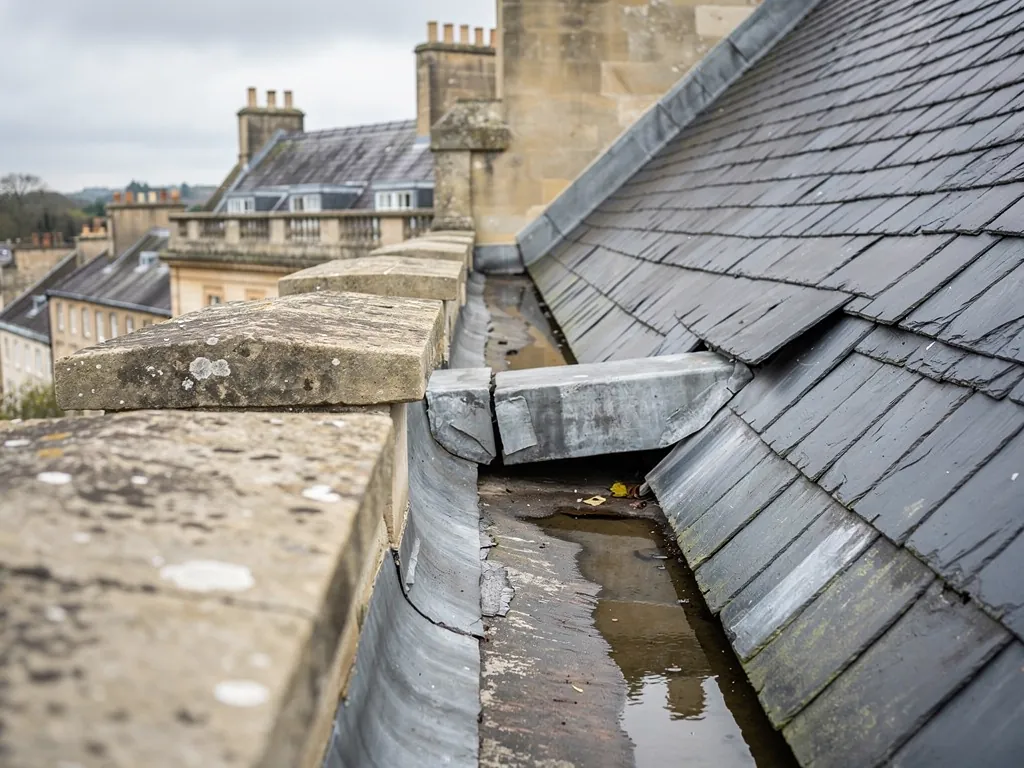
The valley is the dip where one slope runs into another, usually lined in lead with slates or tiles lapping its edges. A box gutter is a lead trough set between two roofs or behind a wall, and it is sized for a big flow of water. Both are hidden from the ground. Both are the first place a large roof leaks when the lead ages, because every storm tests them and the sheet moves with every change in temperature.

On a building of this type, repairs have to respect the building as well as stop the leak. A listed hall needs consent from B&NES for work that affects its character. A like-for-like patch may be straightforward, but a change of covering or a rebuilt rooflight is not. That decision belongs to the council; what we can supply is an exact description of the work that the council can respond to.

The same principles apply on a smaller scale to any Victorian building in the town. Check the gutters first. Look for stains on the ceiling beneath. Compare the roof line with the wall below for signs of movement, and note any rooflight whose kerb has cracked or whose glazing seal has failed. Rooflights over a large hall are among the first features to leak, because the glass, the frame and the lead flashing each move at a different rate. If the cause is the lead, renew it in a way that keeps the original pattern. Our commercial roofing and roof replacement pages cover the larger jobs, and the survey tells us which applies.

Words you will hear

Valley
The dip where one slope runs into another, lined to take both slopes' water.
Box gutter
A lead trough between two roofs or behind a wall, sized for a big flow.
Rooflight
A glazed unit set into a roof, usually flat or low-pitched, to bring daylight into a large room.
Kerb
The raised upstand around a rooflight or roof opening, which is where the weatherproofing is made.

Flat roofs: felt, EPDM and GRP

Flat roofs on extensions, shop backs and garages need a fall, a sound deck and details that shed water at every edge.

A flat roof is never quite flat. It has a slight fall, so that rainwater runs to an outlet, and a membrane that must hold together at laps, edges and penetrations. In a town like Radstock, with many extensions and rear additions, flat roofs matter a great deal.

Three coverings are common, and each behaves differently once it has been in the weather for a few winters. Bitumen felt, including torch-on systems, is laid in layers and sealed at the joints. EPDM is a synthetic rubber sheet, supplied in one piece for a small roof, so there are few joints to fail. GRP means glass-reinforced plastic, applied wet over the deck with a topcoat, which cures to a jointless surface with its own trims. Each has a place. EPDM suits simple shapes. GRP suits awkward ones. Felt suits larger areas where repairs may be needed over time.

The covering is only part of the story. If the deck beneath is damp or rotten, a new membrane will not last. If the roof is a cold deck, with insulation between the joists, condensation can be a hazard. A warm deck puts the insulation above the structure and keeps it dry. We lift a corner during the survey and check the deck before recommending a system. Where the boards are soft, we replace them first, and where the insulation is wet, we say what it will take to dry or renew it. A flat roof that has been covered over without that check usually fails at the same place again, so the order of work matters as much as the product chosen.

Typical UK flat-roof prices, as reported by MyBuilder in 2026, run at about £90 to £130 per square metre for EPDM and £95 to £150 for GRP, depending on size and detail. Your fixed quote follows the survey. Our flat roofing page describes each system, including how long it lasts and when repair is enough.

Flat roof coverings compared

CoveringHow it is laidSuits
Bitumen feltLayers, sealed at the lapsLarger areas that may need repair later
EPDMOne rubber sheet, glued to the deckSimple shapes with few edges
GRPResin and glass matting that sets on the roofAwkward shapes and small roofs

Haydon, the slopes and the miners' terraces

Housing built for the pits sits on ground that has moved, and the roofs on top of it are best judged one at a time.

Haydon is an outlier of Radstock that was built to house the miners for the local pit, and like most housing of its kind its roofs have been repaired many times over the years. The ground beneath this part of Somerset is Lias limestone, and the steepest slopes of the Kilmersdon and Snail's Bottom valleys have frequently slipped. That is the ground, not the roof, and it is not our field. What a roofer can do is report what the roof shows.

Signs worth noting are a ridge line that has dipped, a chimney leaning away from the wall, cracks that cross a gable, and tiles that slide in the same direction on one slope. Each might be a roofing fault, or a sign of settlement. We look at the timbers, the wall plate and the joints between roof and wall. If the evidence points beyond the roof, we flag it and suggest asking a structural engineer before money goes into a new covering.

Many terrace roofs, though, simply have the problems that age brings. Early felt perishes. Nails corrode. Mortar fixing on ridge and verge loosens. Soakers, the small lead sheets beside a wall or stack, rot unseen. Sealant gets applied to a flashing that needed relaying. The repair is usually straightforward, and a good survey sorts it into what needs doing now and what can wait.

If a whole terrace needs attention, coordinating the work can save money, since scaffold, skips and labour are shared. Where it is one house, we work to the party wall line and leave nothing behind when we go. For the larger jobs, our roof replacement page sets out what a full re-roof involves and how Building Regulations come into it.

Roof or ground

If a roof defect repeats after a sound repair, or shows with cracked walls, ask a structural engineer to rule out movement before re-covering.

Map showing the location of Radstock.

Nearby

Roofers near Radstock

Roofing services in Radstock

Local questions

Radstock queries from the town centre to Haydon

The flat roof on our Radstock shop extension keeps ponding. Is it the membrane or the deck?

Ponding usually means the fall has gone, which points to the deck or the structure under it. A membrane can be renewed, but if the deck holds water, the new covering will pond too. We open a section during the survey, check the boards and the insulation and say what is needed before giving you a fixed price.

Can you work around a business that has to stay open?

Yes, we plan the scaffold, hours and access with the owner first, and we make a leaking roof safe before any longer repair. Pricing follows the survey, and the scope sets out the sequence and noise as well as the materials.

Our building is near the Market Hall. Does a listed neighbour change what we can do?

Not for your own roof unless your building is listed or in a protected setting. Search the Historic England list under your address, then ask B&NES whether any conservation or Article 4 rules apply. If your building is listed, consent is needed for changes that affect its character.

Haydon houses were built for miners. Should I worry about the roof moving with the ground?

We look at the roof for signs of movement, such as a dipped ridge, leaning stacks or cracks at the gables, but a roofer cannot judge the ground. If the signs are there, we recommend a structural engineer before re-covering, so you do not spend money on a roof sitting on a moving wall.

Get your free survey

Get your free roof survey

Tell us what's happening and we'll call you back to arrange a visit. Prefer to talk? Call 01225 285181.

  • Photos of your own roof
  • A fixed price in writing
  • 10-year workmanship guarantee
Call Free survey