
A Mendip village of grey limestone cottages with clay tile roofs

Roofers in Chewton Mendip

Chewton Mendip, 14.6 road miles from Bath and to its south-west, lies in a valley at the source of the River Chew, in country once worked for lead and stone. Roofs here call for sound leadwork, lime where there is stone, and care around the listed houses.

Local roofs

A valley village where lead was dug and stone was cut

The village sits in a valley on the Mendip Hills at the source of the River Chew, inside the Mendip Hills Area of Outstanding Natural Beauty, a designation renamed National Landscape in 2023. It stands on the A39 very close to the A37, a short run from Wells. The parish once held several lead mines and stone quarries.

The best-known building is the church of St Mary Magdalene, built of Lias stone and crowned by a 126-foot tower of Doulting stone that was still unfinished in 1541. Close by, the Gothic-style mansion built for the Waldegrave family before 1791 has gone, and only an 18th-century lodge survives. The parish's Grade II listed buildings include Manor Farmhouse, The Old Rectory, Bathway Cottages and a lime kiln.

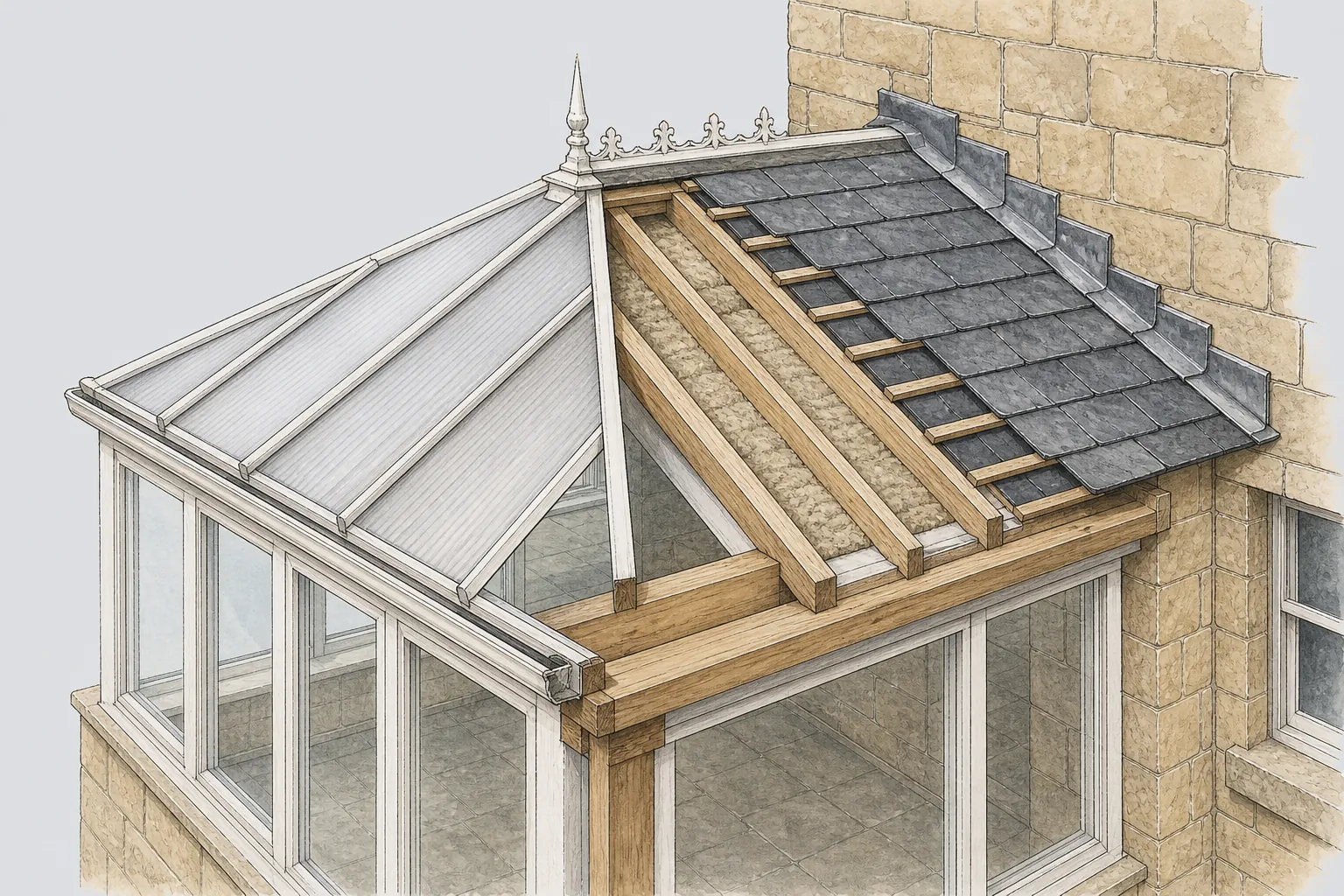
For roofing, this is a place of two materials above all. Lead is the sheet metal that keeps water out of every angle, gutter and chimney junction, and the parish has a long association with it. Stone is the other, and on old stone walls and stacks lime is the right mortar. Where the two meet, at a flashing cut into a stone stack, the quality of both decides whether the junction lasts.

The survey is free and goes up onto the roof. It ends in a photo record and a fixed written price. Repair comes first where repair works, and older roofs get matching materials.

Council
Somerset Council
From central Bath
14.6 road miles, south-west
Church tower
126 feet, Doulting stone, unfinished in 1541
Grade II listed
Manor Farmhouse, The Old Rectory, Bathway Cottages, a lime kiln
Landscape
Within the Mendip Hills National Landscape

What we find

Creeping lead, stone stacks and valley gutters

Lead that has split or creptLead moves with the temperature, so lead cut in over-long pieces, or pinned hard at both ends, cracks where it tried to slide. We look for hairline splits at bends, ripples where the metal has crept downhill and nails or clips that have worked loose.
Stone stacks and their mortarOn a stone stack, the joints should be softer than the stone itself. We probe the pointing, check whether past repairs were done in hard cement, and look at the capping stones for cracks that let water run straight down the flue.
Gutters on a valley floorIn a valley, rain arrives from every side and runs hard. We see whether each run slopes to its outlet, whether the brackets are pulling off the fascia and whether the downpipe empties clear of the wall.

Lead: from the parish to the roof

A parish with lead in its history still depends on the metal for the places where water is hardest to stop.

Chewton Mendip's parish once held several lead mines. The metal that came out of them has a second life on roofs, where it does the jobs no tile or slate can do. A roof is a series of overlaps, and overlaps are only waterproof while water runs downhill across them. At every junction with masonry, a dormer cheek or a neighbouring slope, the overlap has to be completed with something that bends to fit, and sheet lead is the traditional choice.

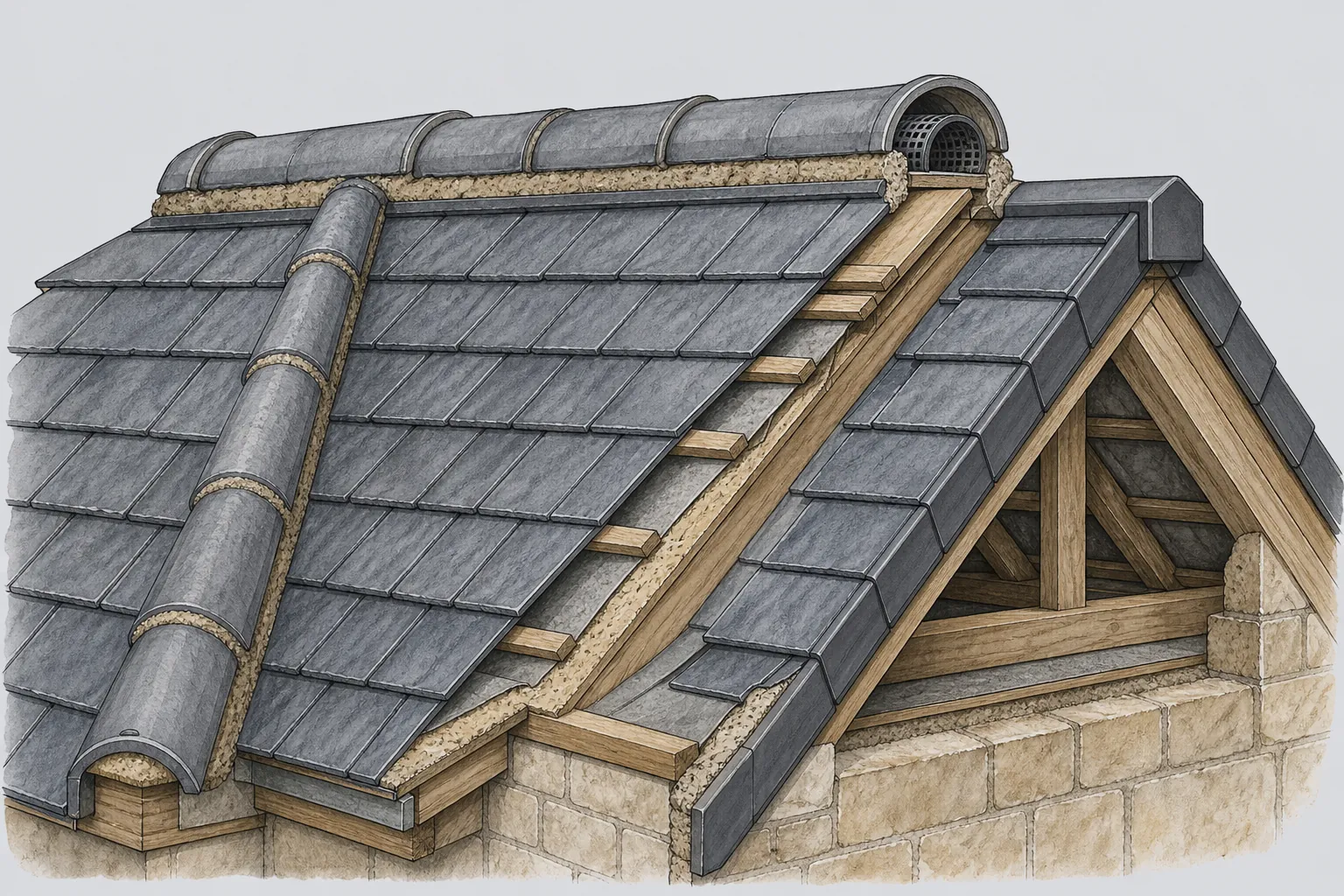
Lead lasts, but it has habits. It expands and contracts more than most roofing materials, so a long, rigidly fixed sheet will crack along the line where it was held in place. Good leadwork is laid in short bays, with joints designed to let the metal slide: rolls over a timber core, drips (small steps) that carry water to the next level, and welts folded into the edges. The specification is expressed as a lead code, the grade number that sets the thickness, and it is chosen to suit the position. We do not publish thickness tables, because the right choice comes from the detail on your roof.

The faults we meet are rarely the metal's alone. A splitting flashing is usually a laying problem, with a bay too long, a clip in the wrong place or an edge hammered flat so it cannot move. Patch repairs have a place on a small split, and a neat patch can buy years, but a long run of cracked lead with the same fault repeating along it usually wants relaying properly.

A MyJobQuote guide from September 2026 reckons a patch of lead at a chimney at about £150 to £250, with whole chimney leadwork averaging around £570 and costing more once scaffold is involved. A flat lead roof is a larger undertaking, quoted per square metre. These are national figures, not our prices; our fixed quote arrives only after we have climbed up and inspected. The detail on laying and repair is on our lead roofing page.

Words you will hear

Flashing
Strip metal, usually lead, dressed over the gap where roof meets chimney or masonry.
Drip
A shallow step built into a lead gutter, handing water down to the next level.
Roll
A raised, rounded joint between two lead sheets, formed over a wooden batten.
Lead code
The grade number that gives the sheet its thickness.

A church in two stones and what that teaches

St Mary Magdalene is built of Lias stone with a Doulting stone tower, and the village's chimneys deserve the same respect for their material.

The church of St Mary Magdalene is built of Lias stone, and its tower, 126 feet high, is of Doulting stone. The church was started in 1441, and the tower was still unfinished in 1541, a century later. The parish had stone quarries of its own, and a stone chimney stack needs the same care over its material as the church does.

A stone stack is a tall, slender thing standing in the wind with fire at its heart. It faces weather on all four sides, and it sheds water at the top onto a roof that has to deal with it. The capping stones on top are first to weather. Below them the joints between stones are the next line of defence, and below those the lead flashing and soakers (the folded lead tabs tucked under each course beside the stack) close the gap to the roof slope.

Repairs to old stone depend on one principle: the mortar should be weaker than the stone. A lime joint is soft and porous, and damp escapes through it before it reaches the face of the stone. A cement joint holds the damp in, and the stones beside it can be the ones to decay. The Bath Preservation Trust made that point about a listed stack in the city, where cement was believed to have worsened the damage and lime was urged for the repair.

That is why a stack is repointed in lime, rebuilt course by course where it has failed, and capped with stone that suits the original. Our page on chimney repairs covers the range, from patching to rebuilding. In MyBuilder's 2026 guide, chimney repointing is typically £500 to £2,000, while rebuilding a stack starts at £2,000, scaffold being a large part of the gap. Treat those as national bands; the price for your stack is fixed after we have surveyed it.

126 ft

Height of the church tower, built in Doulting stone

1541

The year the tower was still unfinished

1791

The date before which the Waldegrave mansion was built; only its lodge remains

Figures: Chewton Mendip entry, Wikipedia, checked October 2026

Listed farmhouses, an old rectory and Bathway Cottages

Several listed buildings in the parish show how often a roof job here starts with a consent question.

The parish lists Manor Farmhouse, The Old Rectory, Bathway Cottages and a lime kiln at Grade II. A farmhouse, a rectory and a row of cottages are different buildings, but they follow one rule that matters to roofing: the listing covers every part of the building, including the roof.

Planning permission is one decision and listed building consent another, and having one does not give you the other. Bath and North East Somerset Council gives sound advice that holds anywhere: speak to the local planning authority before work begins. In this parish that authority is Somerset Council. Mending a faulty part while keeping the existing covering rarely raises the questions that swapping the material, adding a rooflight or rebuilding a stack would. Work done without consent on a listed building is an offence, so asking first costs little. If the answer is that consent is needed, the application can then be built round a clear description of the repair, with no guesswork about the materials.

What you can do before you ask is get the problem described properly. An officer can only answer something specific, so it helps to arrive with the extent of the damage, the proposed materials and a note of anything altered, all with photographs. Our survey produces exactly that. It sets out what is wrong, what we would do and which parts of the job we think need the council's view.

Building Regulations come into it separately. A modest repair seldom triggers them, but a re-roof across a large share of the building does, and an upgrade to the insulation can come with it. If the job is notifiable, we take care of the notice, going through Somerset's in-house team or a registered approver. Gutters and downpipes, which are often the first thing to change on an old building, are dealt with under guttering and fascias.

Myth

A listed building cannot have its roof touched.

Fact

Listing does not freeze a building. Alterations that alter its character need consent, and the planning authority is the body to ask first.

Roofs in a valley and inside a National Landscape

The shape of the ground and the designation of the landscape both feed into how a roof here is drained and what is allowed to change.

Chewton Mendip stands where the River Chew begins, and the village lies in a valley on the Mendip Hills. A valley floor collects rainfall from the slopes around it, and roofs there handle more water than roofs on a plateau. The gutters and downpipes are working near their limit in a heavy shower.

The checks are practical, and most of them can be made from a ladder and a hose on a dry afternoon. Does the gutter fall evenly to its outlet, or does water stand in the middle of a run? Are the brackets sound, and does the fascia behind them have its full strength? Does the downpipe empty onto a drain, or onto ground beside the wall, where it soaks the foundations? On older houses with cast iron, a failed joint or a cracked section is common, and iron, aluminium and uPVC each suit different jobs. MyBuilder's 2026 guide gives guttering as £30 to £70 a metre, with fascia and soffit work dearer, all before scaffold. Those are national ranges only.

The village is within the Mendip Hills National Landscape, the name given in November 2023 to what had been an Area of Outstanding Natural Beauty. The designation concerns the landscape, and what it means for a given roof job is a question for Somerset Council, not something we can rule on. What does carry over is the sensible response, which matches the one for a listed house, and costs nothing extra to follow: like-for-like materials, tidy detailing and no surprises to the neighbours.

Only an 18th-century lodge survives from the Waldegrave mansion. Access is straightforward by the A39 and A37, but village lanes can be narrower, so we plan scaffold, skips and deliveries at the survey rather than leaving them to the first day. Where a lorry cannot stand, we flag it early, because moving materials a long way by hand changes both the time and the price.

Map showing the location of Chewton Mendip.

Nearby

Roofers near Chewton Mendip

Roofing services in Chewton Mendip

Local questions

Asked at the source of the Chew

Why does the lead round my Chewton Mendip chimney keep splitting?

Usually because of how it was laid, not the metal itself. Lead expands and shrinks with the weather, and a flashing cut too long or fixed too hard has nowhere to move, so it cracks along the line of the strain. We check the length of each piece, the fixings and the joins before recommending a patch or relaying, and we write the finding down.

Can the stone on my chimney be repaired without changing its look?

Often, yes. A decayed capping or course can be replaced with stone to suit the original, and the joints repointed in lime so they are softer than the stone around them. Cement is avoided because it can drive moisture into the stone. If the house is one of the listed buildings in the parish, ask Somerset Council about consent before the rebuild is planned.

Does the National Landscape status around Chewton Mendip affect a re-roof?

The designation protects the landscape, and its effect on a particular roof is a question for Somerset Council, which we cannot answer for you. We keep to like-for-like materials and tidy detailing, describe the work in writing and help you take specific questions to the council. A listed building brings its own consent rules on top.

My cottage sits low in the valley and the gutters overflow in heavy rain. What can be done?

Start by finding out why. A blocked outlet, a sagging run that holds water or an undersized pipe each need a different fix. We look at the slope, the brackets and the downpipe, then say whether cleaning, refixing or a fresh run is the answer. Where the pipe discharges beside a wall, we also look at where the water goes next.

Get your free survey

Get your free roof survey

Tell us what's happening and we'll call you back to arrange a visit. Prefer to talk? Call 01225 285181.

  • Photos of your own roof
  • A fixed price in writing
  • 10-year workmanship guarantee
Call Free survey