
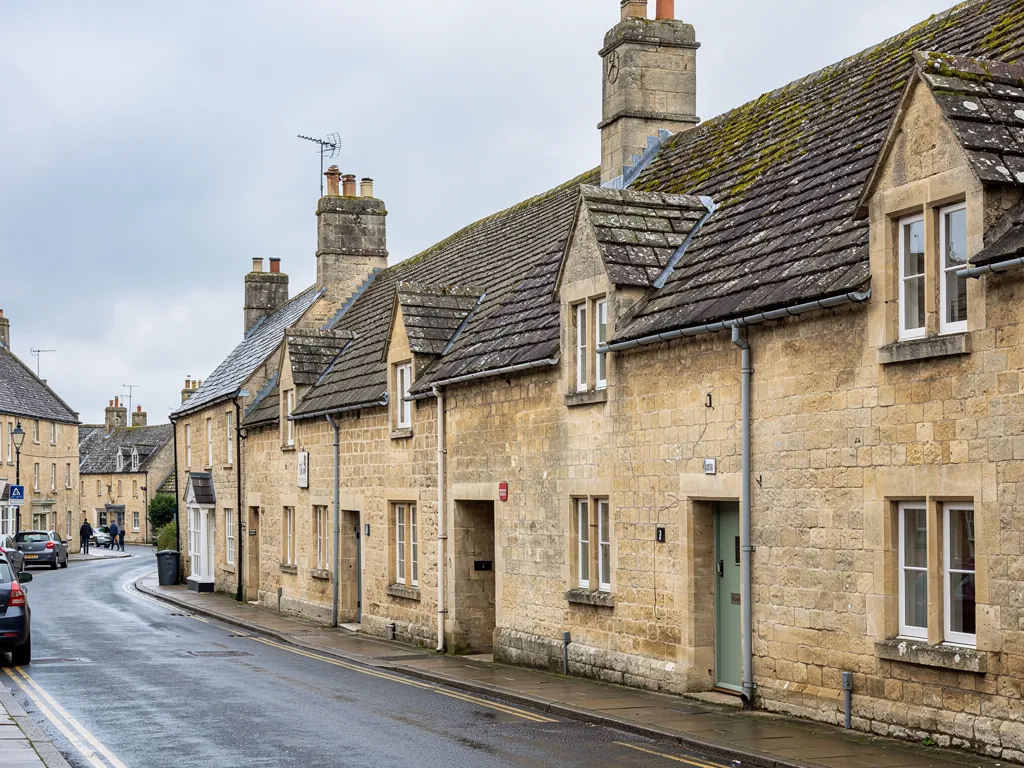
A Cotswold town street of limestone houses with stone tile roofs

Roofers in Minchinhampton

Minchinhampton stands on a hilltop 27.9 road miles north of Bath, with a National Trust common on its doorstep and views across the Severn Estuary. Altitude shapes everything about its roofs, because they take the wind, and they take it from every side.

Local roofs

A hilltop town with a square and a common

Few places in this part of Gloucestershire sit as openly as Minchinhampton. The town occupies high ground, and next to it lies Minchinhampton Common, 580 acres (230 hectares) of Site of Special Scientific Interest that has belonged to the National Trust from 1913. From the common you can see over the Severn Estuary into Wales. For a roofer, that view is a weather report: the open ground that gives it leaves the town exposed to weather from the west.

The centre has the kind of buildings that give a market town its shape. The 17th-century Market House stands in the main square. It was given to the town in 1919 by Lt Col H. G. Ricardo and restored in 1944. The Crown building on the high street dates back to 1715. Holy Trinity parish church lost its spire in 1563, pulled down for safety when the nave arches that carried it were found to be failing, and the stub was then topped with a coronet structure. Further along, Minchinhampton Baptist Church in Tetbury Street dates from 1834, while the Chapel Lane Baptist chapel of 1765 is now a private house.

All of that adds up to a town where the roofs run from the 17th century to the present, where several are on public or historic buildings, and where the sky is large. We start every job by asking how the roof is fixed and how it drains, because those are the two things a hilltop tests hardest.

Council
Stroud District Council
From central Bath
27.9 road miles, north
Common
580 acres, SSSI, National Trust from 1913
Market House
17th century, in the main square
Chapel Lane chapel
1765, now a private house

What we find

Wind-loosened fixings and lead around old stone

Fixings that wind has loosenedOn open ground, tiles and slates are lifted and dropped many more times than they would be in a sheltered street. Each cycle works the fixing a little looser. We run a hand along the courses, check for clipped or nailed units that move, and look at the nail holes before we blame the covering.
Edges, ridges and vergesThe perimeter of a roof is where wind gets a purchase. We examine the ridge line, the hips and the gable edges for cracked bedding and missing fixings, because an edge that fails lets the weather in under the next course.
Lead around old stoneworkWhere a roof meets a church wall, a chapel gable or a chimney, thin lead takes the movement of the building. We look for splits, lifted edges and cracked pointing above the lead, any of which lets rain run behind it.

Wind on the hilltop

A roof with open ground on several sides has to be fixed as if the wind will arrive, because it will.

Height changes how a roof behaves. On a sheltered street in a valley, a tile can sit loose for years because the air barely moves above it. Up here, the same tile is tugged every time a gust crosses the common. The difference is not dramatic on any single day, but over a winter it adds up, and the first signs are small: a chipped edge, a ridge with a hairline crack in the mortar, a slate that has slipped a finger-width and then stopped.

The standard we work to is BS 5534:2014, which governs slating and tiling. Under it, ridge tiles, hip tiles and verges cannot depend on a mortar bed by itself, and a mechanical fixing is expected too. For an exposed hilltop roof that is common sense as much as compliance. A ridge tile held by mortar and nothing else will eventually part company with the roof, and the open question is only whether it happens in a gale.

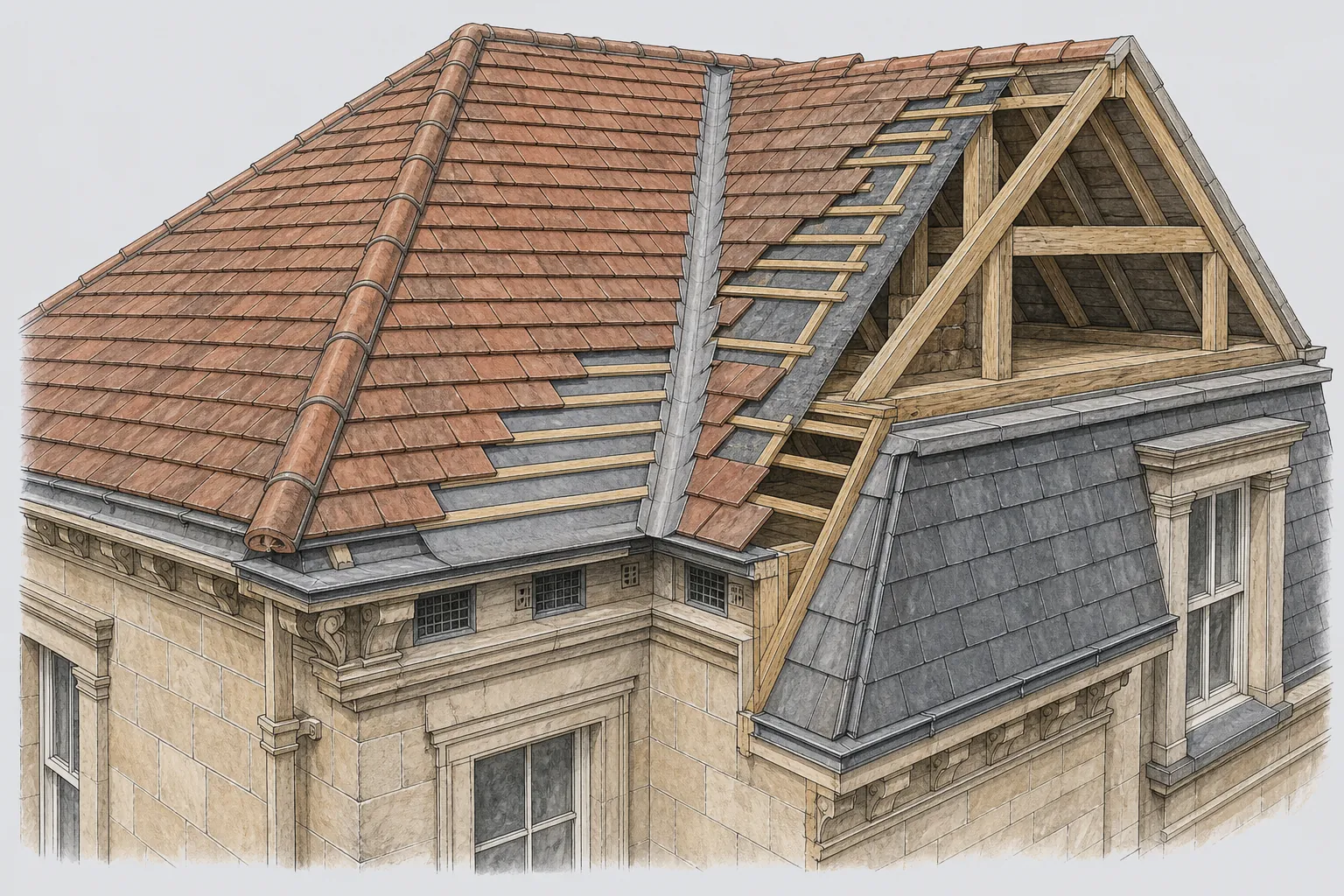
Where a ridge or verge has failed, we have two routes. The first is to rake out the old bedding, rebed with fresh mortar and add the fixings. The other route is dry-fix, where ridge and verge pieces are clipped on without a mortar bed, a system tested to BS 8612:2018. Dry-fix needs less maintenance and flexes with the roof, so on a high roof it is often the sensible choice. On older roofs with bespoke ridge tiles, rebedding keeps the look. The ridge and verge repairs service sets out both routes in detail.

Beyond the edges, we also look at the field of the roof. Clipped tiles, nibs that have snapped, nails that have corroded: all of these show up as slight unevenness in the lines of the courses. If you can see a roof that does not look quite straight any more, it is worth a closer look before the winter.

The Market House, the Crown and the old centre

A high street with a 1715 building and a 17th-century market house calls for quiet, careful repair.

The buildings around the square and along the high street carry their ages openly. The Market House dates from the 17th century. The Crown dates back to 1715. Roofs of that age have usually been mended many times, and the layers of earlier mending are part of the evidence we read: a patch in a different slate here, a lead flashing newer than the stack beneath it there.

What those buildings need is repair with a light touch. Our rule on old roofs is to match what is there, whether that is natural slate, clay or stone, and to reuse the sound original material wherever it can be reused. A roof in the centre of a market town is also seen constantly, so a mismatched repair stands out in a way it would not on a back street.

Some of the buildings in the centre will be listed, and some may fall within a conservation area. We cannot tell you the status of your own property, and neither can anyone else without checking. The planning authority is Stroud District Council, and its website at stroud.gov.uk is the place to ask. If a building is listed, work that alters the roof's character needs listed building consent, a separate permission from planning. Putting back what was there sits at the easy end of that scale; swapping the covering or forming a new opening sits further along it.

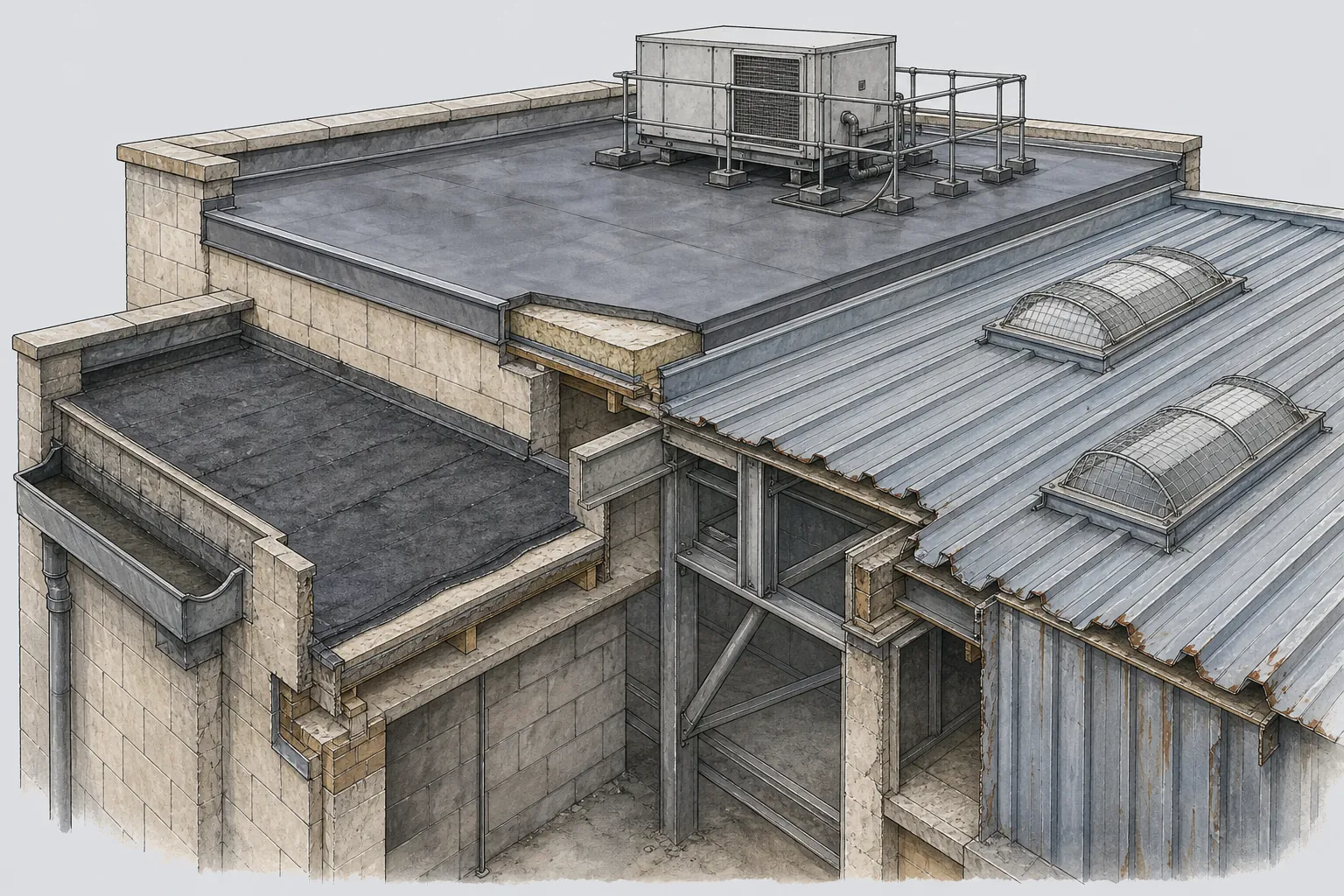
Where lead is part of the repair, we describe it in simple language. Lead sheet is dressed over the top of masonry as a flashing, laid in gutters, or wrapped round a chimney; it ages well if the detailing allows for movement and splits early if not. If the lead on a building in the centre has split at a fold or lifted along its edge, our lead roofing page explains how it is repaired and replaced.

Old roof, light touch

On a building of 1715 or earlier, reuse the sound original covering and replace only what has failed.

Holy Trinity, the chapels and roofs that were never houses

A church with a coronet instead of a spire, and a chapel turned into a home, show how many different roofs a town can hold.

Holy Trinity lost its spire in 1563 when the nave arches that carried it proved to be failing, and the stub was finished with a coronet structure. It is a reminder that large church roofs are not a roofer's problem alone. They sit on masonry, arches and timbers whose movement over centuries has shaped the roof lines we see now, and any repair has to respect that.

Church and chapel roofs are different from house roofs in four ways. They are tall, so access is a job in itself. They are long, so the gutters and the valleys between roofs carry more water. They are often laid with lead in the places houses use something lighter. And their timbers are generally larger, older and less forgiving than domestic rafters. A fault that would be a half-day repair on a house can need scaffolding, a plan and weeks on a church.

Chapels have a further story. Minchinhampton Baptist Church in Tetbury Street dates from 1834, and the Baptist chapel in Chapel Lane, built in 1765, is now a private house. A building designed as a chapel and later converted keeps the roof it was given: wide spans, deep pitches, and a loft space that was never planned as habitable. If you own such a house, the questions are practical. What is the roof made of, and where does it leak? Has it been insulated, and has that been done in a way that lets the timbers breathe?

The last of those is worth care. Insulation fitted tightly against the underside of an old roof can trap moisture where it does the most damage. Our roof inspections page describes how we look at a loft, the timbers and the ventilation as well as the covering, so that a conversion roof is judged as a whole.

How a chapel conversion differs from a standard house roof

FeatureWhy it matters
Wide spanLong rafters or trusses carry the covering, so sag shows up early.
Deep pitchWater runs off fast, but a slipped slate is further to reach.
Lead detailsGutters and abutments may be lead-lined and need specialist repair.
Loft insulationRetrofitted insulation can trap moisture against old timbers.

Living beside the common

Open land brings views, wildlife and the odd tree overhanging a gutter.

Minchinhampton Common is a Site of Special Scientific Interest, and a house beside it is a house beside protected land. The practical effect on a roof is modest but real. Open grassland brings birds, and birds nest in eaves, behind fascias and in gaps below ridge tiles. Bats roost in old roof spaces. Both are protected, so if either turns up during a job, we stop and get the right advice. It is rare for that to change what needs doing, but it can change when.

The other effect is on the gutters. Gutters near open land and mature trees fill with leaves, seed heads and moss, and a gutter that is full does not drain. The overflow spills down the wall face or behind the fascia, and the timber behind a fascia rots quietly. A gutter check twice a year is one of the cheapest forms of roof maintenance there is. Where rot has set in, the gutters, soffits and fascias service covers what a replacement run involves.

Moss and lichen are the other signs of a roof beside open land. A light film does little, but a thick mat keeps the covering wet and can lift edges as it grows. How a roof should be cleaned depends on what it is made of; pressure washing can damage soft or old coverings, so we choose the method for the material.

Finally, the view that makes the common special also makes its neighbours more exposed. Rooflights and roof windows on the weather side deserve a check of their seals and flashings each year. If you are planning a new opening, our skylights and roof windows page is where the consent and permitted development detail lives, so it is not restated here.

Words you will hear

Fascia
The board fixed along the eaves that the gutter hangs from.
Coronet
A crown-like finish, here the structure that tops the stub of the church spire.
Flashing
A thin strip, usually lead, sealing where a roof meets a wall or window.
Eaves
The bottom edge of the roof, hanging out past the wall.

Map showing the location of Minchinhampton.

Nearby

Roofers near Minchinhampton

Roofing services in Minchinhampton

Local questions

Living with the wind in Minchinhampton

Why do ridge tiles on exposed Minchinhampton roofs come loose faster than ones in a valley town?

Wind. A ridge on open high ground is hit by every gust that crosses the common, and mortar on its own will not keep it in place for long. We rake out failed bedding, fix the tiles mechanically and, where it suits the roof, fit a dry-fix system that needs no mortar. The decision depends on the tile type and on whether the existing ridge is worth preserving.

My home is the old Chapel Lane chapel. Are there special concerns for the roof?

The roof you have was designed for a chapel, not a house, so check the loft for ventilation and condensation, because converted roofs are often insulated without that being considered. We survey the covering, the timbers and the lead details, and if anything points to a structural issue we tell you before any repair is priced.

Is it possible to repair a roof next to the Market House without blocking the square?

Work near a public space is planned around access. We agree scaffold positions, pedestrian protection and delivery times in advance, and keep materials tidy and off the pavement. Should the building be listed, the council also has to agree the scope, and we can put that in writing so it is clear what will and will not change.

Do nesting birds or bats near the common delay roof repairs?

They can. Protected species mean work may have to stop or wait while advice is taken, and we would rather tell you about that early. In many cases the repair goes ahead with a few adjustments, such as working outside the nesting season, and the roof is made safe in the meantime.

Get your free survey

Get your free roof survey

Tell us what's happening and we'll call you back to arrange a visit. Prefer to talk? Call 01225 285181.

  • Photos of your own roof
  • A fixed price in writing
  • 10-year workmanship guarantee
Call Free survey