
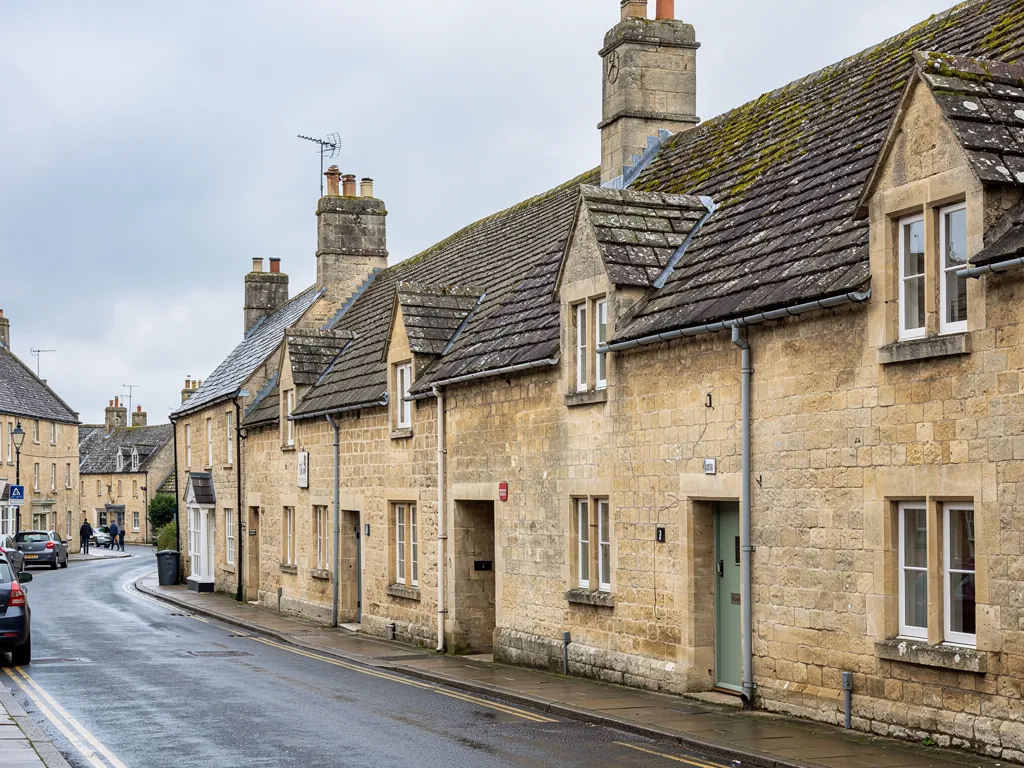
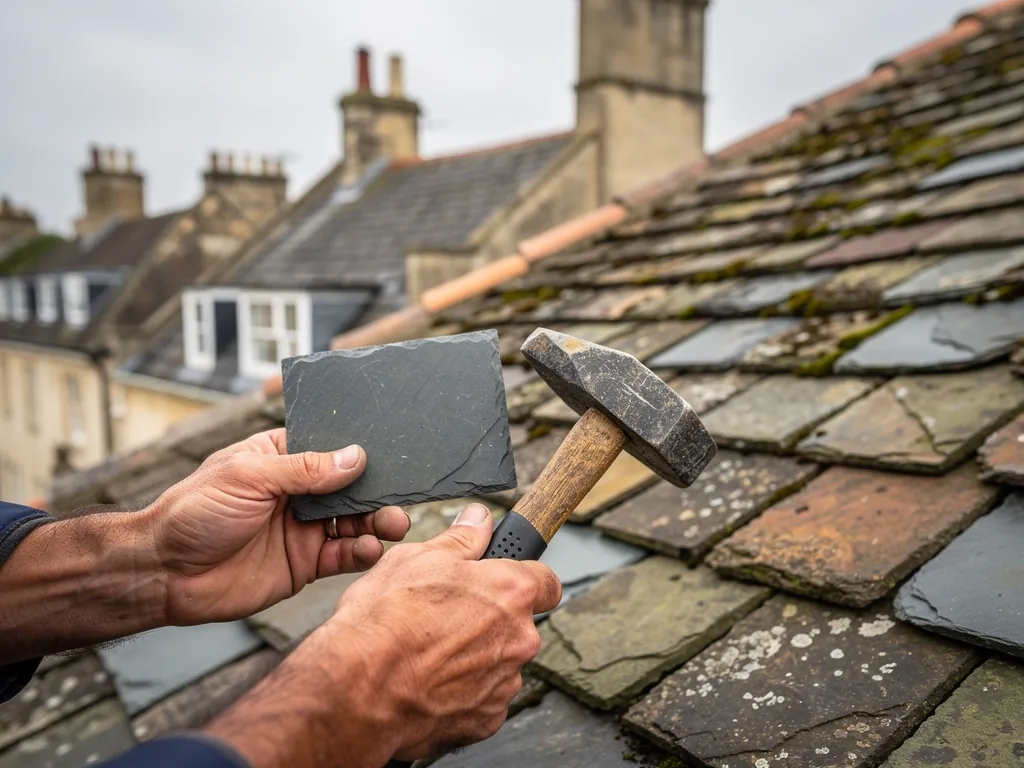
A Cotswold town street of limestone houses with stone tile roofs

Roofers in Stroud

Stroud is 30 road miles north of Bath, a town of steep streets where five valleys meet below the Cotswold escarpment. Getting up to its roofs is half the job, and what we find when we get there ranges from a 1596 market house to converted Victorian industrial buildings.

Local roofs

Five valleys and a lot of hills

Stroud sits below the western escarpment of the Cotswold Hills, at the meeting point of the Five Valleys, and it is noted for its steep streets. Anyone who has walked from the station to the top of the town knows what that means. For a roofer it means that ladders are rarely on level ground, that lorries cannot always reach the front door and that the way a roof is reached is a factor in the price.

The town grew as a cloth town. Its woollen mills were powered by the small rivers that run down through the valleys, and mill buildings are still part of the townscape. Other industrial buildings have been converted: the Victorian landmark of Hill Paul, built as a clothing factory, was saved from demolition by local activists and has been restored and turned into apartments.

Older still are the market house of 1596, now the Old Town Hall and one of the oldest existing buildings in Stroud, and the Grade II listed 17th-century wool merchant's house at Stratford Park that now holds the Museum in the Park. Stroud railway station on the Gloucester to Swindon Golden Valley Line was designed by Isambard Kingdom Brunel and opened in 1845.

We treat each roof as a particular problem. A steep site changes the access plan, an old timber building changes the repair, and a converted mill changes who needs to agree to it. Our survey records all three, with photographs, before a price is fixed in writing.

Council
Stroud District Council
From central Bath
30 road miles, north
Old Town Hall
Built 1596, originally the market house
Museum in the Park
Grade II listed 17th-century house
Station
Designed by Brunel, 1845

What we find

Access, old timbers and shared mill roofs in Stroud

Access problems before they become cost problemsOn a steep street, we look at how a scaffold would stand, where materials could be landed and whether a neighbour's land is needed. A roof that looks simple from the road can be awkward from the back, and it is better to find out before pricing.
Old timbers under old coveringsOn a building from the 1500s or 1600s, the covering can look fine while the timbers beneath have been wet for years. We check bearings, joints and the ends of beams for softness before recommending anything.
Shared and converted roofsA mill conversion or an apartment block has a roof that serves many households. We survey the whole roof, divide the findings by area and give a written scope that everyone can read.

Steep streets and reaching the roof

On a slope, the scaffold takes nearly as much planning as the slating.

Stroud's hills make for good views and awkward working conditions. A terrace on a steep street may have three storeys at the front and four at the back, with a garden that falls away so that a ladder must stand on a slope. A pavement at the front may be narrow, with parked cars and no room for a skip. Every one of those facts affects how the roof is reached, and so what the job costs.

Access is a big part of the price on any roof. For a new roof, MyBuilder (2026) reports typical UK costs of £5,000 to £12,000, and says scaffolding adds about £1,125 and waste disposal £100 to £1,000. On a hill, scaffolding can cost more, because it has to be stepped to follow the ground and made safe for people walking past. The fixed quote that follows our survey includes the access we have planned.

We look at three practical questions before pricing. Can a scaffold stand on the ground at the front or the back? Where can materials be landed, and how far must they be carried? And does any of the work need a neighbour's consent, for example if a scaffold overhangs their land? Answering them early avoids a delay on the day.

A well-planned job on a slope also protects people below. We keep the working area netted and clear, remove debris by chute or bag instead of dropping it, and tidy the site each day. Waste goes away with us when the job ends. If your Stroud roof needs a full re-cover, our roof replacement page goes through each stage, from strip to snagging.

£5,000 to £12,000

Typical UK range for a new roof

about £1,125

Typical added cost of scaffolding

£100 to £1,000

Typical added cost of waste disposal

Figures: MyBuilder new roof cost guide, 2026

Cloth mills, conversions and Hill Paul

Industrial buildings such as Hill Paul have found new lives as homes, and their roofs have had to keep up.

Stroud's cloth trade left the valleys with mill buildings of every size. Hill Paul, a Victorian clothing factory that local activists saved from demolition, is now apartments, and it shows the pattern: a large building, a roof designed for one purpose and now serving many households.

A converted industrial roof is rarely simple. It may be a long run of pitched sections with valleys between them, or a flat roof behind a parapet, or a mixture of both with a lantern or rooflight in the middle. The drainage is usually the first thing to check. A parapet gutter, a lined channel along the base of a parapet wall, carries water from a big area to a few outlets, and if one blocks, the water goes where it can. A box gutter works the same way, tucked between two slopes. When either fails, the leak shows in a ceiling that may be some distance from the cause.

The other thing that distinguishes a conversion is insulation and ventilation. A roof that has been converted from an open industrial space to a lived-in one has been fitted with insulation, and sometimes with a vapour layer, that was not part of the original. If the work was not done carefully, the result can be condensation in the roof void. Our survey looks at the roof from above, from below and from inside the void, because a mill roof can fail in any of those places.

Writing a repair scope for a building with many owners takes patience. We photograph the roof, mark the defects on a simple plan and price the work area by area. A managing agent can then put a single document in front of everyone with an interest. The roof inspections service describes the report.

Words you will hear

Parapet gutter
A channel behind the low wall at a roof edge.
Box gutter
A concealed trough running between roof slopes or behind a wall.
Lantern
A raised glazed section on a flat or low roof that lets in daylight.
Void
The empty space inside a roof between the ceiling and the covering.

The Old Town Hall and a wool merchant's house

A building from 1596 and a house of the 1600s show how long an old roof can serve when it is looked after.

The Old Town Hall, originally the market house, was built in 1596 and is one of the oldest existing buildings in Stroud. At Stratford Park the Museum in the Park occupies a Grade II listed 17th-century wool merchant's house. Both buildings are evidence of the same principle: a roof can last for centuries if the timbers stay dry and the repairs are made in sympathy with what was there.

On a building like these, the roof is structure as well as covering. Heavy old timbers carry the load, and the ends of those timbers, where they sit in the wall, are the most vulnerable. If water gets in at the wall head, the ends can rot without any sign inside. We check by sounding with a probe, by looking for the stain and the smell of wet timber and by examining the underside of the covering wherever the loft can be reached.

The covering also matters. Stone, clay and slate each have their own character, and a repair in a different material shows. We aim to reuse sound original material, add matching units where more are needed and use lime mortar on old masonry. Cement is hard and rigid, and where it is used on old, soft stone it can drive moisture into the wall.

A listed building such as the wool merchant's house needs listed building consent for work that affects its character. Stroud District Council is the planning authority, and its guidance is available at stroud.gov.uk. For smaller repairs on older buildings, our roof repairs service covers how we diagnose a leak, make it safe and then fix the cause.

Brunel's station and planned maintenance for bigger buildings

Large public and commercial roofs last longest when somebody looks at them regularly.

Stroud railway station was designed by Isambard Kingdom Brunel and opened in 1845 on what is now the Gloucester to Swindon Golden Valley Line. It is a fair illustration of a building from the railway age whose roof was meant to stay in service for a very long time. Station canopies, goods sheds, public halls, chapels, schools and shops share a trait: their roofs are large, partly hidden and often out of the sight of the people responsible for them.

That invisibility is where planned maintenance earns its place. A roof that is walked and photographed once a year is a roof whose small faults are caught early: a lifted flashing, a gutter outlet half-blocked with leaf litter, a split in a lead gutter. A roof that is looked at only after it leaks has already let water into the building.

A maintenance visit for a larger building follows a routine. We clear the gutters and outlets, check the flashings and the upstands, look at the ridge and the verges, examine the covering for slipped or cracked units and record anything new since we last went up. We write it up, with photographs and a list of work in order of priority. The building's owner or manager can then plan and budget instead of reacting.

Typical UK inspection costs are reported by MyBuilder (2026) at £150 to £500, depending on the type of inspection and the size of the roof. A fixed quote follows once we have surveyed the building. For schools, shops, offices and other commercial properties in and around Stroud, the same approach holds, and our roof inspections service sets out what the report contains.

Annual look

A large roof is cheapest to keep when it is checked once a year and mended in small jobs, not left until it leaks.

Map showing the location of Stroud.

Nearby

Roofers near Stroud

Roofing services in Stroud

Local questions

Reaching a Stroud roof, and other questions

My Stroud house is on a steep street. Will the roof cost more because of the slope?

It can, and the cause is usually access, not the roof. Scaffold on sloping ground may need stepping, and loads of tile may have a long carry. We look at the front, back and sides during the survey so the written price reflects what is actually involved, and tell you where the slope is adding cost.

Can the roof of a converted mill be surveyed without disturbing the residents?

Yes. We survey from the outside where we can, from the roof itself and from the roof void where there is access, and we arrange entry through the managing agent. The survey produces a plan and photographs of the defects so repairs can be agreed and scheduled around the people who live there.

The Old Town Hall dates from 1596. How do roofs that age survive?

By having their weak points noticed and mended early. Big old timbers last when the wall heads stay dry, the covering is sound and the gutters are kept clear. A repair that matches the original material and uses lime on old masonry keeps that going. A roof of that age should be looked at by someone used to heritage work before anything is lifted.

Does a re-cover on a town-centre Stroud house need anyone's permission?

It depends on the building. Whether a property is listed, or lies in a conservation area, is a question for Stroud District Council, and a listed house needs listed building consent for changes touching its character. Building Regulations may also apply to a larger re-cover. Check with the council first, and we can give you a written scope to take with you.

Get your free survey

Get your free roof survey

Tell us what's happening and we'll call you back to arrange a visit. Prefer to talk? Call 01225 285181.

  • Photos of your own roof
  • A fixed price in writing
  • 10-year workmanship guarantee
Call Free survey