
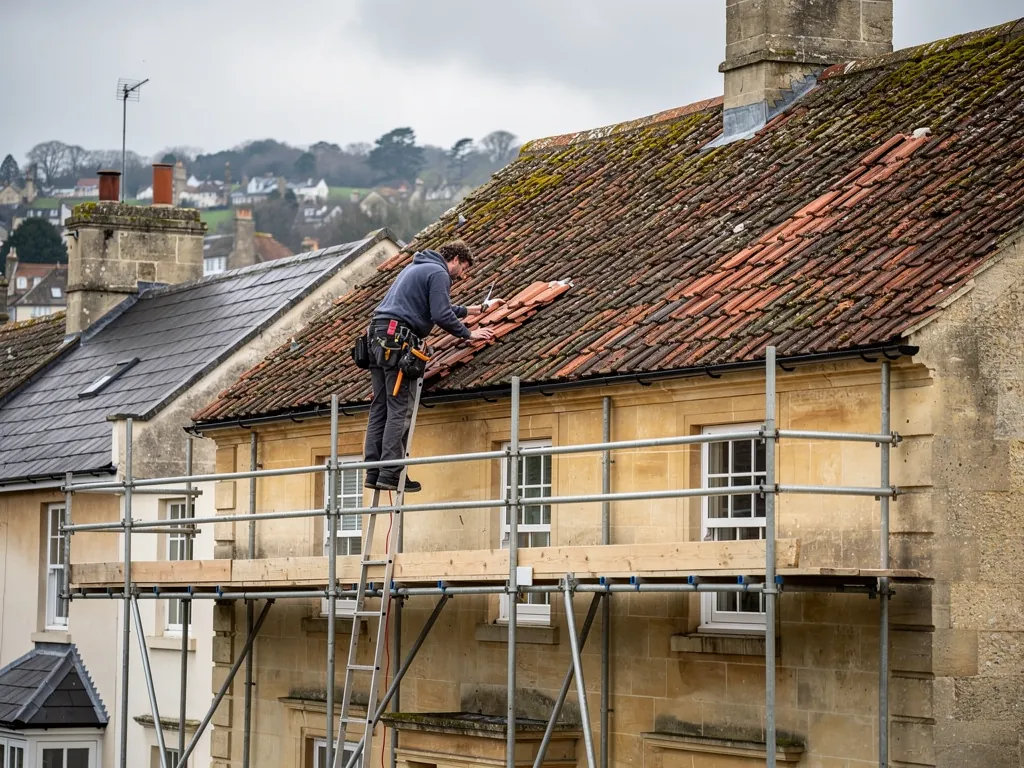
Tiles are described in two overlapping ways. One is the material, which is usually clay or concrete. The other is the shape, which is plain, interlocking or pantile, and each shape can be made in either material. People mix the two up, and a quote that says only "tiles" can hide a large difference in price, weight and appearance. This guide sorts them out. It describes each type in turn, then compares them on the four things that usually decide the choice: how they look from the street, how much they weigh on the roof frame, how long they tend to last, and what drives their cost. It also covers how to work out what you already have, which matters for repairs, because a replacement tile has to suit the tiles around it and the timbers beneath them. Throughout, the aim is to help you ask better questions of whoever is quoting, not to push one tile over another.
Material and shape are separate choices
Start by separating the two ideas. Clay tiles start as wet clay, which is pressed or moulded and then baked hard in a kiln. Concrete tiles are made from sand, cement and pigment, cast under pressure and cured. The shape is the profile of the tile and the way it overlaps its neighbours.
A plain tile is small and nearly flat, with a slight camber across its width, and it is laid in a double lap: each course overlaps the one two below it, so every spot on the roof has two thicknesses of tile. An interlocking tile is large, with a channel and a rib along its edges that engage with the next tile, so the roof is covered with a single lap. A pantile is a large tile with an S-shaped wave, also in a single lap, and each one tucks under the roll of its neighbour.
That gives six combinations in principle, though in practice clay is most often met as plain tiles or pantiles, and concrete as interlocking tiles. Clay interlocking tiles exist, and so do concrete plain tiles. When someone says a roof is clay, ask which shape. When they say it is plain tiled, ask whether the tiles are clay or concrete. The answers change how the roof behaves, how it is repaired and what a matching replacement would be.
Natural slate and stone slates are separate coverings, not tiles, and our guide on how a pitched roof is built places them alongside the others. Here we keep to the five tile types.
Plain tiles: small, many, and the most forgiving to detail
Plain clay tiles are the traditional English roofing tile. Each one is roughly the size of a hand, so a whole roof needs thousands, and the double lap gives the covering a thick, textured look with a gentle ripple. Because the units are small, the covering follows curves, hips and valleys without cutting large pieces, which is why plain tiles suit complicated roof shapes.
Plain tiles hang from the batten by two nibs on the back, with a pair of nails in a few courses only. The weight of the double layer holds them down in normal weather. That is also their weak point on an older roof: the nibs are narrow, and when one snaps, the tile above shifts. Our guide to common pitched roof problems explains that failure and the repair.
Handmade clay plain tiles vary in colour and surface from one tile to the next, with orange, red, brown and mottled shades in a single roof, which gives older roofs their soft, blended appearance. Machine-made clay plain tiles are more regular. Concrete plain tiles imitate the shape at lower cost, but they are flatter in colour and lack the surface texture of fired clay.
Two B&NES village appraisals, for Wellow and for Freshford and Sharpstone, mention clay on older roofs. The Freshford text goes further and warns that concrete tiles used for re-covering would harm the look of the place. We make no claim that plain tiles are common across Bath itself, but where a conservation area appraisal says this about its own roofs, it is worth reading before choosing a replacement.
For a deeper look at this one type, see our guide to clay plain tiles.
Interlocking tiles: large, light on labour, quick to lay
Interlocking tiles were developed to cover roofs faster and with fewer joints. Each tile has a side lock, a groove on one edge that receives a rib on the next tile, and a head and tail that overlap the courses above and below. The large format means far fewer tiles per square metre of roof, so a team lays them quickly.
The profile is usually shallower than a pantile and may be flat or gently ridged. Most interlocking tiles are concrete, and they are a familiar sight on newer estates and on older houses that have been re-roofed. Clay interlocking tiles are also made, and they offer the colour range of clay with the speed of the larger format.
The overlap is smaller on a single-lap tile than on a double-lap one, and the side lock does the sealing work. Each tile therefore relies on the underlay and the batten spacing for a good share of its performance. Wind-driven rain is more likely to reach the underlay on a single-lap roof, which is part of why the condition of the underlay matters so much underneath concrete tiles.
Interlocking tiles also have a minimum pitch. Below it, rain can be driven up and across the laps. The limit depends on the manufacturer and the tile, and our guide on minimum roof pitch explains why you should check it before changing a covering on a shallow slope.
The speed and the large units are the strengths. The trade-off is that large units are less able to follow awkward geometry, so valleys, hips and abutments need cut tiles, and each cut edge is a spot where the finish can look ragged or let water in.
Pantiles: the S-shaped single-lap clay tile
A pantile has a distinctive wave in section, with a trough that carries the water and a roll that overlaps the neighbouring tile. Pantiles are made in clay and in concrete, and they are laid in a single lap, which means the roof is light for the area it covers.
In clay, pantiles have a characteristic warm tone and, in the handmade versions, an uneven surface that catches the light. They are usually fixed with a clip or nail at intervals, bedded at the ridge and verge, and laid at pitches that are shallower than plain tiles can take. That shallow-pitch capability made them practical for outbuildings, extensions and lean-to roofs.
One of the working points about pantiles is the verge. Where a pantile meets a gable wall, the wave has to be finished with something: a mortar fillet, a dry verge unit, or a specially shaped half tile. Each of those is a place where weather attacks first, and each needs to be bedded and mechanically held. The same goes for the ridge, where the tiles must be filled correctly beneath the cap.
The Bath Preservation Trust notes in one casework record that a Trust casework note on a Grade I terrace address mentions clay pantiles on a back slope while the main pitch is slate. That shows pantiles in use on older Bath buildings, but it is one house, and we make no wider claim about how common they are in the city or the countryside around it.
If you are weighing pantiles against another covering, our guide to pantile roofs goes into their detailing.
Looks, weight, lifespan and cost side by side
The table below sets out how the five types compare. It is qualitative on purpose. Tile lifespans and weights vary between manufacturers and between production batches, and we do not quote figures we cannot source. Ask for the manufacturer's data sheet for any tile you are considering.
| Type | Look | Weight on the frame | Lifespan | Cost |
|---|---|---|---|---|
| Clay plain tile | Textured, varied, soft colour | Moderate, double lap | Long if the nibs and nails hold | Higher; many small units |
| Concrete plain tile | Flatter, more uniform | Heavier than clay plain | Surface colour fades first | Lower than clay plain |
| Interlocking concrete | Bold, regular profile | Heavy per tile, single lap | Fixings and underlay decide it | Generally the lowest to lay |
| Interlocking clay | Clay colour, regular profile | Lighter than concrete | Long, with sound fixings | Higher than concrete |
| Clay pantile | Wavy, warm, often uneven | Light for its area | Long if bedding is kept up | Mid to higher |
Weight deserves a closer look because it is the figure most often forgotten. A heavier covering puts more load on rafters and walls that were sized for the original roof. Switching to something noticeably heavier is regulated. At a rise of 15 per cent or more in covering weight, you need approval, and the structure gets checked. The answer on heavier roof tiles shows how to test a particular swap against that line.
Price needs a wider view than the tile alone. Scaffold, stripping, battens, underlay, lead and the work to hips and valleys sit around it. Re-felting an old roof while the tiles are off is a related decision, covered in our answer on re-felting cost.
Clay or concrete: how to decide on a particular roof
No tile wins on every count, so the decision comes down to the roof in front of you. Four questions usually settle it.
What is on the roof now?
A like-for-like replacement is the simplest case. It keeps the weight about the same, keeps the look, and avoids questions about consent. If the existing tiles are clay, a concrete replacement changes the appearance, adds weight and may need approval.
Does the house have heritage protection?
Bath's World Heritage Site follows the city boundary, and about half of that area is also a conservation area. If the building is listed, the covering cannot be changed until B&NES Council has given consent, and ignoring that step is an offence. An unlisted house inside the conservation area is a softer case, but a different material is still a topic to raise with B&NES planning before anything is ordered. A handful of streets carry Article 4 directions, and the council's policy map shows which.
What can the frame carry?
An old cut roof sized for light clay or slate may not take heavy concrete without strengthening. We check the rafters and purlins from the loft, and that finding can settle the question by itself.
What is the pitch?
Every tile has a limit below which it should not be laid. A shallow roof can narrow the options to a tile designed for low pitches.
Our answer on clay or concrete tiles takes these questions through in a shorter form.
Matching, reclaimed tiles and what a survey tells you
Repairs raise a different problem from replacement: finding a tile that fits among the ones already there. Tile sizes and profiles changed over the years, and an old roof can contain several makes. A new tile pushed into an old roof often shows by its colour, so for a repair we try reclaimed tiles from a similar roof first. Our short guide to reclaimed roof tiles explains when they are the right answer and when they are not.
Identifying what you have is easier than it sounds. Count the thickness of the covering at the eaves: two layers suggests plain tiles. Look at the shape along the edge of a gable: a wave means a pantile, a flat or ribbed single layer means an interlocking tile. Look at the surface: a gritty, uniform finish with a faded top coat is typical of concrete, and a glazed or grainy, uneven one points to clay. A few clear pictures of the edges and the surface, taken from a window or the pavement, are enough for a first opinion.
The survey does the rest. We go up, lift tiles where needed to see the battens and underlay, and note what is sound and what is not. Pictures of your own roof come back to you with a written fixed price for the tile you pick and the timber work under it. If a repair is enough, that is what gets priced. If the house is in a conservation area, check the tile choice with the council before ordering, as a change of colour or profile can need consent. To see the whole service, start from pitched roofing in Bath.