
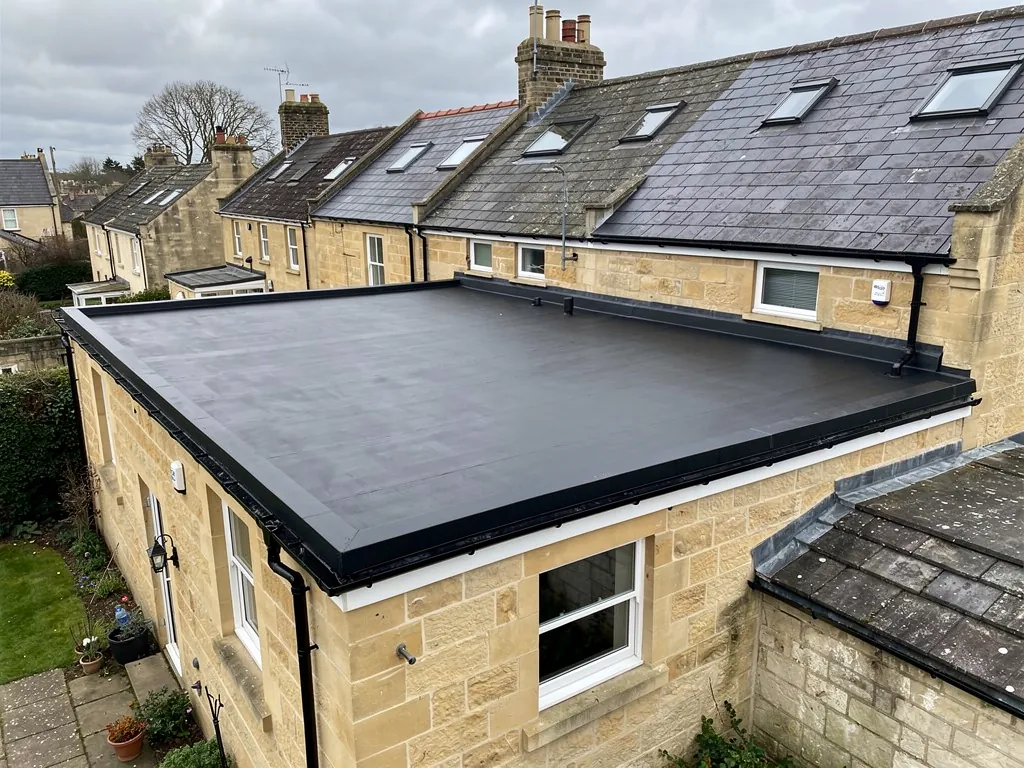
Most domestic flat roofs in Bath are covered in one of three ways. EPDM is synthetic rubber supplied as one large sheet. GRP stands for glass-reinforced plastic, a fibreglass and resin shell formed in place on the deck. Torch-on felt is bitumen sheet, fused in layers with a gas flame. All three can keep a dry extension for many years, and all three can fail early when the detailing around them is poor. That last point matters more than the brand of membrane. This guide sets the three against each other on the four things most owners ask about: how long they last, what they cost, how they look from the house and the garden, and what happens when one is damaged. Where the answer depends on the roof rather than the material, we point that out. For the wider decision, including warm and cold decks, our guide to the best flat roof material picks up where this comparison stops.
How each covering is made and laid
The way a covering is made explains most of how it behaves, so it is worth a minute before comparing figures.
EPDM rubber
EPDM, short for ethylene propylene diene monomer, is a synthetic rubber supplied in a large sheet. On a small roof the sheet is cut to cover the whole deck with no joint at all. It is glued to the deck, the corners are folded and sealed with preformed pieces, and the edges are finished with a trim. Because the sheet arrives in one piece, there are very few seams to fail. Our page on EPDM rubber roofs covers the laying in detail.
GRP fibreglass
GRP is built on site. Boards are laid and sealed, a layer of resin is rolled out, fibreglass matting is pressed into it, and further resin and a pigmented top coat finish the surface. The result is a hard shell with no joints that sets to the shape of the roof. It depends on dry weather and a deck that does not move, because the shell is rigid. See GRP fibreglass roofs for the build-up.
Torch-on felt
Torch-on felt is a bitumen sheet reinforced with a polyester core. Two or three layers are usually fused to the deck and to each other by heating the underside with a gas torch until the bitumen softens. The layers overlap, so the system has lapped joints that need to be sealed carefully, and the top layer often carries a mineral surface to protect the bitumen from the sun. We cover it on the torch-on felt roofs page.
None of these coverings is waterproof by itself in the way people imagine. Each one depends on the deck beneath it, the falls that let water run off, and the upstands where the roof meets a wall. A roof built well in any of the three beats a poorly built roof in any of the others.
The three side by side
The table sets out how the coverings compare on the points that most often decide the choice. The cost column uses typical UK ranges reported by MyBuilder's flat roof cost guide (2026), last updated in August 2026. The price you sign is a fixed quote written once we have surveyed the roof.
| Covering | Typical UK price | Joints | Finish | Typical repair |
|---|---|---|---|---|
| EPDM | £90 to £130 per m² | Few or none on small roofs | Matt black rubber | Cleaned patch with primed tape or glue |
| GRP | £95 to £150 per m² | None across the field | Smooth, in a choice of colours | Cut back, then laminate and top coat |
| Torch-on felt | £70 to £100 per m² | Lapped seams | Mineral-chip or smooth bitumen | Patch of felt fused over the fault |
Lead sits outside this comparison, but the same guide prices it higher still, at £150 to £200 or more for each square metre. The figures are national and describe the covering as laid. They do not stand in for what a particular roof will cost.
The pattern in the table is the one most owners find in practice. Felt is the lowest purchase price, but it has the most seams and the most places for an edge to lift. EPDM costs more per square metre and gains from having few joints. GRP costs the most of the three on these ranges and gives the neatest finished surface, at the price of a rigid skin that dislikes movement.
Lifespan: what actually decides it
Published lifespans for flat roof coverings vary widely between sources, and several are written by manufacturers. We do not put a figure on any of the three here, because a figure would suggest a promise the material cannot make. What we can describe is the order of things that wear a flat roof out. For lifespan by situation, see our answer on how long a flat roof lasts.
Standing water is the first. A roof laid without enough fall holds ponds after rain, and the covering under a pond ages faster than the rest. Bitumen felt softens and blisters under it, GRP can craze at its top coat, and EPDM tolerates it better but still collects silt and algae in the dips. Water that never drains is a design fault, not a material fault, and it shortens the life of every covering.
Movement is the second. Timber decks swell and shrink with moisture. A rigid GRP shell on a deck with weak fixings can crack along the board lines. Felt lets the deck move a little more. EPDM, glued across the field, copes with small movement but not with a deck that has rotted.
Sunlight and foot traffic come third. Felt without a mineral cap loses its surface to ultraviolet light. GRP top coats fade and chalk. EPDM is naturally resistant to the sun, which is a reason it is often chosen for roofs that nobody walks on. Tools, pots and chairs scuff or puncture whatever is there, so a roof that is used as a terrace is built differently, as our guide to walking on a flat roof explains.
The last factor is the person who laid it. Corners, upstands and trims are where most flat roofs let water in, and they depend entirely on workmanship, whichever covering sits on top.
What the money buys: cost per square metre and the rest
Typical UK figures from MyBuilder's flat roof cost guide (2026) put a replacement flat roof at £2,800 to £7,500, which works out at around £75 per square metre, and the per-metre ranges in the table above sit alongside that average. Your price is set after we have been on site, and it will not simply be area multiplied by a rate.
The covering is only part of what is priced. Four things move the total more than the choice between the three materials.
- The deck. If the boards beneath are wet, soft or stained, they are replaced. A new membrane over a rotten deck fails with it.
- Insulation. A roof that is stripped back might need upgrading to current thermal standards. Our page on flat roof regulations explains where that applies.
- Edges and upstands. Trims, drip edges and the height of the upturn against the wall all take time, and they are the parts that decide whether the roof stays dry.
- Access. A roof reached only through the house, or one that needs scaffold, costs more to build than a ground-floor garden extension.
Because a cheaper covering needs the same deck and the same edge work as a dearer one, the saving between felt and GRP is smaller than the headline rates suggest on a roof with a poor deck. Equally, a premium covering does not justify itself on a roof whose falls are wrong. Put the money where the fault was. For a fuller look at what influences the quote, our guide to flat roof cost goes through the line items.
Appearance, and what suits a Bath property
On many Bath houses the flat roof is seen from the upper floors, from a neighbour's window, or from a hill road above the house. Appearance then matters more than people expect, and the three coverings differ more than the brochures suggest.
EPDM is matt black. It is plain and unfussy, and it suits a roof that sits behind a parapet or beneath a green finish. The sheet has a slightly rubbery look in strong light, and the trims are typically aluminium in a mill or powder-coated finish.
GRP is the most adaptable to look at. It can be tinted, and it forms clean, sharp edges, so it suits a contemporary rear extension where the roof is a feature. The surface is smooth and can look glossy if the top coat is not matt.
Torch-on felt looks like felt. A mineral finish gives a speckled grey or green surface that weathers into the surroundings, and a lapped seam is visible on close inspection. It is a conventional answer on a garage, a porch or an outbuilding, and less often the first choice for a roof that is overlooked.
Listed buildings and conservation areas add a layer of control. B&NES Council decides listed building consent, and a change of covering on a listed house, or on a visible roof in a sensitive setting, is something to raise with the council before any work starts. Our page on flat roofs on listed homes sets out what to ask. Where a historic flat roof is lead, the usual answer is to keep it as lead, and we would say the same here: a sheet-metal roof that was built that way is put right in the same material.
Repairs: which covering forgives damage
Damage happens to every flat roof eventually, usually from a dropped tool, a branch, a fallen slate from the main roof, or a chair leg. How easy the repair is differs between the three.
EPDM is the simplest to patch. The area is cleaned, a primer is applied, and a repair patch or a length of self-adhesive tape is pressed on. It works on a small cut or a puncture. A fault along a glued seam or at a corner calls for more work, and a roof with many repairs may be near the end of its life. Because EPDM is glued to the deck, a leak can travel under the sheet and show up some distance from the hole, which makes tracing slower than it looks.
GRP repairs well when the damaged area is cut back to sound material, ground and laminated afresh with matting and resin, then top-coated. Colour matching an older, faded surface is hard, so a repair on a visible roof may show. GRP also cracks rather than stretches, so a crack that returns after repair points to deck movement that needs correcting first.
Torch-on felt is patched by fusing a new piece over the fault. It is quick and cheap, and for that reason a felt roof can end up covered in patches. A felt repair involves a naked flame, which brings a risk when the roof sits above timber, so we plan it with care and prefer cold-applied methods where the deck allows. For leaks that are hard to find, see our answer on a leaking flat roof.
When the question becomes repair or replace, the covering matters less than the state of the deck. Our guide to repair versus replacement sets out how we decide. We repair where repair works, and when it does not we tell you and give the reasons in writing.
Choosing between them
If you want a rule of thumb, here is the one we use after a survey rather than before it. It is a starting point for a conversation about your roof, not a verdict.
- EPDM suits a simple, uninterrupted roof where a single sheet will cover the deck, and where plain black is acceptable.
- GRP suits a roof with awkward shapes, many penetrations or a visible finish that matters, on a deck that is sound and well fixed.
- Torch-on felt suits a smaller roof such as a porch or outbuilding, or a tight budget on a simple shape, with the understanding that the seams are the maintenance point.
Then check the points that cut across the choice. What lies beneath the covering, warm deck or cold deck, affects condensation and the regulations. Our page on warm and cold deck roofs explains the difference. The upturn at the wall, the trims and the outlets matter more than the sheet, so ask what the quote says about them. And ask who carries out any Building Regulations notification when the work is large enough to need it. We handle that side where work is notifiable.
For the other side of the argument, our guide to the pros and cons of a flat roof asks whether a flat roof is right at all. If you want a person on the roof before deciding, a survey with photographs of the deck and edges turns the comparison above into one between real figures for your own roof. Our flat roofing hub has the full list of what we fit and repair.